
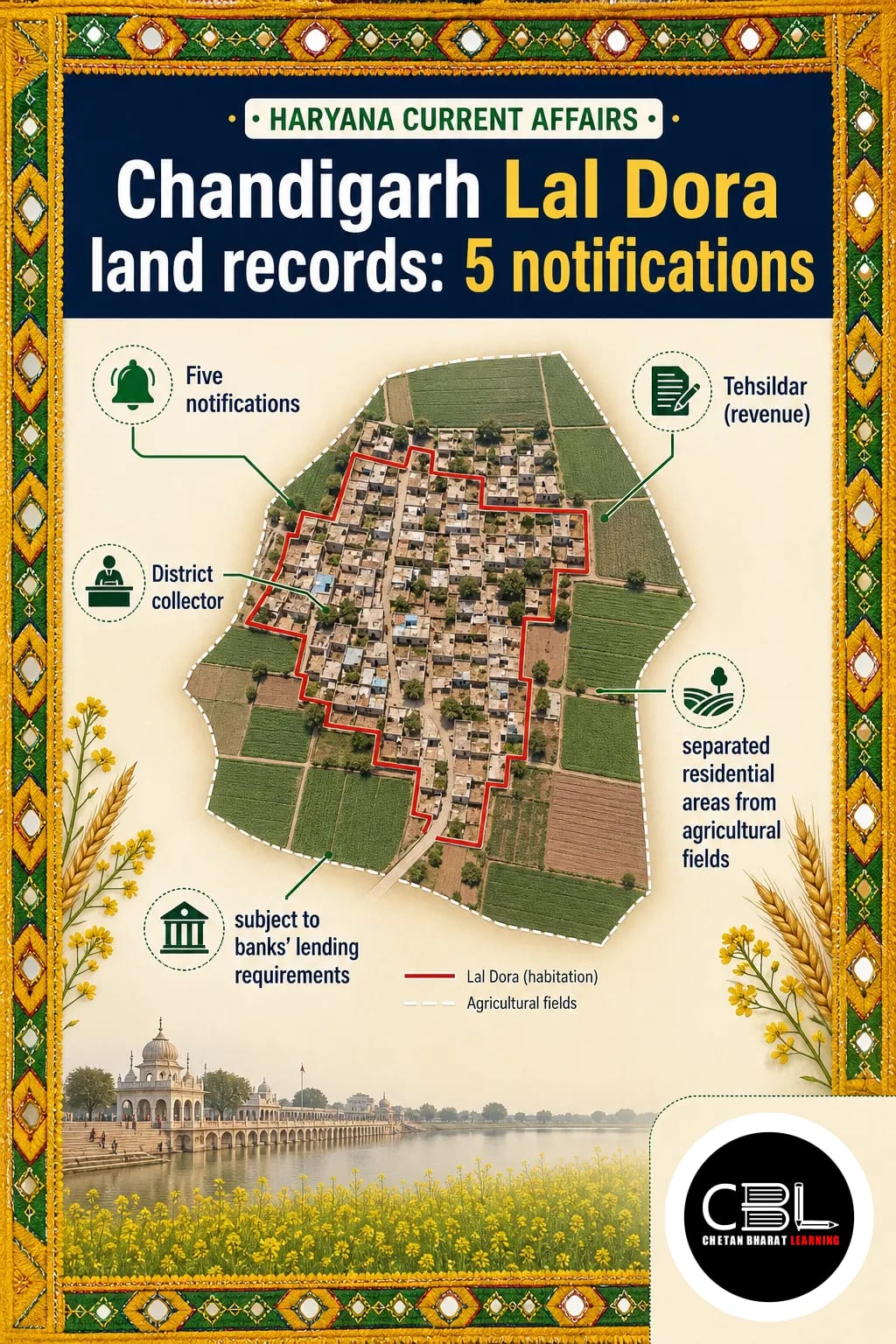
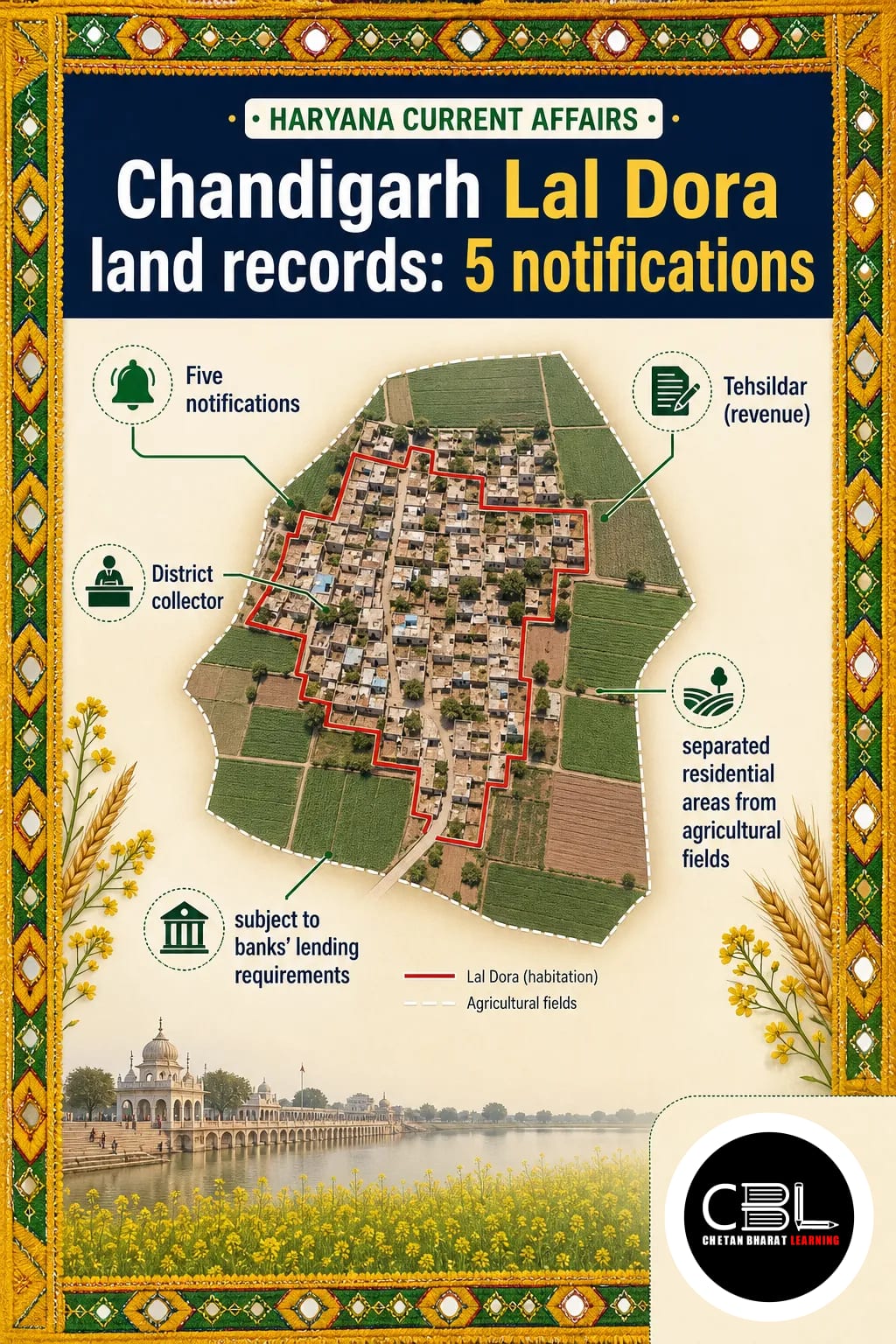
Chandigarh Lal Dora land records will give village properties a formal record-of-rights mechanism. The Union Territory administration has issued five notifications under the Punjab Abadi Deh (Records of Rights) Act, 2021. The development is relevant to Haryana current affairs because Chandigarh is Haryana’s capital.
Quick answer: Chandigarh Lal Dora land records will be prepared and maintained under the Punjab Abadi Deh (Records of Rights) Act, 2021. On Wednesday, the Union Territory administration issued five notifications for village habitation properties. The district collector, sub-divisional magistrates and tehsildar have designated roles in the process.
Key facts about the notifications
The five notifications establish an administrative mechanism for Chandigarh’s Abadi Deh property records.
| Point | Details |
|---|---|
| Law | Punjab Abadi Deh (Records of Rights) Act, 2021 |
| Notifications | Five |
| District-level chief officer | District collector |
| Recording and resolution officers | Sub-divisional magistrates in their respective jurisdictions |
| Assistant officer | Tehsildar (revenue) |
What is Lal Dora?
Lal Dora refers to traditional village habitation areas marked by a red line on British-era revenue maps. The line separated residential areas from agricultural fields. These habitation areas are also known as Abadi Deh.
Many residents have lacked comprehensive formal revenue records for their houses and plots. Consequently, they have relied on possession documents, family records and other evidence to support their claims.
Who will prepare the property records?
Designated revenue officials will oversee the preparation of records of rights and address related matters. At the district level, the district collector is the chief recording and resolution officer.
Sub-divisional magistrates serve as recording and resolution officers in their jurisdictions. Meanwhile, the tehsildar (revenue) is the assistant recording and resolution officer. The revenue secretary-cum-commissioner has become commissioner, Chandigarh division; the earlier 1977 notification has been cancelled.
Why do these land records matter?
Chandigarh Lal Dora land records could clarify ownership claims and help address disputes over inheritance and possession. They may also make property transactions less cumbersome.
Previously, the absence of comprehensive records created difficulties in dealings with financial institutions. The new records could therefore improve access to institutional credit, subject to banks’ lending requirements. However, the notifications establish a process; they do not mean that every property record has already been prepared.
- Shared capital: Chandigarh is the capital of both Haryana and Punjab.
- State formation: Haryana was formed on 1 November 1966.
Source: Hindustan Times Chandigarh, 12 November 2026
Prelims Practice Corner
Frequently Asked Questions
What does Lal Dora mean in Chandigarh villages?
Lal Dora means the traditional village habitation area marked by a red line on revenue maps. The line separated residential areas from agricultural fields.
Which law governs the new Chandigarh village property records?
The Punjab Abadi Deh (Records of Rights) Act, 2021 governs the new mechanism. Chandigarh’s administration issued five notifications to implement it.
Will Lal Dora records guarantee bank credit?
No, bank credit is not guaranteed. The records could improve access, subject to banks’ lending requirements.
Related Current Affairs
Preparing for UPSC, PCS or HCS?
Talk to a mentor at Chetan Bharat Learning, Chandigarh. Free guidance on choosing the right exam and building a study plan.
Chat on WhatsAppCall 97793 53345UPSC / IAS / PCS coaching in Chandigarh · Trusted by aspirants across Punjab & Haryana









Leave a Reply
You must be logged in to post a comment.