

UPSC Mapping
| Prelims | Landslides, Western Ghats, Disaster Management |
|---|---|
| Mains | GS Paper III – Disaster Management & Environment |
| Region | Western Ghats |
| Hazard | Rainfall-induced landslides |
| UPSC Theme | Disaster Risk Reduction |
What is Kerala Landslides?
A landslide is the downward movement of rock, soil or debris under the influence of gravity. Unlike earthquakes, landslides generally require a triggering factor such as prolonged rainfall.
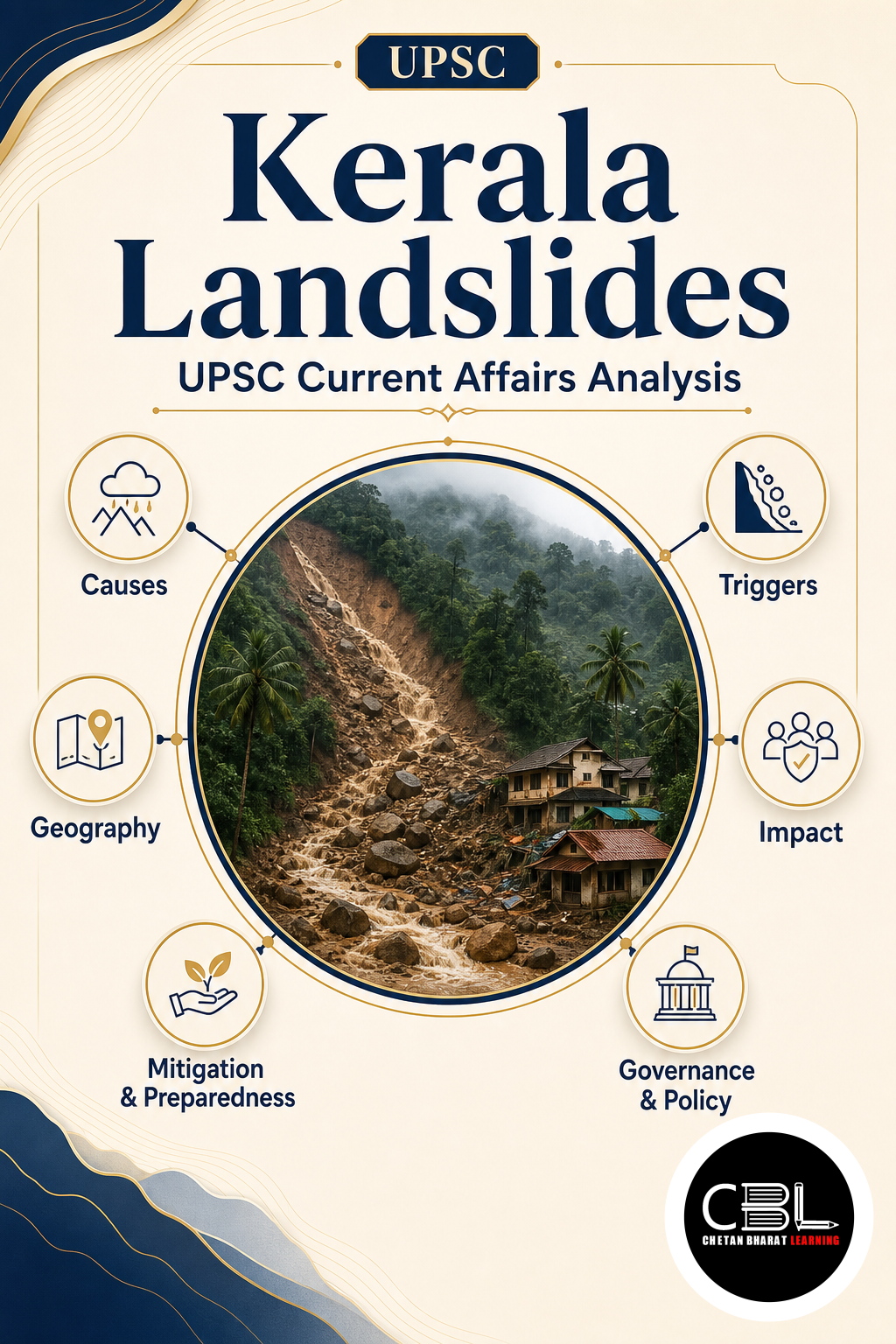
Kerala landslides occur mainly in the steep slopes of the Western Ghats, where fragile terrain, intense monsoon rainfall and human activities interact to increase instability.
Why is Kerala Landslides in News?
Kerala witnessed another spell of exceptionally heavy rainfall, resulting in multiple landslides and renewed concern over slope stability. Continuous rainfall over several days is often more dangerous than a single cloudburst because water gradually saturates the soil.
Both natural and human-induced factors increase vulnerability. For official disaster information, refer to NDMA.
Key Features
- Prolonged rainfall: Continuous rainfall increases pore-water pressure and weakens slope strength.
- Western Ghats terrain: Steep slopes and weathered rocks naturally favour landslides.
- Human intervention: Quarrying, mining, road construction and unplanned development destabilise slopes.
- Land-use change: Deforestation and plantation expansion reduce slope stability.
- Climate influence: More intense rainfall events may increase future landslide risk.
Challenges
Managing landslide risk requires coordinated scientific planning.
- Dense settlements: Many vulnerable villages lie close to unstable slopes.
- Infrastructure exposure: Roads, schools and public facilities face repeated damage.
- Balancing development: Infrastructure projects must consider geological sensitivity.
- Monitoring gaps: Continuous rainfall monitoring and early warning remain essential.
- Land-use regulation: Stronger implementation is necessary.
Way Forward
Risk reduction requires scientific land-use planning, afforestation, improved drainage, hazard mapping and strict regulation of high-risk activities. Community awareness and resilient infrastructure should complement these measures.
Strengthening early warning systems and integrating geological assessments into development planning can reduce future losses. See the Geological Survey of India for hazard-related resources.
Prelims Practice Corner
-
Q1. Landslides primarily involve:
- (a) Wind erosion
- (b) Downward movement of rock and soil
- (c) Volcanic eruption
- (d) River deposition
Answer: (b) Gravity-driven movement of slope material.
-
Q2. Kerala is highly vulnerable mainly because of:
- (a) Desert climate
- (b) Western Ghats terrain and heavy rainfall
- (c) Glacier melt
- (d) Tides
Answer: (b).
-
Q3. Which activity increases landslide risk?
- (a) Afforestation
- (b) Quarrying
- (c) Contour farming
- (d) Mulching
Answer: (b).
-
Q4. Continuous rainfall increases:
- (a) Rock hardness
- (b) Soil pore-water pressure
- (c) Wind velocity
- (d) Solar radiation
Answer: (b).
-
Q5. Disaster management is covered mainly under:
- (a) GS I
- (b) GS II
- (c) GS III
- (d) GS IV
Answer: (c).
Mains Practice Questions
Q1. Discuss the causes of increasing landslide vulnerability in Kerala. (10 marks)
Answer Structure
Intro: Define landslides.
Body: Natural factors, rainfall, geology, human activities, climate concerns.
Conclusion: Integrated disaster risk reduction.
Q2. Evaluate the role of sustainable land-use planning in reducing landslide disasters. (15 marks)
Answer Structure
Intro: Explain disaster vulnerability.
Body: Planning, regulation, afforestation, monitoring, community participation.
Conclusion: Sustainable development improves resilience.
FAQs on Kerala Landslides
Why is Kerala prone to landslides?
Steep Western Ghats slopes, prolonged rainfall and human interventions together increase vulnerability.
Does heavy rainfall alone cause landslides?
Prolonged rainfall acts as a trigger after slopes become saturated.
Why is this important for UPSC?
The topic connects geography, environment, climate change and disaster management in both Prelims and GS Paper III Mains.
Related Current Affairs
Preparing for UPSC, PCS or HCS?
Talk to a mentor at Chetan Bharat Learning, Chandigarh. Free guidance on choosing the right exam and building a study plan.
Chat on WhatsAppCall 97793 53345UPSC / IAS / PCS coaching in Chandigarh · Trusted by aspirants across Punjab & Haryana
Leave a Reply
You must be logged in to post a comment.