

Important for
| Prelims | Science & Technology |
|---|---|
| Mains | GS Paper 3 (Science & Technology & Security) |
Quick Facts
| Satellite Type | Geo Imaging Satellite |
|---|---|
| Also Known As | EOS-05 |
| Key Application | Disaster monitoring & agriculture |
What is GISAT-1A Satellite?
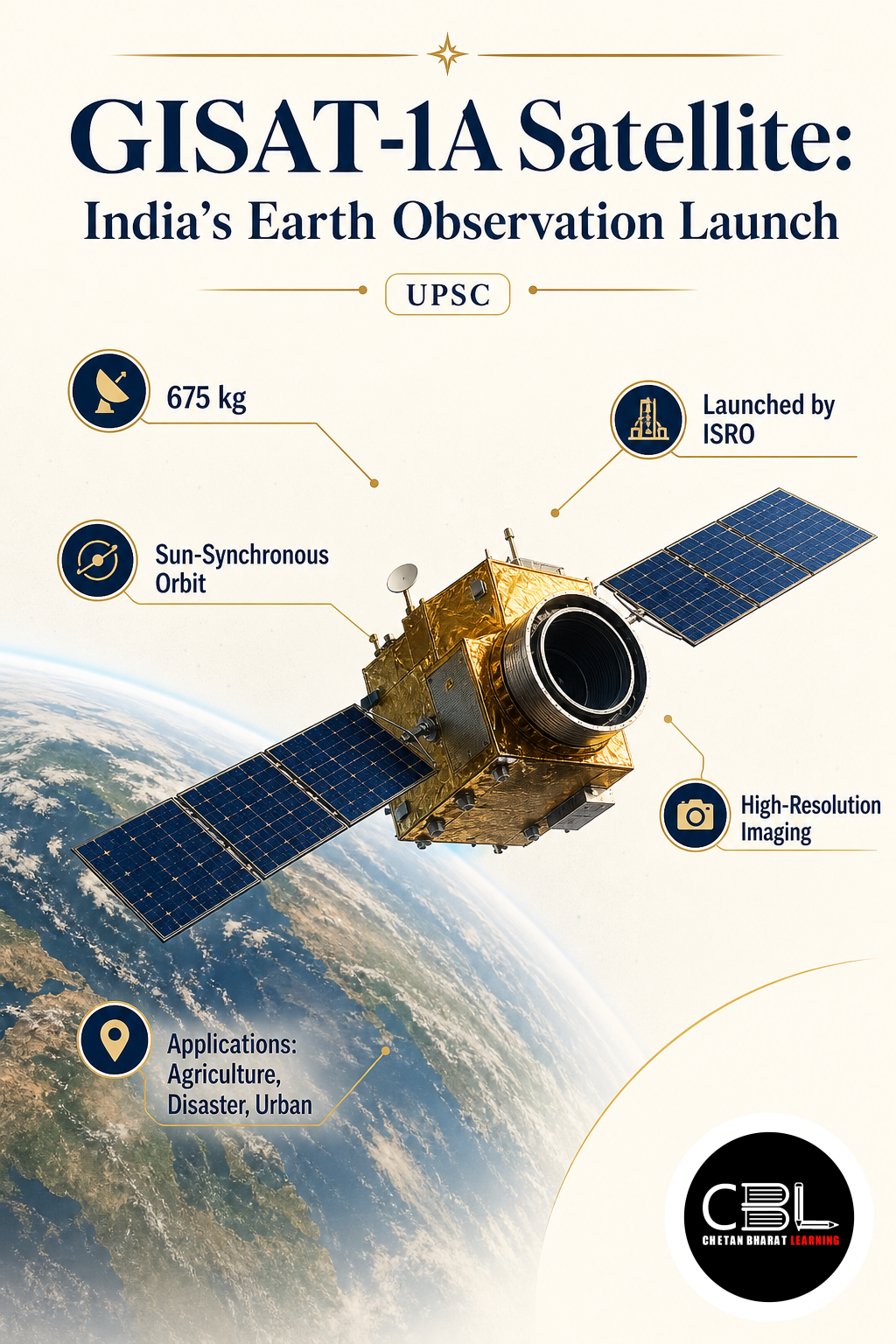
The GISAT-1A Satellite (also known as EOS-05) is a Geo Imaging Satellite designed to provide frequent imaging of large areas from geostationary/geosynchronous orbit. Unlike polar-orbiting satellites, geostationary satellites can observe the same region continuously, making them ideal for disaster monitoring, weather tracking, and surveillance.
The satellite’s applications include agriculture (crop monitoring), disasters (floods, cyclones, landslides), forestry (forest-cover monitoring), water resources (reservoirs, drought), urbanisation, and strategic monitoring. ISRO’s resumption of launches after a hiatus underscores the importance of launch vehicle reliability for maintaining operational constellations.
Why is GISAT-1A Satellite in News?
The GISAT-1A Satellite is in the news because ISRO is preparing to launch it after a seven-month operational hiatus caused by launch anomalies, including the PSLV-C62/EOS-N1 failure and GSLV-F15/NVS-02 issues. The launch is critical for restoring operational confidence and deploying replacement satellites.
The article highlights that a launch anomaly does not mean the entire rocket design is defective—a failure investigation identifies specific technical causes. However, launch failures can have economic, strategic, and developmental consequences, as satellites are now critical infrastructure. For more details, refer to this PIB release.
Key Features of GISAT-1A Satellite
- Geostationary Orbit: Provides persistent observation of the same region, unlike polar-orbiting satellites.
- Temporal Resolution: Frequent imaging enables real-time disaster monitoring and rapid response.
- Multi-Application: Supports agriculture, forestry, water resources, urban planning, and security.
- Strategic Importance: Persistent observation supports national security and maritime domain awareness.
- NavIC Connection: The LVM3 launch vehicle is also crucial for NavIC satellite deployment.
Challenges in GISAT-1A Satellite Launch
- Launch Vehicle Reliability: Recent failures have raised concerns about operational reliability.
- Propulsion and Guidance: Complex multi-stage systems are prone to anomalies in propulsion, guidance, avionics, or separation.
- Operational Gaps: Launch delays can leave strategic systems (like NavIC) without replacements.
- Economic Impact: Satellite failures affect services that modern economies depend on—communication, navigation, weather, banking.
- Space as Critical Infrastructure: A launch failure is not merely a scientific setback but has economic and strategic consequences. For more on space challenges, visit the science and technology section.
Way Forward for GISAT-1A Satellite
To ensure the success of the GISAT-1A Satellite launch, ISRO must conduct thorough failure investigations and implement corrective measures. Strengthening the indigenous space ecosystem—with redundancy and robust testing—is essential.
Expanding the launch vehicle production capacity and developing reusable technologies can reduce costs and improve reliability. The GISAT-1A launch is a test case for India’s ability to maintain operational constellations and support strategic autonomy. For international best practices, refer to the ESA.
Prelims Practice Corner
-
Q1. What is the primary orbit of GISAT-1A?
(a) Low Earth Orbit (b) Geostationary/Geosynchronous Orbit (c) Polar Orbit (d) Sun-Synchronous Orbit
Answer
(b) GISAT-1A is a geostationary satellite.
-
Q2. What is a key advantage of geostationary Earth observation?
(a) Higher resolution (b) Frequent observation of the same region (c) Lower cost (d) Global coverage
Answer
(b) Geostationary satellites can observe the same region continuously.
-
Q3. Which launch vehicle is used for GISAT-1A?
(a) PSLV (b) GSLV (c) LVM3 (d) SSLV
Answer
(c) GISAT-1A is launched using LVM3.
-
Q4. What is the connection between GISAT-1A and NavIC?
(a) They are the same satellite (b) Both use the LVM3 launch vehicle (c) NavIC is a ground station (d) No connection
Answer
(b) LVM3 is important for launching both GISAT-1A and NavIC satellites.
-
Q5. Why is launch vehicle reliability important?
(a) Only for scientific missions (b) Satellites are critical infrastructure for economy and security (c) To reduce costs (d) Only for international missions
Answer
(b) Satellites support communication, navigation, weather, banking, and defence.
Mains Practice Questions
Q1. Discuss the importance of geostationary Earth observation satellites for disaster management and national security in India. (250 words, 15 marks)
Answer Structure:
- Intro: Introduce GISAT-1A and its geostationary orbit.
- Body: Discuss applications: disaster monitoring, agriculture, forestry, water resources, security. Analyse challenges: launch reliability, operational gaps. Suggest measures: robust testing, redundancy, and indigenous development.
- Conclusion: Emphasise the strategic importance of maintaining operational constellations.
Q2. What are the strategic and economic consequences of launch failures for India’s space programme? (150 words, 10 marks)
Answer Structure:
- Intro: Note that launch failures affect more than science.
- Body: Discuss economic impacts: disruption of services (communication, navigation, banking). Strategic impacts: gaps in surveillance, delay in replacement satellites, and dependence on foreign systems.
- Conclusion: Conclude that reliability is essential for strategic autonomy.
FAQs on GISAT-1A Satellite
What is GISAT-1A?
It is an Earth-observation satellite designed for frequent imaging of large areas from geostationary orbit.
What are the applications of GISAT-1A?
Applications include disaster monitoring, agriculture, forestry, water resources, urbanisation, and security.
Why is launch vehicle reliability important for India?
Satellites are critical infrastructure for communication, navigation, weather, banking, and defence, making launch reliability strategically vital.
Related Current Affairs
Preparing for UPSC, PCS or HCS?
Talk to a mentor at Chetan Bharat Learning, Chandigarh. Free guidance on choosing the right exam and building a study plan.
Chat on WhatsAppCall 97793 53345UPSC / IAS / PCS coaching in Chandigarh · Trusted by aspirants across Punjab & Haryana
Leave a Reply
You must be logged in to post a comment.