

UPSC Mapping
| Prelims | Governance |
|---|---|
| Mains | GS Paper 2 |
Quick Facts
| Regulator | FSSAI |
|---|---|
| Label Shape | Hexagonal |
| Target | Sugar, Salt, Fat |
| Global Model | Chile |
Article
The proposed food warning label aims to tackle India’s growing obesity epidemic effectively. The FSSAI recently introduced this framework to regulate ultra-processed diets. Policymakers designed this intervention to protect vulnerable children from deceptive marketing tactics. Students can track similar updates in our daily current affairs archive regularly. The Supreme Court actively monitors this critical public health mandate.
What is food warning label?
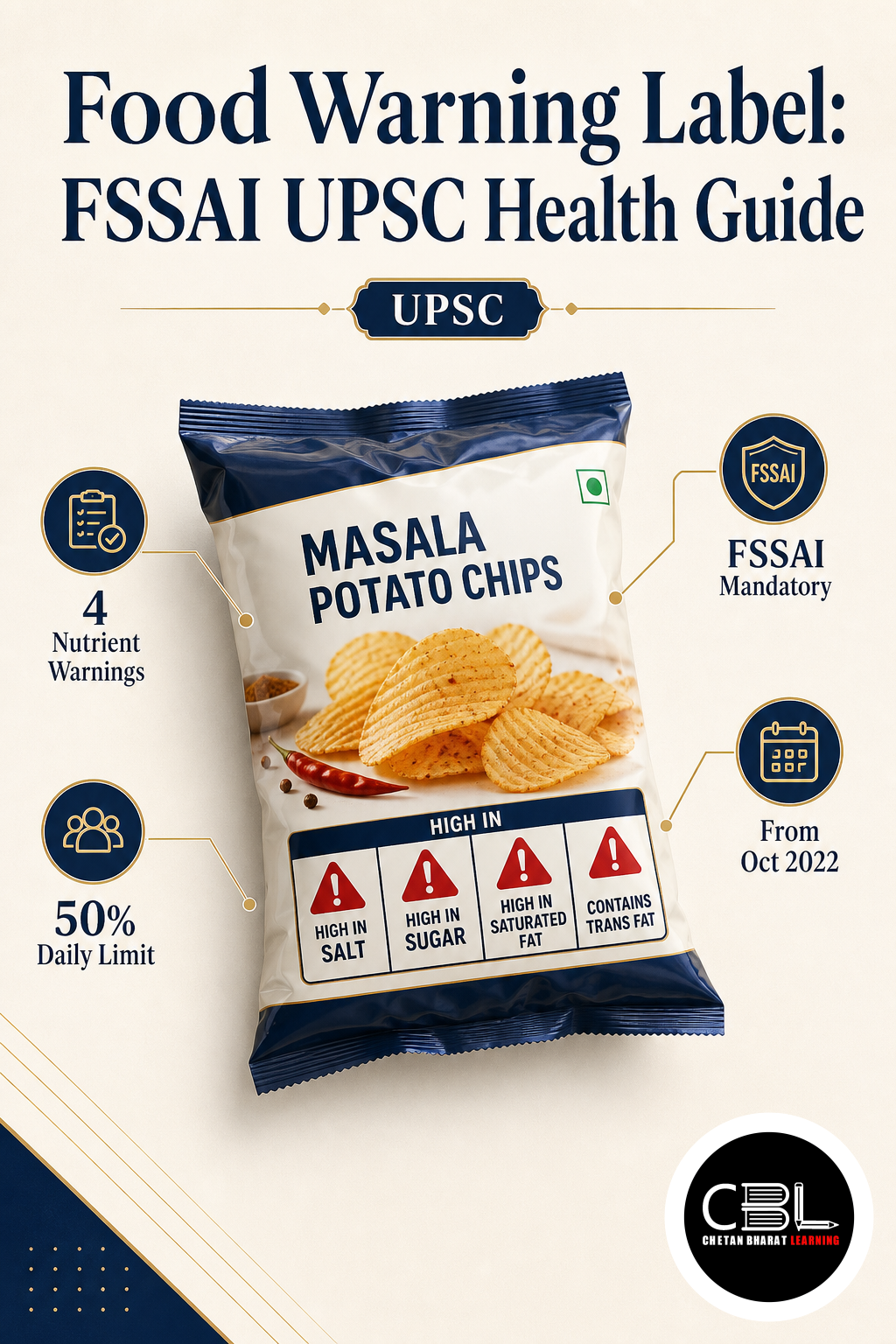
The food warning label functions as a quick nutritional display on the front of packages. It explicitly alerts consumers about high levels of sugar, salt, and saturated fats. This system ensures buyers do not require deep nutritional expertise to identify unhealthy foods.
Regulators specifically designed this framework to target ultra-processed foods. These industrial formulations contain refined ingredients and excessive additives. The prominent red hexagonal shape immediately signals potential health risks to shoppers.
Why is food warning label in News?
The Supreme Court recently pulled up the FSSAI for failing to implement the food warning label promptly. The apex court emphasized the urgent need to address India’s rising childhood obesity rates. You can review global dietary guidelines via this WHO portal for precise health standards.
Health experts highlight that India currently faces a severe double burden of malnutrition. The country simultaneously battles widespread undernutrition and rapidly increasing obesity rates. Implementing clear packaging rules will drastically improve consumer awareness across retail markets.
Key Features
- Hexagonal Shape: Highlights excessive sugar, salt, and fat content on packaged goods.
- Beverage Specific: Sweetened drinks will carry a separate dedicated warning to target liquid calorie intake.
- Star Rating Rejection: Discarded the confusing health star rating system to prevent misleading positive associations.
- Information Symmetry: Bridges the massive knowledge gap between manufacturers and regular buyers.
- Ultra-Processed Focus: Targets industrial formulations containing refined ingredients and chemical additives.
Challenges
Despite its noble intent, the food warning label faces several structural and behavioral hurdles. Addressing these limitations remains crucial for maximizing actual public health outcomes.
- Threshold Limits: The two-or-more unhealthy ingredients rule might exclude products carrying single-ingredient health risks.
- Font Size Concerns: Experts warn the proposed text might remain too small for quick retail reading.
- Industry Pushback: Food manufacturers frequently resist strict front-of-pack regulations citing high compliance costs.
- Complex Behaviour: Eating habits deeply depend on economic wherewithal, cultural awareness, and faith-based restrictions.
- Double Burden: India simultaneously battles severe undernutrition, making blanket food restrictions politically sensitive.
You can explore similar health schemes in our governance section for deeper insights.
Way Forward
The administration must notify the final implementation schedule without further bureaucratic delays. Simplifying the threshold criteria will ensure that single-ingredient risks receive adequate visual warnings. Providing localized awareness campaigns will drastically improve rural comprehension of these nutritional labels.
Check the latest FSSAI notifications for strategic regulatory updates. The government must periodically review the baseline methodologies to ensure they reflect current global dietary standards. Continuous refinement of the food warning label will guarantee that the initiative delivers genuine health protection.
State governments must actively align their local school canteen policies with central guidelines to maximize regional synergies. Coordinated efforts between different administrative tiers will eliminate junk food access for school children. This unified approach will significantly accelerate the national transition towards a healthier society.
Prelims Practice Corner
Q1. Which statutory body proposed the red hexagonal labels for packaged foods?
- (a) NITI Aayog
- (b) FSSAI
- (c) ICMR
- (d) CDSCO
Answer: (b) The Food Safety and Standards Authority of India proposed these front-of-pack warnings.
Q2. Which country successfully reduced sugary drink consumption using black octagonal warning labels?
- (a) Brazil
- (b) Mexico
- (c) Chile
- (d) South Africa
Answer: (c) Chile witnessed a 24 per cent drop in sugary drink consumption after introducing these labels.
Q3. What specific nutritional rating system did the regulator recently discard?
- (a) Traffic light system
- (b) Health star rating
- (c) Nutri-Score
- (d) Glycemic index
Answer: (b) The regulator discarded the health star rating to prevent misleading positive associations.
Q4. The term double burden of malnutrition refers to the coexistence of which two conditions?
- (a) Diabetes and hypertension
- (b) Undernutrition and obesity
- (c) Anaemia and goitre
- (d) Stunting and wasting
Answer: (b) India simultaneously battles widespread undernutrition and rapidly increasing obesity rates.
Q5. Which category of food items will carry a separate dedicated warning under the new proposal?
- (a) Dairy products
- (b) Sweetened beverages
- (c) Canned vegetables
- (d) Bakery items
Answer: (b) Sweetened drinks will carry a separate dedicated warning to target liquid calorie intake.
Mains Practice Questions
Q1. Discuss the significance of front-of-pack labelling in addressing India’s double burden of malnutrition. (10 marks)
Intro: Define the double burden of malnutrition and the FSSAI’s proposed red hexagonal labels.
Body: Explain how clear visual warnings bridge the information gap, target ultra-processed foods, and prevent non-communicable diseases while coexisting with undernutrition challenges.
Conclusion: Conclude that informed consumer choice is a critical pillar of modern preventive public health governance.
Q2. “Individual food choices are heavily shaped by the food environment rather than mere willpower.” Analyze this statement in the context of proposed FSSAI regulations. (15 marks)
Intro: Introduce the concept of the modern food environment and the aggressive marketing of ultra-processed foods.
Body: Analyze the failure of back-of-pack technical information, the rejection of misleading star ratings, and the necessity of state intervention to ensure information symmetry.
Conclusion: Suggest that warning labels must integrate with broader awareness campaigns and stricter junk food advertising regulations.
FAQs on food warning label
Why did FSSAI reject the health star rating system?
Health experts criticized the star rating system because stars are generally perceived as positive endorsements. Warning labels bearing them were often associated with increased consumption of unhealthy foods, defeating the core public health objective.
How does this address the double burden of malnutrition?
India simultaneously battles severe undernutrition and rising obesity rates. By explicitly highlighting excessive sugar, salt, and fat, these labels help curb the rising intake of empty calories without restricting access to essential nutritious foods.
What global precedent supports this specific intervention?
Chile provides a strong global precedent after introducing black octagonal warning labels in 2016. The country subsequently witnessed a massive 24 per cent drop in sugary drink consumption, proving the efficacy of prominent visual warnings.
Related Current Affairs
Preparing for UPSC, PCS or HCS?
Talk to a mentor at Chetan Bharat Learning, Chandigarh. Free guidance on choosing the right exam and building a study plan.
Chat on WhatsAppCall 97793 53345UPSC / IAS / PCS coaching in Chandigarh · Trusted by aspirants across Punjab & Haryana
Leave a Reply
You must be logged in to post a comment.