
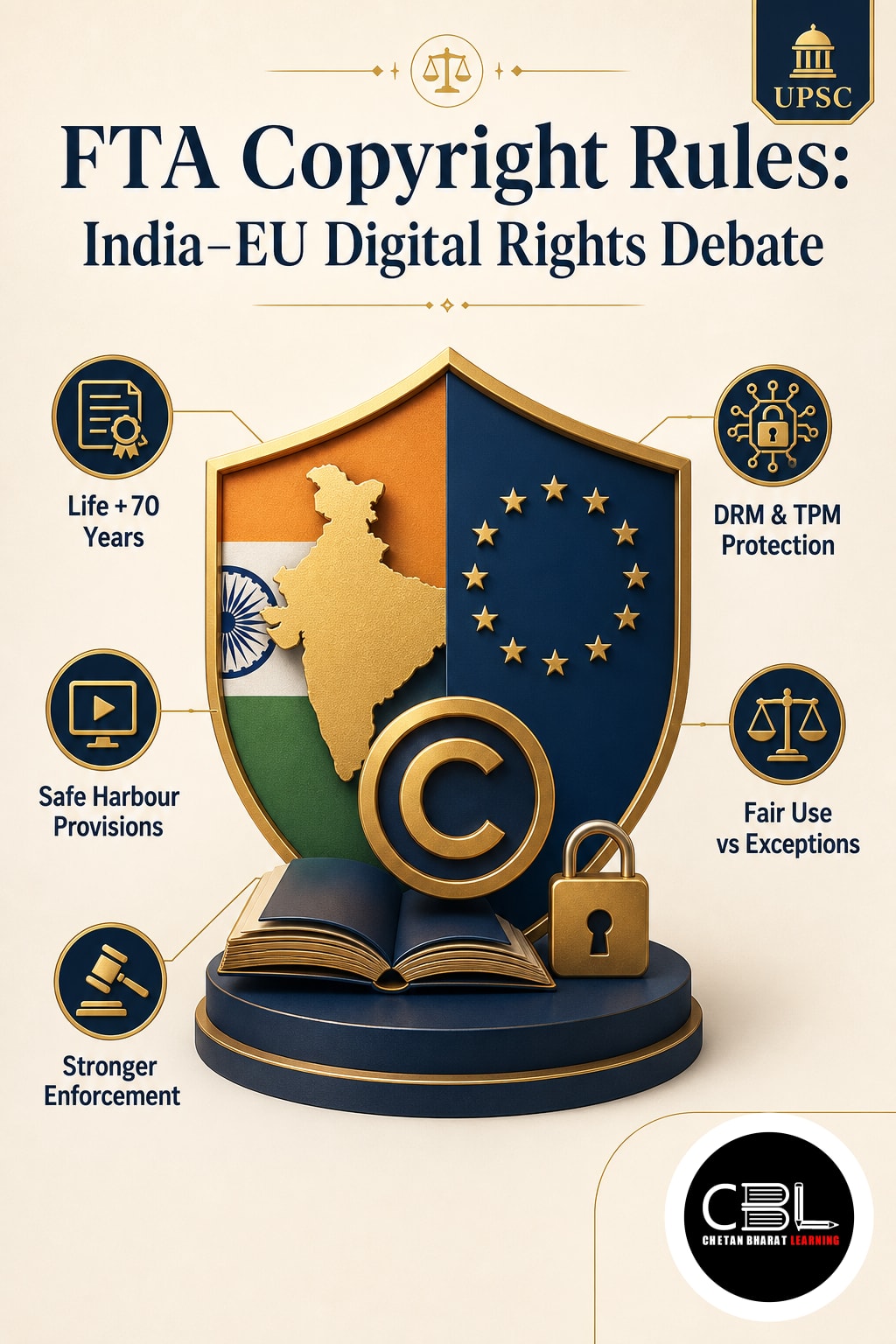

UPSC Mapping
| Important for | Topics |
|---|---|
| Prelims | Copyright Act, WCT and TRIPS |
| Mains | GS Papers II and III — Trade, Digital Rights and IPR |
| Agreement | India–EU Free Trade Agreement |
|---|---|
| Negotiations Concluded | January 2026 |
| Indian Law | Copyright Act, 1957 |
| Global Framework | TRIPS, Berne Convention and WCT |
Article
FTA Copyright Rules now place digital rights and lawful access within India–EU trade diplomacy. The debate matters because copyright provisions can affect creators, students, libraries, platforms and technology firms simultaneously across subscription contracts, public institutions, cross-border licensing, content moderation and platform design in fast-growing digital markets, influencing how consumers access knowledge and culture during everyday online activity. It also connects trade policy with domestic safeguards, which aspirants can track through the daily current affairs archive.
What is FTA Copyright Rules?
FTA Copyright Rules refer to the copyright and related-rights obligations contained in the India–EU free trade agreement’s intellectual-property chapter, which creates reciprocal standards for two large markets. They address reproduction rights, enforcement, technological protection measures and rights-management information across physical and digital commerce. The chapter sits alongside commitments concerning trademarks, designs, trade secrets and plant varieties, but it does not automatically replace either side’s domestic copyright statute.
These provisions must be read with India’s Copyright Act, 1957, the WTO’s TRIPS Agreement, the Berne Convention and relevant WIPO treaties. Copyright gives right holders protected interests, while carefully framed exceptions preserve education, research, accessibility, commentary, preservation and specified technical uses. The central policy task is to deter commercial infringement without treating every unlicensed digital act as unlawful or weakening the incentives that support original creative production.
Why is FTA Copyright Rules in News?
FTA Copyright Rules gained attention after India and the European Union concluded negotiations in January 2026 and published information about a wide-ranging trade agreement. The European Commission later advanced formal approval before signature, while India’s Commerce Department said the chapter reinforces TRIPS-based protection for copyright and several other intellectual-property categories. Its official India–EU trade factsheet also highlights exchanges on technology transfer, information flows, business partnerships and digital-library cooperation.
Public discussion now examines whether detailed digital-enforcement clauses could narrow India’s practical copyright flexibilities, including technical, educational and research uses recognised under national law. Commentators question the interaction among national treatment, temporary digital copies, technological locks and the three-step test, while the official EU summary describes a high protection level aligned with Indian and European laws. Since formal approvals and implementation remain necessary, the legal effect will depend on authoritative text, ratification, domestic measures and the approach adopted by regulators and courts.
Key Features
- Copyright and related rights: Covers works and neighbouring interests, alongside other IP categories, seeking predictable protection while preserving each party’s legal institutions and procedures.
- National treatment framework: Ensures non-discriminatory protection for right holders from the other side, supporting licensing and reducing nationality-based inequality.
- Digital protection measures: Remedies against unauthorised circumvention of technological locks, distinguishing infringement from legitimate access through express exceptions.
- Rights-management information: Protects electronic data identifying a work or licensing conditions, improving royalty administration while accounting for knowledge and intent.
- Limitations and enforcement: Links injunctions, damages and border measures with international principles governing exceptions, requiring proportionate remedies.
Challenges
India must reconcile effective enforcement with constitutional values, affordable knowledge and technological innovation.
- Fair-dealing uncertainty: Overbroad implementation of Section 52 could chill lawful activity and push costly precautionary licensing.
- Technological-lock tension: Compliance must distinguish piracy from accessibility, security research, interoperability and other lawful purposes.
- Education and library access: Uncertain liability or restrictive licensing can raise costs and widen inequalities in access to learning resources.
- Temporary digital copies: Browsing, caching and cloud services create incidental copies, so precise drafting is essential to avoid disproportionate claims.
- Implementation and oversight: Requires parliamentary scrutiny, transparent consultations, impact assessment and periodic review.
Way Forward
India should implement FTA Copyright Rules with a clear savings clause for lawful exceptions under the Copyright Act. Rules must protect right holders against commercial piracy while recognising education, accessibility, preservation, interoperability, security testing and legitimate technical processes. Authorities should define intent, knowledge and proportional remedies carefully, preventing automated enforcement from overriding statutory rights.
The government can publish an implementation assessment and consult stakeholders before legal changes. Courts should interpret exceptions in line with commitments and public interest; the WIPO Copyright Treaty framework permits digital exceptions subject to the three-step test. Transparent review, accessible grievance systems and impact studies will preserve balance as technologies and cross-border markets evolve.
Prelims Practice Corner
-
Q1. The WIPO Copyright Treaty is primarily associated with which subject?
- (a) Geographical indications
- (b) Copyright in the digital environment
- (c) Patent examination
- (d) Plant-variety registration
Answer: (b) The treaty develops international copyright protection, including obligations relevant to digital uses.
-
Q2. Which provision of India’s Copyright Act lists acts that do not constitute infringement?
- (a) Section 14
- (b) Section 31
- (c) Section 52
- (d) Section 65B
Answer: (c) Section 52 contains specified copyright limitations and exceptions.
-
Q3. Section 65A of the Copyright Act concerns:
- (a) Copyright registration
- (b) Technological protection measures
- (c) Compulsory licences
- (d) Broadcast organisations
Answer: (b) Section 65A addresses circumvention of effective technological measures with an intention to infringe.
-
Q4. The three-step test for copyright exceptions is found in which international legal setting?
- (a) Berne Convention and related instruments
- (b) Montreal Protocol only
- (c) Basel Convention only
- (d) UNCLOS only
Answer: (a) The Berne framework uses the test, which also appears in TRIPS and the WIPO Copyright Treaty.
-
Q5. Consider the following statements: 1. TRIPS forms part of the WTO framework. 2. Copyright exceptions have no relevance to education. Which option is correct?
- (a) 1 only
- (b) 2 only
- (c) Both 1 and 2
- (d) Neither 1 nor 2
Answer: (a) TRIPS is a WTO agreement, while copyright exceptions can directly support educational uses.
Mains Practice Questions
-
Q1. Examine how India can reconcile stronger copyright enforcement under a trade agreement with access to education and digital innovation. (15 marks)
Answer Structure:
- Intro: Frame copyright as a balance between creator incentives and public access.
- Body: Cover treaty obligations, Sections 52 and 65A, educational access, technological measures, innovation and proportional enforcement.
- Conclusion: Recommend transparent implementation that preserves lawful exceptions and rewards creativity.
-
Q2. Discuss the importance of domestic policy space in the intellectual-property chapters of modern free trade agreements. (10 marks)
Answer Structure:
- Intro: Define policy space as the capacity to regulate within international commitments.
- Body: Address public interest, development needs, treaty flexibilities, legislative scrutiny, judicial interpretation and stakeholder consultation.
- Conclusion: Link balanced rules with innovation, legitimacy and sustainable trade cooperation.
FAQs on FTA Copyright Rules
Do FTA Copyright Rules immediately change Indian law?
No. The agreement must complete the required approval and entry-into-force processes, while domestic implementation depends on India’s constitutional and legislative framework. Existing Indian law continues to govern unless valid legal measures change it.
What does Section 52 protect?
Section 52 specifies acts that do not constitute copyright infringement, subject to its conditions. These include certain uses involving research, criticism, reporting, instruction and technical processes.
Why do technological protection measures matter?
They help right holders control unauthorised access or copying of digital works. A balanced regime must also protect lawful circumvention and permitted uses from excessive liability.
Related Current Affairs
Preparing for UPSC, PCS or HCS?
Talk to a mentor at Chetan Bharat Learning, Chandigarh. Free guidance on choosing the right exam and building a study plan.
Chat on WhatsAppCall 97793 53345UPSC / IAS / PCS coaching in Chandigarh · Trusted by aspirants across Punjab & Haryana
Leave a Reply
You must be logged in to post a comment.