
UPSC Syllabus Mapping
| GS Paper | GS-II & GS-III |
|---|---|
| Subject | Governance, Science and Technology, Research & Development |
What is Foreign Contribution Regulation Act?
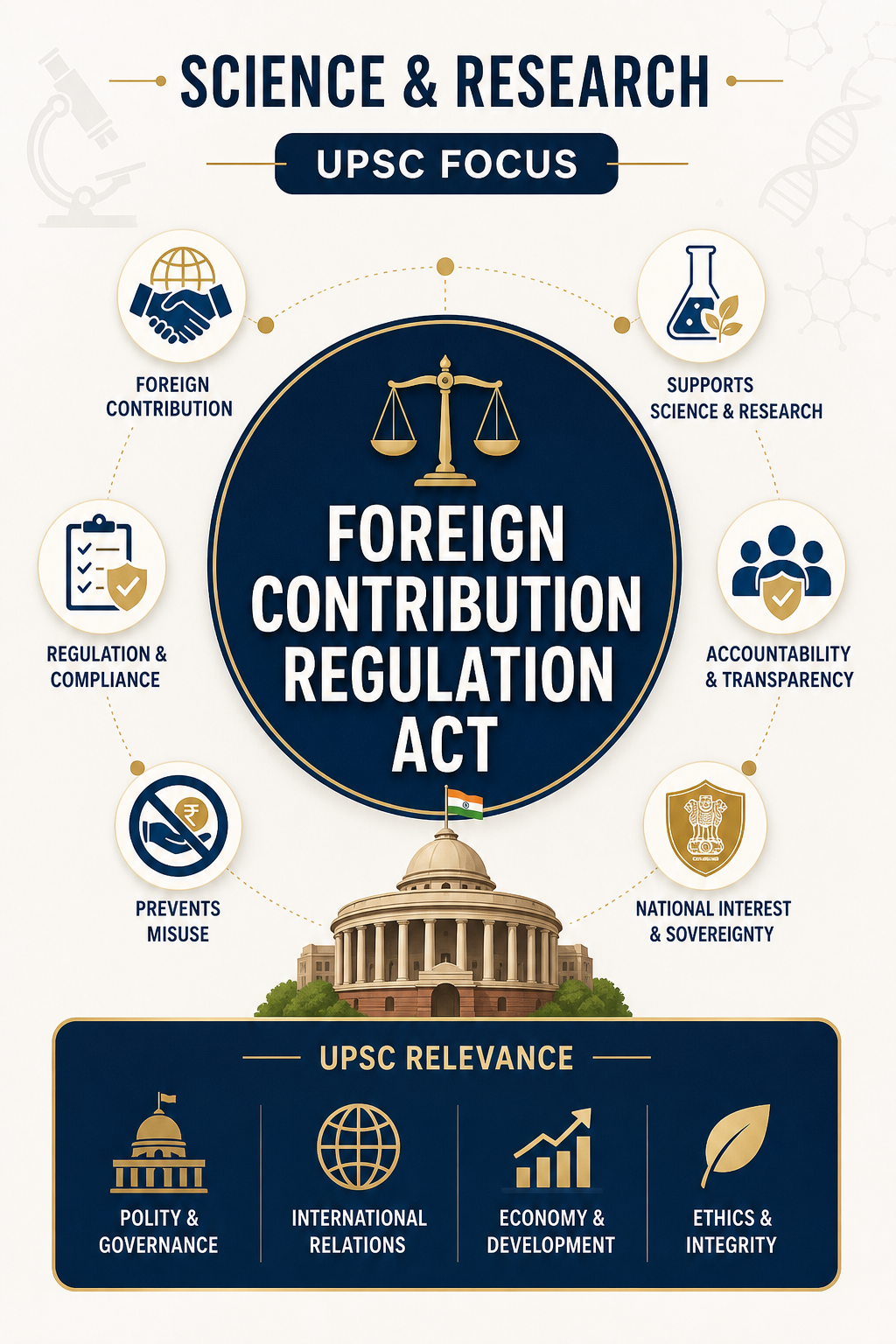
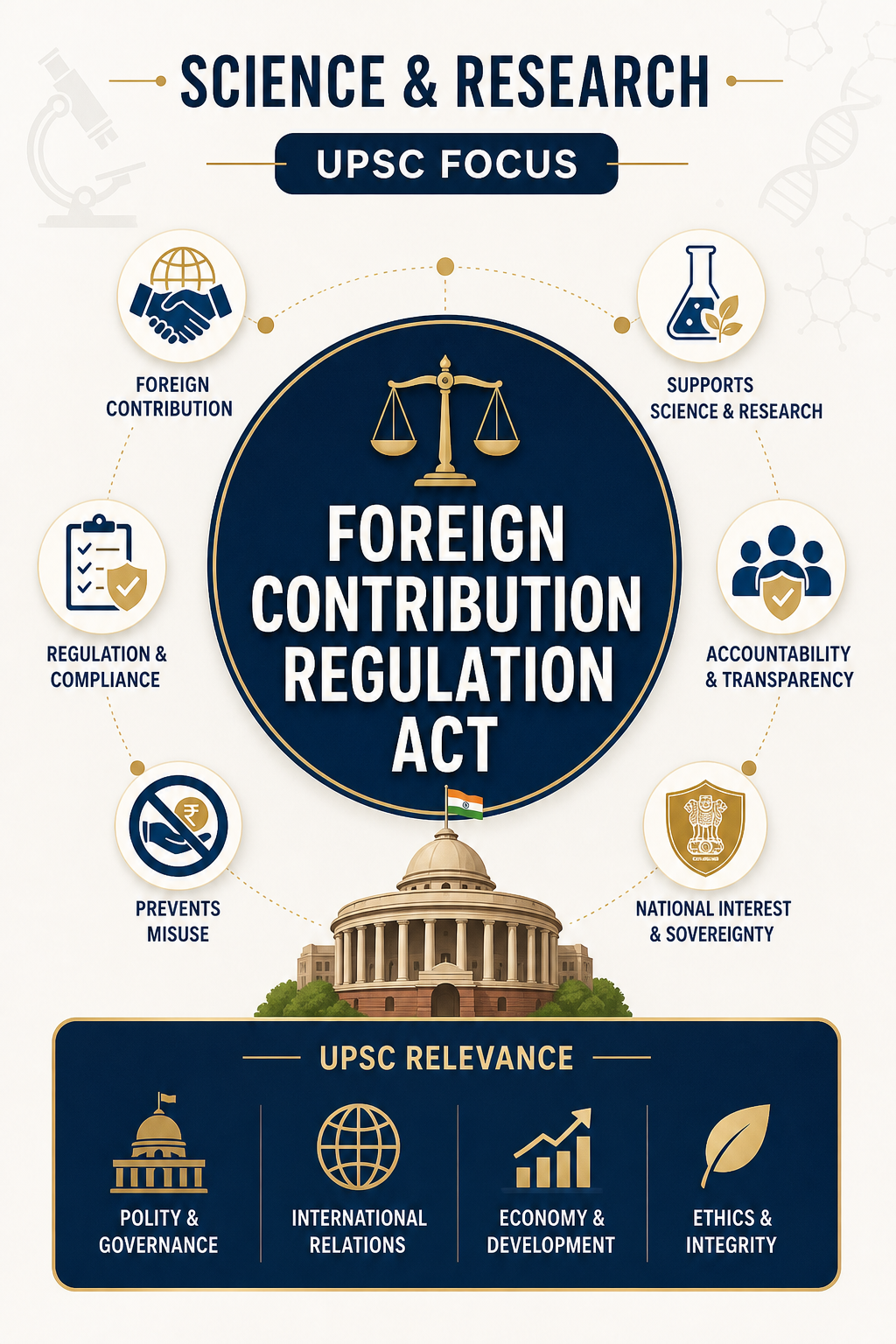
The Foreign Contribution Regulation Act (FCRA) regulates the acceptance and utilisation of foreign contributions by individuals, associations, educational institutions and organisations in India. Its primary objectives are to ensure transparency, prevent misuse of foreign funds and safeguard national interests.
Originally enacted in 1976 and comprehensively revised in 2010, the Act was further amended in 2020 to strengthen compliance requirements, centralise the receipt of foreign contributions and enhance regulatory oversight.
Why is Foreign Contribution Regulation Act in News?
A newspaper opinion article argues that although the Foreign Contribution Regulation Act promotes accountability and national security, some provisions may inadvertently complicate international scientific collaboration. Concerns include restrictions on the handling of foreign research grants and limitations on sub-granting funds among collaborating institutions.
The discussion highlights the need to balance legitimate regulatory objectives with India’s ambition to become a global research and innovation hub. Official information is available at Ministry of Home Affairs.
Key Features of Foreign Contribution Regulation Act
- Regulates receipt and utilisation of foreign contributions.
- Promotes transparency and financial accountability.
- Seeks to prevent foreign influence that may adversely affect national interests.
- Requires eligible organisations to obtain registration or prior permission.
- Mandates designated bank accounts for receiving foreign contributions.
- Provides monitoring, reporting and compliance mechanisms for funded entities.
Challenges Related to Foreign Contribution Regulation Act
Research institutions often participate in multi-country projects involving multiple universities and funding agencies. Administrative restrictions, limits on fund transfers and compliance burdens may slow collaborative research, particularly in emerging areas such as climate science, artificial intelligence, biotechnology and public health.
India also faces broader research challenges, including relatively low investment in research and development, limited industry-academia collaboration and uneven research infrastructure. For related science and governance topics, visit the UPSC current affairs library.
Way Forward for Foreign Contribution Regulation Act
A balanced regulatory framework should continue protecting national security while facilitating genuine academic and scientific collaboration. Simplifying compliance procedures for recognised research institutions, strengthening auditing mechanisms, encouraging industry participation and expanding domestic research funding through initiatives such as the Anusandhan National Research Foundation can improve India’s global research competitiveness.
Further information on government policies can be accessed through PIB Official Release.
Prelims Practice Corner
- The Foreign Contribution Regulation Act is administered by which ministry?
- Which amendment strengthened several compliance provisions under the FCRA?
- The primary objective of the FCRA is to regulate what?
- The Anusandhan National Research Foundation primarily aims to strengthen which sector?
- Which GS Paper covers Science and Technology developments and their applications?
Answers
- Ministry of Home Affairs
- FCRA Amendment Act, 2020
- Acceptance and utilisation of foreign contributions
- Research and innovation ecosystem
- GS-III
Mains Practice Questions
Q1. Examine the objectives of the Foreign Contribution Regulation Act and discuss the challenges it poses for international scientific collaboration.
Answer Outline:
- Objectives
- Transparency
- National security
- Research funding
- Global collaboration
- Balanced regulation
Q2. Discuss the importance of international scientific collaboration for India’s innovation ecosystem. Suggest policy measures to strengthen research while safeguarding national interests.
Answer Outline:
- Research competitiveness
- Technology transfer
- Anusandhan National Research Foundation (ANRF)
- Governance reforms
- Accountability
FAQs on Foreign Contribution Regulation Act
What is the Foreign Contribution Regulation Act?
The Foreign Contribution Regulation Act is a law that regulates the receipt and utilisation of foreign contributions by eligible individuals and organisations in India.
Why is the Foreign Contribution Regulation Act important?
It seeks to ensure transparency, prevent misuse of foreign funds and safeguard national security while regulating foreign-funded activities.
Why is this topic important for UPSC?
It links governance, internal security, science policy, research funding and higher education, making it relevant for both GS-II and GS-III.
Related Current Affairs
Preparing for UPSC, PCS or HCS?
Talk to a mentor at Chetan Bharat Learning, Chandigarh. Free guidance on choosing the right exam and building a study plan.
Chat on WhatsAppCall 97793 53345UPSC / IAS / PCS coaching in Chandigarh · Trusted by aspirants across Punjab & Haryana
Leave a Reply
You must be logged in to post a comment.