

UPSC Mapping
| Prelims | Science & Technology |
|---|---|
| Mains | GS Paper 3 (Science & Technology) |
Quick Facts
| Voyager 1 Distance | 25.4 billion km |
|---|---|
| Voyager 2 Distance | 21.35 billion km |
| Launch Year | 1977 |
Article
What are the Voyager Missions?
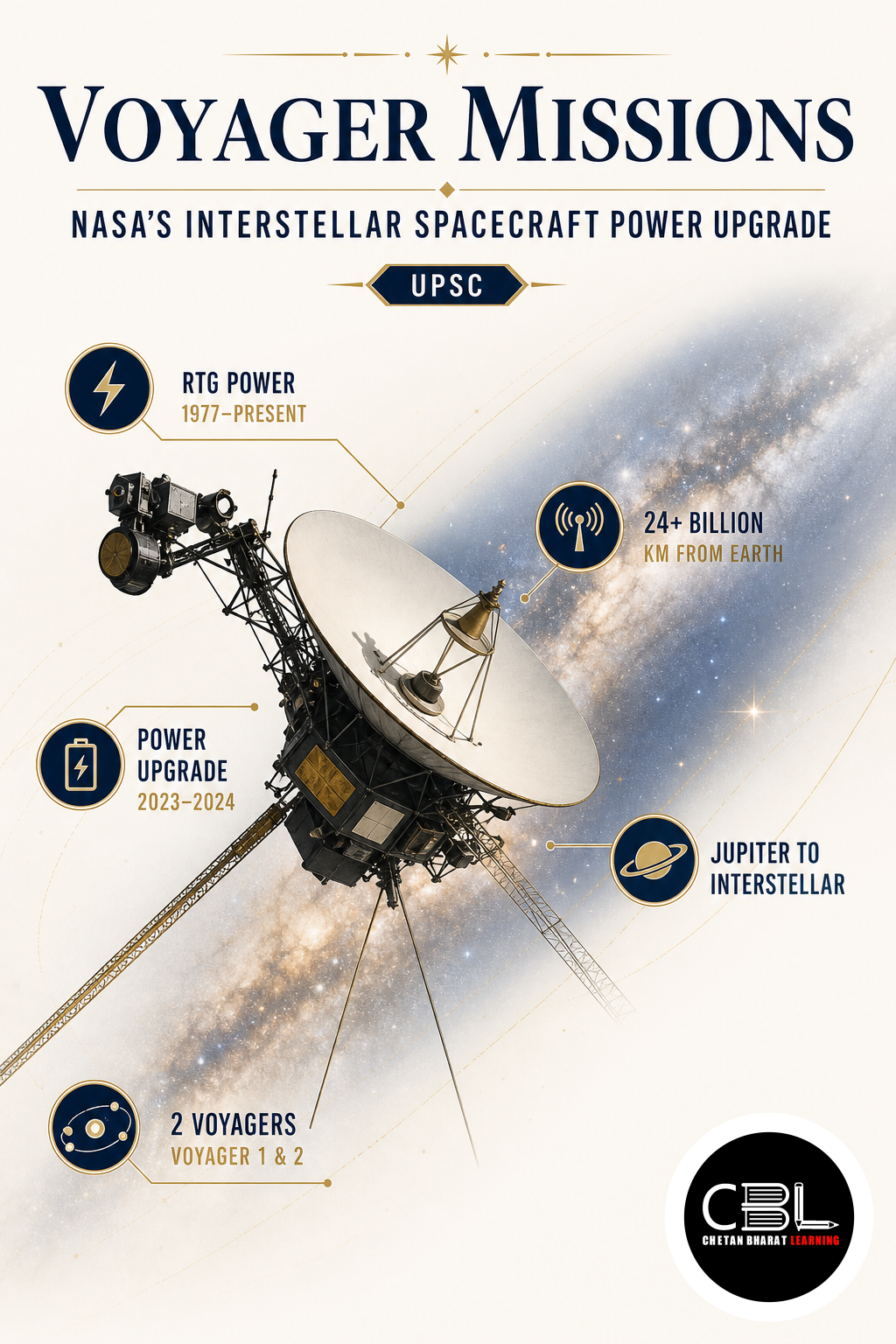
Voyager Missions consist of two spacecraft—Voyager 1 and Voyager 2—launched in 1977 to explore the outer planets and interstellar space. Voyager 1 visited Jupiter in 1979 and Saturn in 1980, and is now the most distant artificial object from Earth at 25.4 billion kilometres. Voyager 2 visited Jupiter (1979), Saturn (1981), Uranus (1985), and Neptune (1989)—the only spacecraft to have visited Uranus or Neptune.
Both spacecraft are now in interstellar space, beyond the Sun’s heliosphere. They are powered by radioisotope thermoelectric generators (RTGs), which convert heat from decaying plutonium into electricity, losing about 4 watts of power every year.
Why are Voyager Missions in News?
Voyager Missions are in the news because NASA engineers successfully implemented a power-saving upgrade—known internally as the ‘Big Bang’ fix—on Voyager 2, extending its science mission by at least another year. The upgrade involves adjusting how the spacecraft manages power, allowing continued operation of scientific instruments.
With Voyager 2’s upgrade completed successfully, NASA now plans to apply a similar fix to Voyager 1. This will enable both spacecraft to continue transmitting valuable data from interstellar space for longer. For more details, refer to the PIB release.
Key Features of Voyager Missions
- Interstellar Travel: Both spacecraft are in interstellar space, the only functioning ones beyond the Sun’s influence.
- Planetary Exploration: Voyager 2 is the only spacecraft to have visited Uranus and Neptune.
- RTG Power: Powered by radioisotope thermoelectric generators using decaying plutonium.
- Golden Record: Each carries a golden record with sounds and images of Earth for any extraterrestrial intelligence.
- Longevity: Over 48 years in space, far exceeding original design life.
Challenges in Voyager Missions
- Power Decay: RTGs lose about 4 watts of power annually, limiting instrument operations.
- Communication Delay: Signals take over 22 hours to reach Voyager 1, making real-time control impossible.
- Cold Temperatures: Spacecraft systems are exposed to extreme cold, requiring careful thermal management.
- Aging Components: Electronics have been operating for over 48 years, with some failures inevitable.
- Budget Constraints: Continued operation requires funding, which competes with newer missions.
Way Forward for Voyager Missions
To continue Voyager Missions, NASA will apply the ‘Big Bang’ fix to Voyager 1 to extend its mission life. Prioritising which instruments to keep operational is essential to maximise science return. Continued support from the scientific community and public interest is vital.
Lessons from the Voyagers are informing the design of future interstellar missions, such as the Interstellar Probe concept. The Voyager Golden Record remains a testament to humanity’s desire to reach out beyond our solar system. For international best practices, refer to the NASA.
Prelims Practice Corner
-
Q1. In which year were the Voyager spacecraft launched?
(a) 1969 (b) 1977 (c) 1980 (d) 1990
Answer
(b) Both Voyager spacecraft were launched in 1977.
-
Q2. Which spacecraft is the most distant artificial object from Earth?
(a) Voyager 2 (b) Voyager 1 (c) Pioneer 10 (d) New Horizons
Answer
(b) Voyager 1 is the most distant artificial object at 25.4 billion km.
-
Q3. Which planets did Voyager 2 visit that no other spacecraft has visited?
(a) Jupiter and Saturn (b) Uranus and Neptune (c) Mars and Venus (d) Mercury and Pluto
Answer
(b) Voyager 2 is the only spacecraft to have visited Uranus and Neptune.
-
Q4. How are the Voyager spacecraft powered?
(a) Solar panels (b) Radioisotope thermoelectric generators (c) Nuclear reactors (d) Batteries
Answer
(b) They are powered by RTGs using decaying plutonium.
-
Q5. What is the ‘Big Bang’ fix on Voyager 2?
(a) A software update (b) A power-saving upgrade to extend mission life (c) A new antenna (d) A propulsion system change
Answer
(b) It is a power-saving upgrade that extends the spacecraft’s science mission.
Mains Practice Questions
-
Q1. Discuss the significance of the Voyager missions for space exploration and their contribution to our understanding of the outer solar system and interstellar space. (250 words, 15 marks)
- Intro: Introduce the Voyager missions and their unique status.
- Body: Discuss their achievements: planetary exploration, interstellar travel, Golden Record. Analyse challenges: power decay, communication delay. Suggest the importance of continued operation and future interstellar missions.
- Conclusion: Emphasise the Voyagers as a testament to human curiosity and engineering.
-
Q2. What are radioisotope thermoelectric generators (RTGs), and why are they used in deep-space missions like Voyager? (150 words, 10 marks)
- Intro: Define RTGs as nuclear power sources.
- Body: Explain that RTGs convert heat from radioactive decay into electricity. They are essential for deep-space missions where solar power is insufficient due to distance from the Sun. The Voyagers use RTGs with plutonium-238.
- Conclusion: Conclude that RTGs enable long-duration interstellar missions.
FAQs on Voyager Missions
What are the Voyager missions?
They are two NASA spacecraft launched in 1977 to explore the outer planets and interstellar space, now the most distant human-made objects.
How far are the Voyagers from Earth?
Voyager 1 is about 25.4 billion km away, and Voyager 2 is about 21.35 billion km away.
What is the Golden Record?
It is a phonograph record carried by both Voyagers, containing sounds and images of Earth, intended for any extraterrestrial intelligence.
Related Current Affairs
Preparing for UPSC, PCS or HCS?
Talk to a mentor at Chetan Bharat Learning, Chandigarh. Free guidance on choosing the right exam and building a study plan.
Chat on WhatsAppCall 97793 53345UPSC / IAS / PCS coaching in Chandigarh · Trusted by aspirants across Punjab & Haryana
Leave a Reply
You must be logged in to post a comment.