
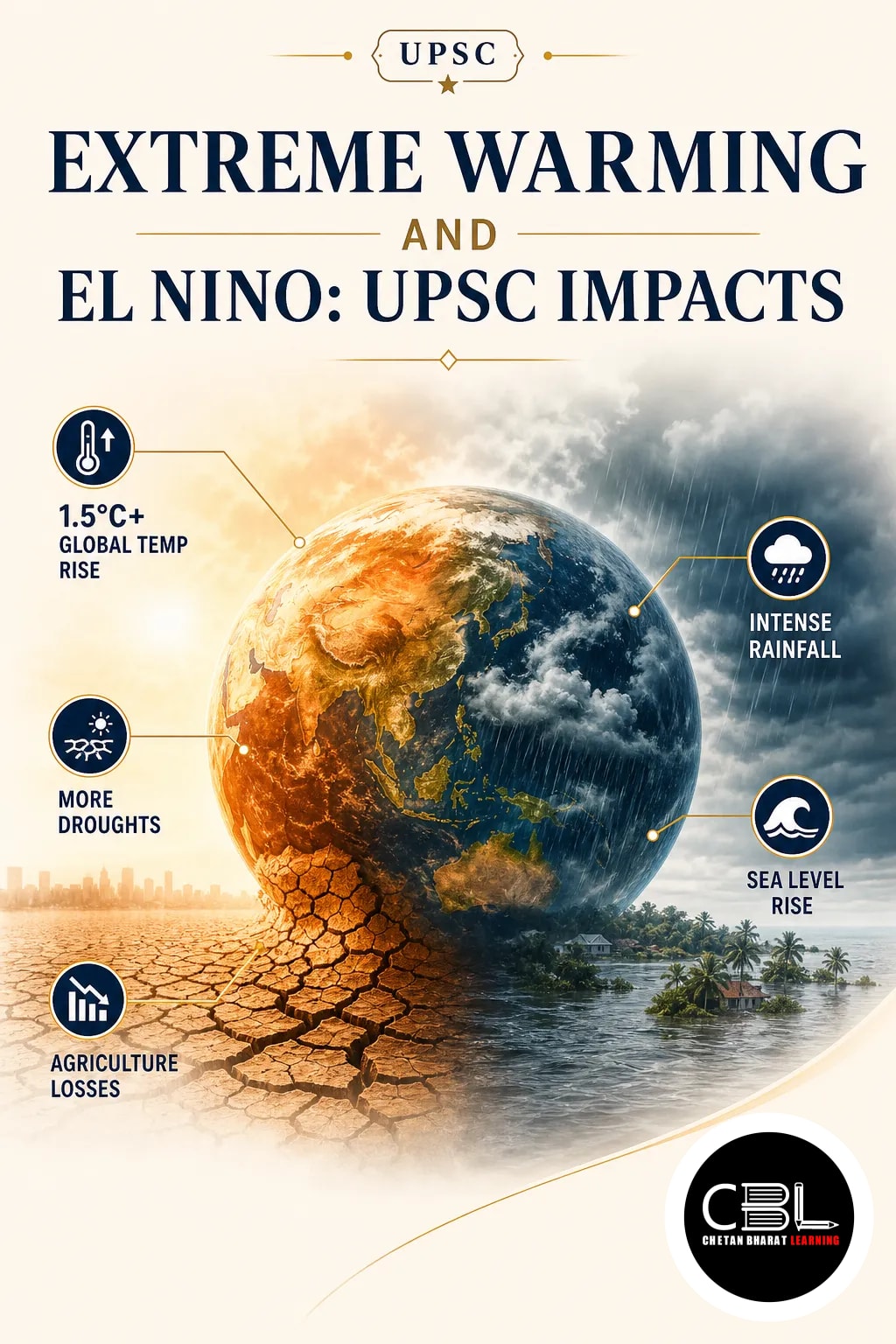

Extreme warming is back in focus as El Niño impact discussions turn to a possible ‘Godzilla’ episode. Such warming matters because it can alter rainfall, heat, fisheries, and farm output across regions.
What is extreme warming?
Extreme warming refers to an unusually intense rise in ocean or atmospheric temperatures linked to climate variability. In the El Niño phase, warmer-than-normal sea surface temperatures develop in the central and eastern equatorial Pacific, disturbing global circulation.
This disruption can weaken or shift rainfall systems, including the Indian monsoon. It can also raise the chance of heat stress, drought-like conditions in some regions, and volatile weather elsewhere.
Why in News?
The Indian Express explainer highlights how a strong El Niño may trigger extreme warming with effects beyond the Pacific. India could face rainfall irregularity, while other parts of the world may see floods, heatwaves, or crop stress.
The issue is relevant for UPSC because ENSO influences agriculture, water resources, disaster management, and price stability. It also links climate science with livelihood security.
Key Features
- Ocean-atmosphere coupling — El Niño begins with warming in the equatorial Pacific and changes in wind patterns.
- Monsoon sensitivity — India’s rainfall can become erratic when the circulation pattern weakens over the Indian Ocean region.
- Food system impact — Crop yields may fall if heat, rainfall gaps, or water stress coincide with the growing season.
- Global spillovers — Climate shocks can appear in multiple continents at once, affecting trade and prices.
- Health and energy stress — Higher temperatures can increase heat-related illness and push up cooling demand.
Challenges
- Rainfall uncertainty — Farmers and water managers face planning difficulty when seasonal forecasts become less reliable.
- Agricultural vulnerability — Rainfed regions remain exposed to crop losses when monsoon timing or intensity changes.
- Price pressure — A weather shock can raise food inflation through lower supply and higher transport costs.
- Disaster preparedness gap — States may struggle if heatwaves, dry spells, and local flooding occur together.
- Climate adaptation limits — Weak irrigation, storage, and risk insurance reduce the capacity to absorb shocks.
Way Forward
India needs stronger seasonal forecasting, crop advisories, and district-level heat action plans. Better irrigation scheduling, resilient seeds, and crop diversification can reduce the damage from extreme warming.
Policy support should also improve water storage, insurance coverage, and market response during climate stress. Coordination between weather agencies, agriculture departments, and disaster managers is essential.
Source: Indian Express Explained, 2026-10-24
- El Niño impact: Monsoon risks and agricultural vulnerability (4 Sep 2026)
- Ocean Warming: Climate Crisis Warning Signs (27 Aug 2026)
This topic is relevant for state PCS because Punjab and Haryana depend heavily on climate-sensitive agriculture. Questions may link El Niño to monsoon behaviour, irrigation demand, heat stress, and food inflation in north Indian states.
FAQ
How does El Niño differ from La Niña?
El Niño is the warm phase of the ENSO cycle, while La Niña is the cool phase. The two phases influence rainfall, temperature, and storm patterns differently across the world.
Why does extreme warming matter for India?
It can disturb the southwest monsoon, which is crucial for agriculture and water supply. It may also raise the risk of heat stress and food inflation.
Which GS paper covers this issue?
It fits best under GS Paper III because it involves environment, climate change, agriculture, disaster management, and food security. It can also support Prelims preparation in geography and ecology.
Related Current Affairs
Preparing for UPSC, PCS or HCS?
Talk to a mentor at Chetan Bharat Learning, Chandigarh. Free guidance on choosing the right exam and building a study plan.
Chat on WhatsAppCall 97793 53345UPSC / IAS / PCS coaching in Chandigarh · Trusted by aspirants across Punjab & Haryana
Leave a Reply
You must be logged in to post a comment.