

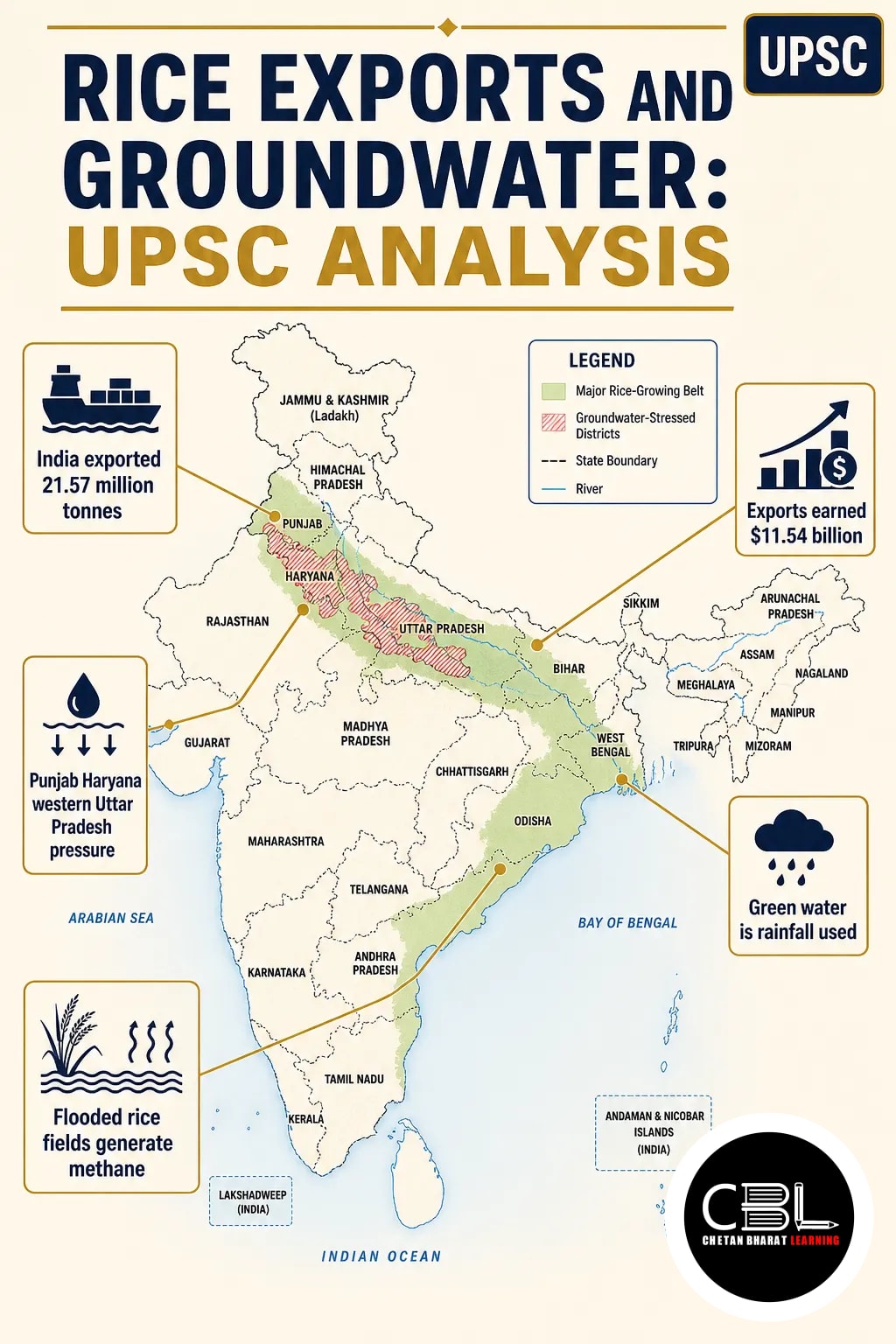
India’s rice exports reached 21.57 million tonnes in 2025-26, but their environmental cost raises a policy question. For more context, explore CBL’s environment and resource coverage.
Quick answer: India’s rice exports earned $11.54 billion in 2025-26, but production draws on groundwater in several regions. Punjab, Haryana and western Uttar Pradesh face particularly acute pressure. The editorial proposes a shift from export volume to value, alongside measures to reduce water use and emissions per unit of rice.
What is the policy issue?
India must balance its rice export competitiveness with the water and environmental costs of cultivation. The country has been the world’s largest rice exporter since 2012. However, export earnings alone do not reveal how much scarce groundwater production consumes.
Estimated rice production reached 154.02 million tonnes in 2025-26. Major producers include Uttar Pradesh, Telangana, West Bengal, Punjab, Chhattisgarh and Odisha. Production conditions differ across these states; therefore, a uniform water-saving policy may not suit every region.
Why are rice exports in focus?
The Hindu editorial highlights rising exports alongside the need to measure their resource footprint. Exports rose from 17.73 million tonnes in 2020-21 to 21.57 million tonnes in 2025-26. Meanwhile, their value increased from $8.82 billion to $11.54 billion.
Data from the Agricultural and Processed Food Products Export Development Authority (APEDA) also show a difference between the two export segments. Basmati generated nearly as much total value as non-Basmati despite a substantially smaller volume.
| 2025-26 indicator | Basmati | Non-Basmati |
|---|---|---|
| Export volume | 6.52 million tonnes | 15.04 million tonnes |
| Export value in dollars | $5.67 billion | $5.86 billion |
| Export value in rupees | ₹50,138 crore | ₹51,892 crore |
The segment comparison supports a value-oriented strategy, but it does not establish that all Basmati cultivation is sustainable. For that, policymakers must also assess where and how the crop is grown.
What is virtual water in rice trade?
Virtual water is the water used to produce a commodity that is subsequently traded. Rice exports therefore carry an indirect water footprint, although no equivalent volume of water physically travels with the grain.
Green water refers to rainfall used by crops. In contrast, blue water comes from sources such as groundwater, rivers and reservoirs. Heavy reliance on blue water can place pressure on locally available supplies.
The editorial identifies acute groundwater pressure in Punjab, Haryana and western Uttar Pradesh. It also notes groundwater-fed rice cultivation in parts of West Bengal, Bihar, Odisha, Chhattisgarh, Telangana, Andhra Pradesh, Tamil Nadu and Karnataka. Consequently, assessments must distinguish local water conditions rather than treating every tonne alike.
Arguments for maintaining export competitiveness
Rice exports bring earnings and demonstrate India’s capacity to serve distinct markets. The editorial therefore does not call for a blanket reduction in exports.
- Established market position: India has accounted for about 30–35% of global rice exports in recent years.
- Different market segments: Basmati and non-Basmati serve a premium segment and a high-volume segment respectively; therefore, policy can support both while improving resource efficiency.
- Value addition: Quality, branding, processing, traceability and geographical indications can help raise value rather than relying only on greater volumes.
- Farmer livelihoods: Export strategy should consider income per unit of water, not merely water savings or shipment totals.
Procurement incentives also matter to this transition. For state-level context, see CBL’s coverage of Punjab’s paddy procurement funding and its paddy procurement target.
What are the sustainability concerns?
Groundwater depletion and agricultural emissions can weaken the long-term sustainability of rice production. However, the extent of these risks depends on local practices and resource conditions.
- Aquifer pressure: Groundwater-fed cultivation can draw down scarce local stocks, especially in already stressed areas.
- Methane: Flooded rice fields can generate methane, a greenhouse gas. Therefore, water management has a climate dimension as well as a resource dimension.
- Other emissions: Excessive or inappropriate use of nitrogen-based fertilisers and intensive farm operations can contribute to other greenhouse gas emissions.
- Technology trade-offs: Water-saving practices can affect different emissions differently; consequently, their net effects require local assessment.
- Transition risks: Diversification requires attention to farmer incomes and market access; otherwise, a technically suitable alternative may not be attractive to cultivators.
What is the way forward?
A differentiated strategy should align cultivation with water availability, groundwater status and agroclimatic conditions. It should combine production changes with better measurement and stronger export value.
Match practices to local conditions
In highly water-stressed areas, incentives for less water-intensive crops should complement irrigation efficiency. Elsewhere, alternate wetting and drying (AWD), which alternates flooded and non-flooded periods, can be assessed for local suitability. Direct-seeded rice (DSR) involves sowing seed directly rather than transplanting seedlings.
Integrated nutrient management can also improve resource use. However, AWD, DSR and nutrient practices require context-specific evaluation because soil and climate affect their outcomes and emissions trade-offs.
Measure water, carbon and value together
The editorial proposes a water-carbon-value framework rather than a single export-volume target. Its indicators include export value per tonne and per cubic metre of blue water, groundwater used per tonne, and irrigation water productivity.
In addition, policymakers should monitor emissions per kilogram of rice, farmer income per unit of water and groundwater trends in major rice districts. Together, these measures can reveal whether higher earnings coincide with lower resource pressure.
Useful for Essay and GS IV: Economic success is more durable when the value created today does not conceal the resource costs borne tomorrow.
Source: The Hindu, 16 November 2026
- Punjab paddy procurement funds: State seeks higher CCL (15 Nov 2026)
Asked in UPSC: Previous Year Questions
- UPSC CSE Mains 2025 (GS Paper III): Examine the factors responsible for groundwater depletion in India. What steps has the government taken to mitigate it?
UPSC connects groundwater depletion with its causes and policy responses; therefore, revise both alongside the rice example.
Punjab and Haryana face acute groundwater pressure linked to rice cultivation, making crop diversification relevant to state governance. Therefore, PCS answers can connect procurement incentives, irrigation choices and farmer incomes with groundwater sustainability.
Prelims Practice Corner
Mains Practice Questions
Frequently Asked Questions
How much rice did India export in 2025-26?
India exported 21.57 million tonnes. These exports earned $11.54 billion, according to the source.
What is the difference between green water and blue water?
Green water is rainfall used by crops; blue water comes from sources such as aquifers, rivers and reservoirs. Therefore, their local resource implications can differ.
Does the editorial recommend reducing rice exports?
No; it recommends improving export value and reducing resource costs per tonne. It therefore favours differentiated production rather than a blanket reduction in shipments.
How does rice cultivation contribute to greenhouse gas emissions?
Flooded rice fields can generate methane. In addition, inappropriate fertiliser use and intensive farm operations contribute to other emissions.
Related Current Affairs
Preparing for UPSC, PCS or HCS?
Talk to a mentor at Chetan Bharat Learning, Chandigarh. Free guidance on choosing the right exam and building a study plan.
Chat on WhatsAppCall 97793 53345UPSC / IAS / PCS coaching in Chandigarh · Trusted by aspirants across Punjab & Haryana









Leave a Reply
You must be logged in to post a comment.