
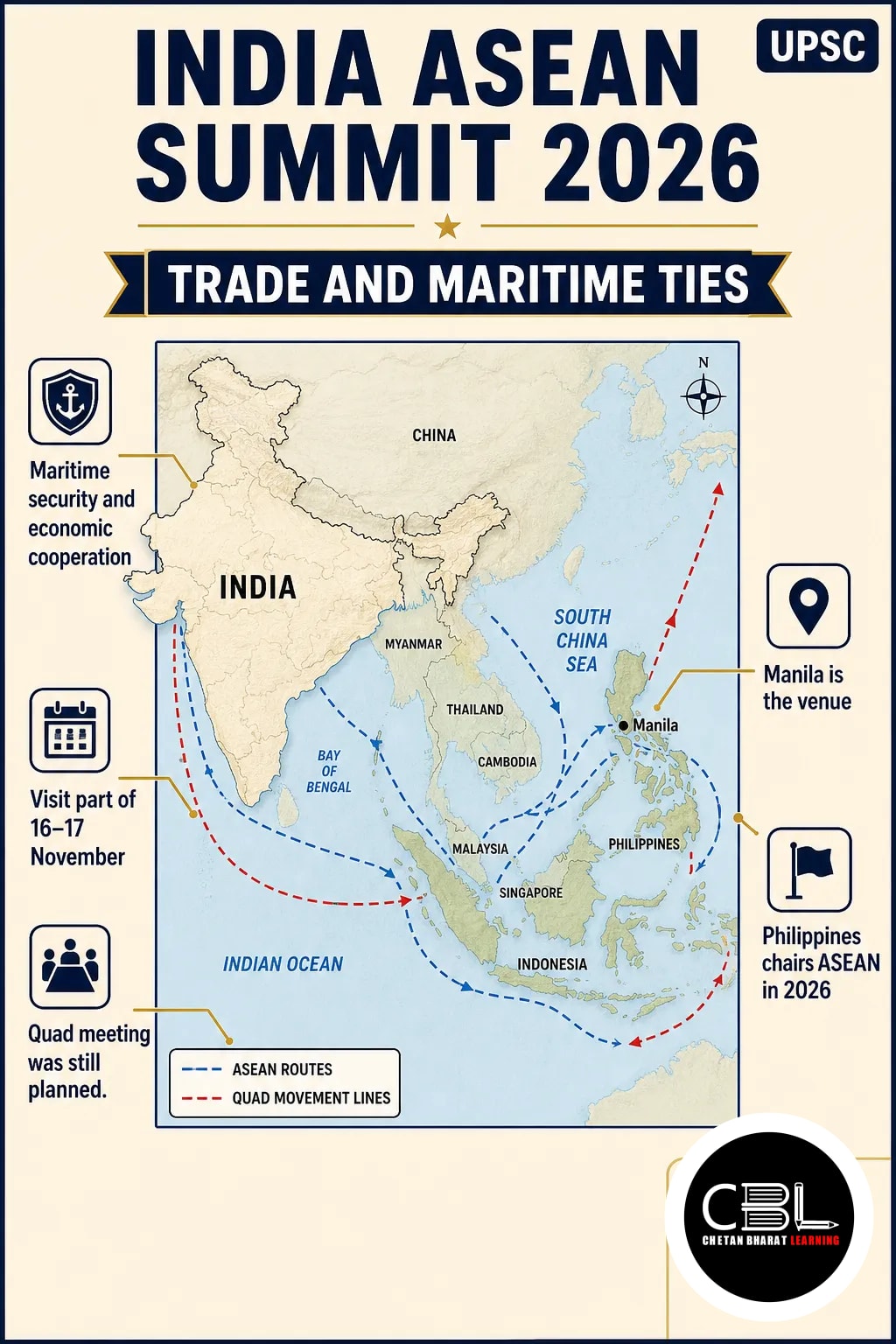
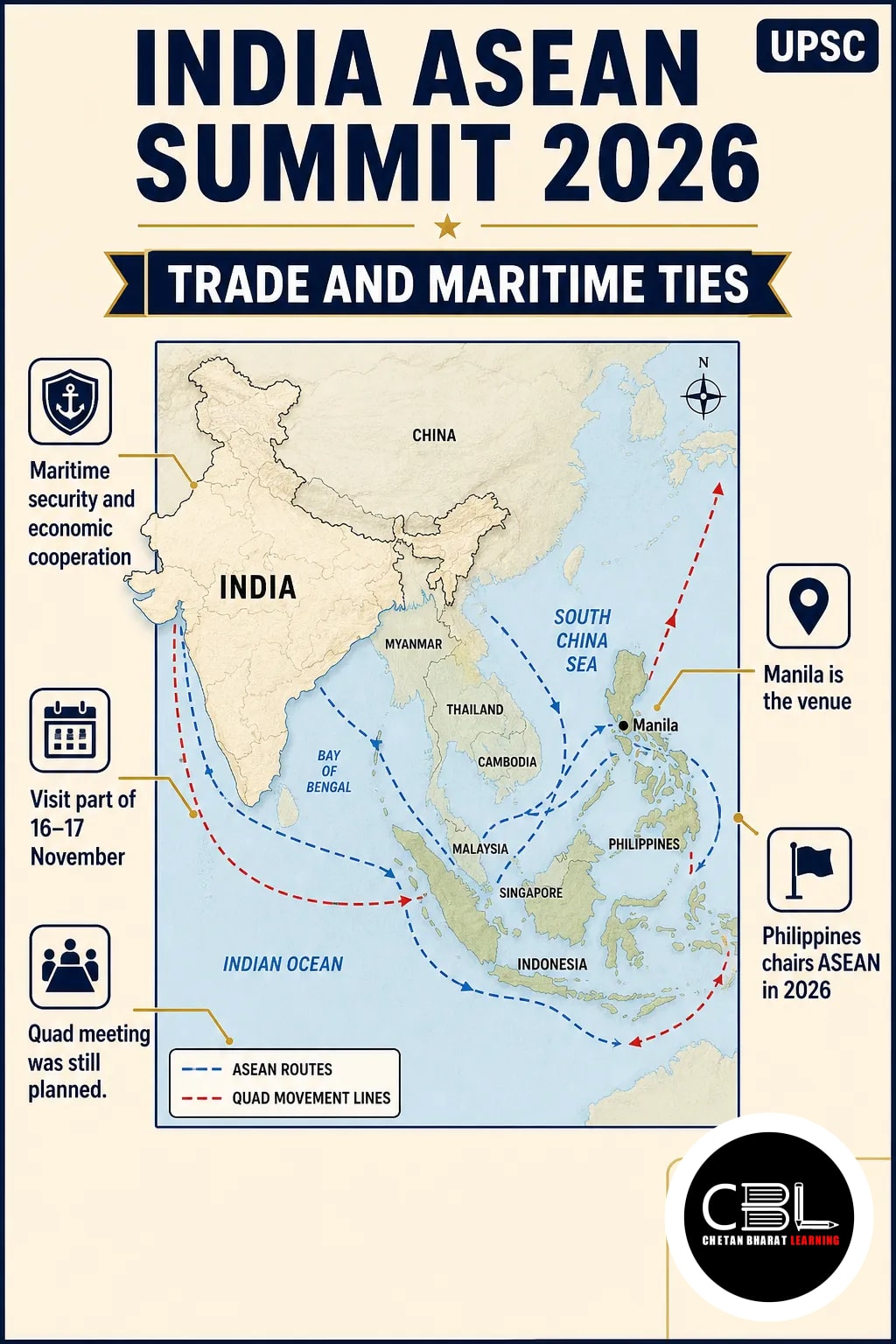
UPSC Mapping
| Area | Key fact |
|---|---|
| Visit | 16–17 November 2026 |
| Venue | Manila, Philippines |
| 2026 theme | Year of Maritime Cooperation |
| ASEAN chair | Philippines |
Article
India ASEAN summit 2026 will bring trade and maritime security into focus as Prime Minister Narendra Modi visits Manila. For broader context, explore CBL’s international relations coverage.
Quick answer: The India ASEAN summit 2026 forms part of Modi’s 16–17 November visit to Manila, Philippines. The agenda centres on maritime security, economic cooperation and development partnership. He is also scheduled to attend the East Asia Summit; meanwhile, a Quad leaders’ summit is being planned on the sidelines.
What is on the India ASEAN summit 2026 agenda?
The summit will review the partnership across maritime security, economic cooperation and development. The Association of Southeast Asian Nations (ASEAN) and India will also have an opportunity to discuss regional developments and new areas of cooperation.
Modi is scheduled to attend the ASEAN-India Summit and the East Asia Summit on 17 November. In addition, his programme includes a dinner hosted by Philippine President Ferdinand Marcos Jr. and meetings with other leaders.
A Quad leaders’ summit is being planned on the sidelines; its formalisation remained under discussion before the visit. The Quad brings together India, Australia, Japan and the United States. For context, read about India’s strategic stakes in the proposed Quad meeting.
What are the key facts and expected outcomes?
The Manila meetings offer a chance to review existing cooperation, but the source does not identify any concluded agreements.
| Area | Key fact or agenda |
|---|---|
| Economic cooperation | Trade, investment, connectivity and diversified supply chains |
| Maritime cooperation | Security, safety, connectivity and the blue economy |
| Development partnership | Capacity building through support for the Initiative for ASEAN Integration |
| 2027 milestones | 35 years of ASEAN-India relations and five years of their Comprehensive Strategic Partnership |
| Summit participation | Modi’s 13th ASEAN-India Summit participation since 2014 |
The Philippines chairs ASEAN in 2026 under the theme ‘Navigating our future, together’. Meanwhile, ASEAN will mark its 60th anniversary in 2027.
Why does the partnership matter for India?
The partnership connects India’s economic priorities with security and development in neighbouring Southeast Asia.
Trade, connectivity and supply chains
Officials identify stronger trade and investment ties as a central objective. Moreover, better connectivity can help businesses reach markets, while diversified supply chains can reduce dependence on a single source or route.
These objectives require attention to transport links and the practical costs of moving goods. However, the source provides no trade figures or specific trade agreement outcomes; the agenda should not be mistaken for a completed deal.
Maritime security and regional institutions
India and Southeast Asia occupy adjoining maritime zones, making maritime safety and security shared concerns. Consequently, cooperation can support safer movement at sea alongside disaster preparedness and resilience.
In Manila, Marcos called for an effective South China Sea code of conduct consistent with international law, including the United Nations Convention on the Law of the Sea (UNCLOS). Meanwhile, the ASEAN-led East Asia Summit offers a forum for leaders to discuss security and other shared concerns.
Development and capacity building
India supports the Initiative for ASEAN Integration to help narrow development gaps through capacity building. Officials identify Cambodia, Laos, Myanmar and Timor-Leste as places covered by these efforts.
Such cooperation complements commercial ties because skills and institutions help partners use connectivity opportunities. India also engages ASEAN partners bilaterally; for example, see the earlier coverage of India-Singapore defence talks.
What challenges could limit cooperation?
Geopolitical tensions and implementation gaps could make common objectives harder to realise.
- Regional security: Tensions in the South China Sea complicate cooperation; therefore, dialogue and adherence to international law remain important.
- Economic resilience: Supply-chain diversification requires reliable connections and coordination; otherwise, stated ambitions may not translate into easier trade.
- Development gaps: Partners have different capacity needs, so cooperation must address uneven institutional and skills constraints.
- Institutional balance: India engages through ASEAN-led forums and the Quad; consequently, it must coordinate these approaches without treating the groupings as interchangeable.
What should be the way forward?
India and ASEAN can turn summit priorities into specific, reviewable cooperation across trade, maritime safety and capacity building.
- Track connectivity: Identify practical bottlenecks and review progress regularly; this can make trade objectives more measurable.
- Build maritime resilience: Strengthen safety and disaster preparedness cooperation, while supporting dialogue based on international law.
- Match skills to needs: Design capacity-building efforts around partner priorities; in addition, assess whether training reaches intended beneficiaries.
- Use regional forums: Maintain engagement through ASEAN-led platforms and bilateral channels, so economic and security discussions reinforce each other.
The India ASEAN summit 2026 is therefore best assessed by subsequent decisions and implementation, not by the agenda alone.
Source: The Indian Express, 16 November 2026
- Quad summit Manila 2026: India’s Strategic Stakes (15 Nov 2026)
- India Singapore Defence Talks: Key Outcomes for UPSC (28 Oct 2026)
- Quad Critical Minerals and Supply Chains: UPSC (1 Nov 2026)
Asked in UPSC: Previous Year Questions
- UPSC CSE Prelims 2026 (GS Paper I): Which of the following projects are part of India-ASEAN connectivity cooperation: Kaladan Multi-Modal Transit Transport Project, IMT Trilateral Highway and Agartala-Akhaura Rail Line?
- UPSC CSE Mains 2025 (GS Paper III): Why is maritime security vital to India’s sea trade? Discuss maritime and coastal security challenges and the way forward.
UPSC connects regional partnerships with connectivity projects and maritime security; therefore, revise both institutions and strategic geography.
Punjab PCS and Haryana HCS General Studies can test ASEAN, the Quad and the location of Manila. In addition, candidates can link regional connectivity and supply-chain resilience to questions on India’s external economic relations.
Prelims Practice Corner
Mains Practice Questions
Frequently Asked Questions
Where is the India ASEAN summit 2026 being held?
Manila, Philippines, is the venue. The summit is part of Modi’s 16–17 November visit; the Philippines also chairs ASEAN in 2026.
What are the main agenda items for India and ASEAN?
Maritime security, economic cooperation and development partnership are the three main areas. In addition, officials identify connectivity, investment and resilient supply chains as priorities.
What is the ASEAN-India Year of Maritime Cooperation?
It is the partnership’s maritime cooperation focus for 2026. It covers security and safety; in addition, it includes connectivity and the blue economy.
Was a Quad summit confirmed as completed in Manila?
No, the source says a leaders’ meeting was being planned. Therefore, it should not be described as a completed summit or agreement.
Related Current Affairs
Preparing for UPSC, PCS or HCS?
Talk to a mentor at Chetan Bharat Learning, Chandigarh. Free guidance on choosing the right exam and building a study plan.
Chat on WhatsAppCall 97793 53345UPSC / IAS / PCS coaching in Chandigarh · Trusted by aspirants across Punjab & Haryana








Leave a Reply
You must be logged in to post a comment.