
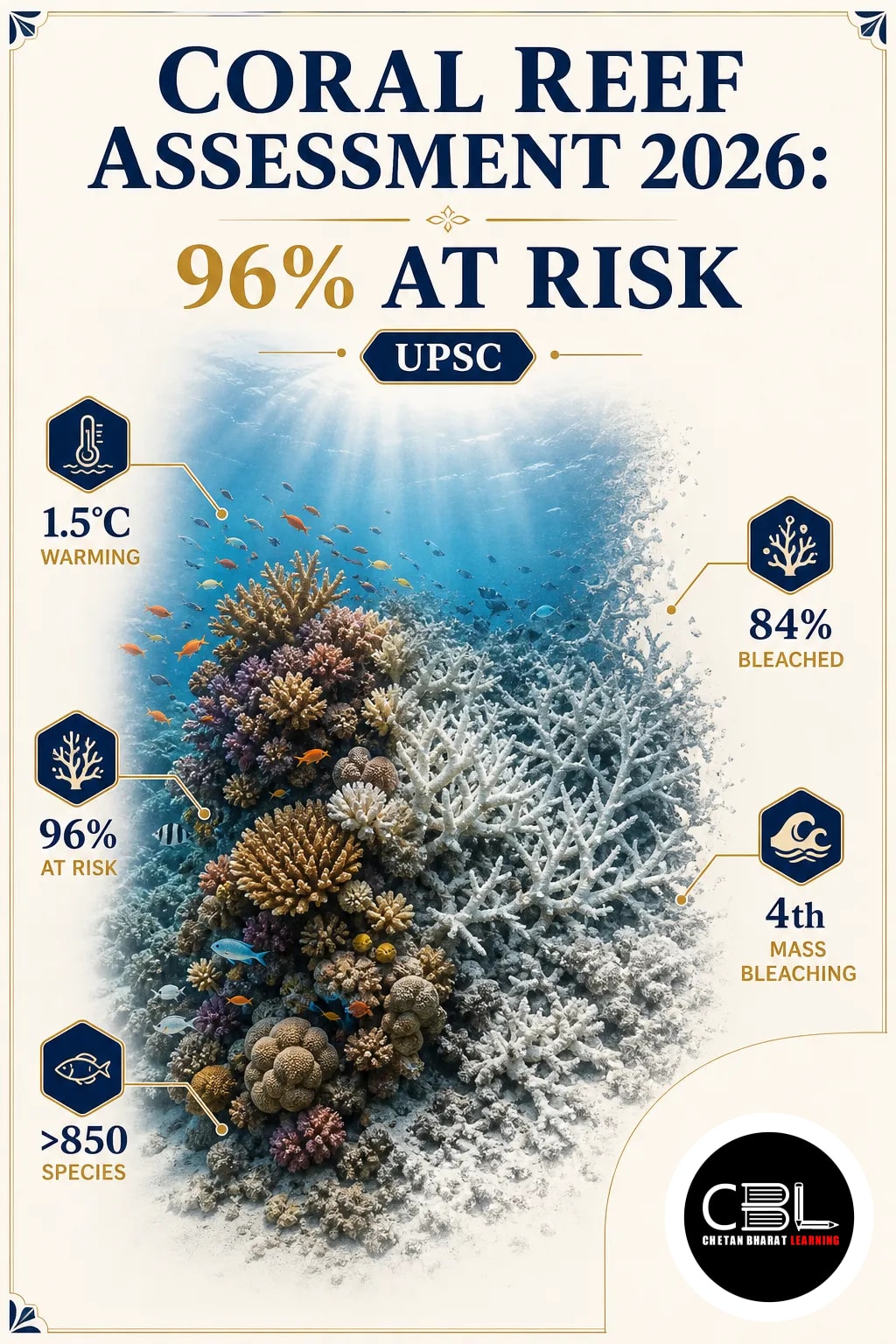
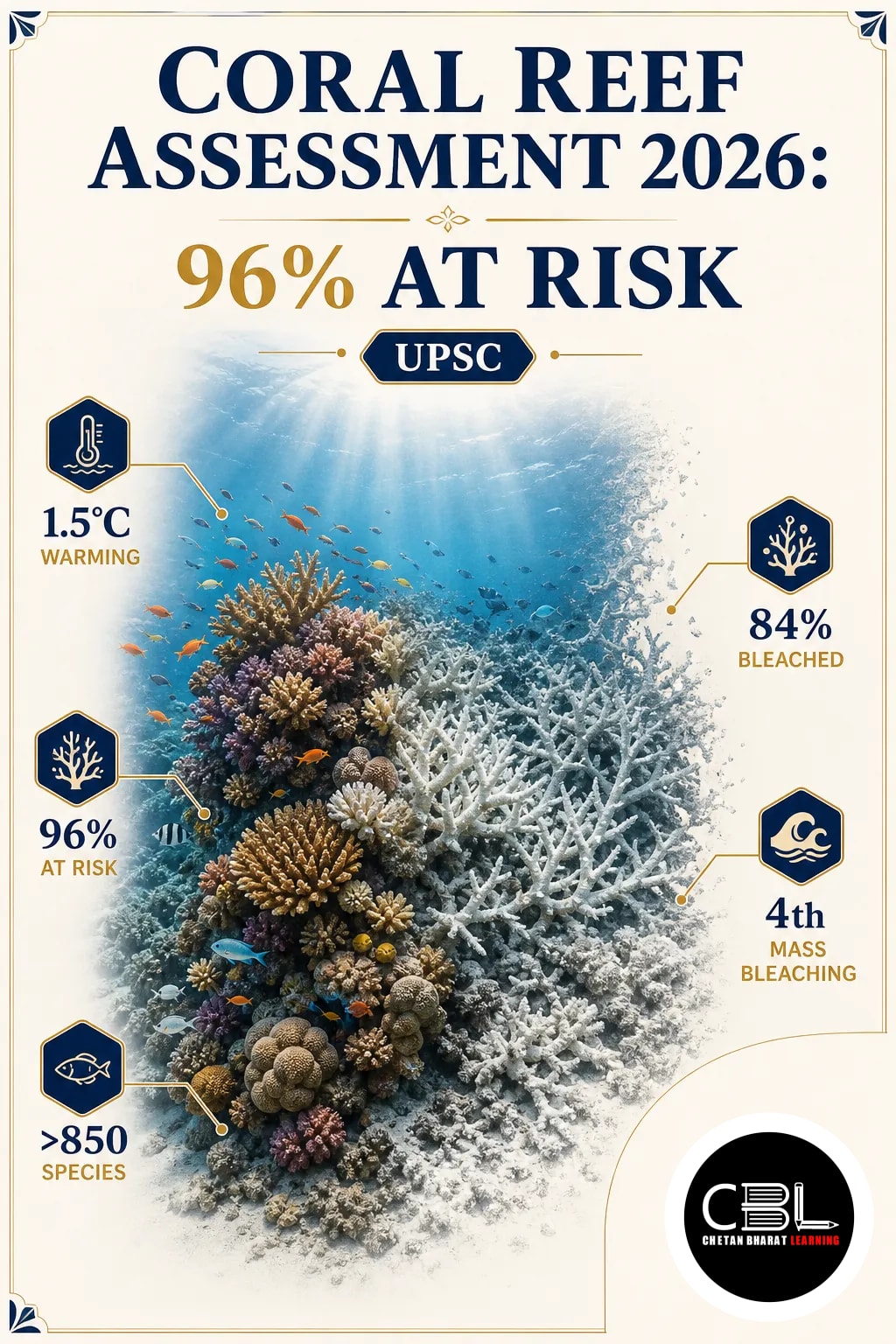
The Coral Reef Assessment 2026, released by the International Union for Conservation of Nature (IUCN) on 22 October 2026, reveals that 96% of assessed shallow-water coral reef ecosystems are Critically Endangered. The landmark findings highlight the growing danger of ocean warming, marine heatwaves and ecological degradation. The assessment is particularly relevant to UPSC Environment and Ecology preparation. Explore related developments in the daily current affairs archive.
What Are Coral Reefs?
Coral reefs are underwater structures formed primarily from calcium carbonate skeletons produced by colonies of tiny marine animals called coral polyps. Many reef-building corals maintain a symbiotic relationship with microscopic algae, known as zooxanthellae, which provide energy through photosynthesis.
Most tropical reef-building corals thrive in warm, shallow, clear and sunlit marine waters. Although reefs occupy less than 1% of the ocean floor, they support approximately one-quarter of marine fish species. Their extraordinary biodiversity has earned them the description rainforests of the sea.
Key Findings of the Coral Reef Assessment 2026
The first global IUCN Red List of Coral Reef Ecosystems assessed shallow, sunlit reefs across 127 tropical and subtropical marine ecoregions. Its classification considers both observed ecological deterioration and projected future climate pressures.
| Indicator | Global Finding |
|---|---|
| Total assessed ecoregions | 127 |
| Critically Endangered | 122 ecoregions (96%) |
| Already collapsed | 1 ecoregion: Western Galápagos Islands |
| Data Deficient | 4 ecoregions |
| Critically Endangered from observed changes alone | 30 ecoregions (24%) |
| Assessed coral reef area | 188,362 sq. km |
| Projection horizon | Approximately 2075 |
Important distinction: Critically Endangered does not mean that 96% of reefs have already collapsed. It indicates an extremely high risk of ecosystem collapse under the assessment methodology, including projected marine heat stress.
The IUCN findings cover 99.8% of the assessed reef area within the Critically Endangered category. The assessment considered ecosystem functioning rather than merely counting individual threatened coral species.
Source: IUCN official assessment announcement.
About the IUCN Red List of Ecosystems
The IUCN Red List of Ecosystems is a scientific framework that evaluates the probability of ecosystem collapse. It differs from the IUCN Red List of Threatened Species, which examines the extinction risk faced by individual species.
The global coral reef assessment involved more than 250 experts and covered reef ecosystems in over 80 countries and territories. Researchers examined five dimensions: shrinking distribution, restricted geographic range, environmental degradation, disruption of ecological processes and quantitative collapse risk.
The methodology combined historical ecological observations, satellite temperature records and future climate projections. This approach explains why the estimated critical risk increases sharply when researchers include future marine heatwaves.
India’s Coral Reefs and Their Significance
India has important reef ecosystems in the Gulf of Mannar, Gulf of Kachchh, Lakshadweep Islands and Andaman and Nicobar Islands. These regions support fisheries, coastal livelihoods, biodiversity and tourism.
The assessment groups South Asian reefs into 13 ecoregions covering India and neighbouring waters. All 13 are classified as Critically Endangered when projected climate change is considered. This regional finding highlights the vulnerability of India’s marine ecosystems, although it does not provide a separate percentage for Indian reefs.
For India, reef degradation raises concerns regarding coastal resilience, marine food chains and the sustainable blue economy. Conservation also connects with India’s responsibilities under the Convention on Biological Diversity and its wider climate commitments.
Ecological and Economic Significance
- Marine biodiversity: Coral reefs provide habitats, nursery grounds and feeding areas for fish and numerous invertebrates.
- Coastal protection: Reef structures dissipate wave energy, helping reduce shoreline erosion and coastal flooding.
- Fisheries and food security: Reef-associated fisheries support household incomes and food supplies across tropical coastal communities.
- Tourism and livelihoods: Diving, recreation and related services generate employment in many island and coastal economies.
- Ecological resilience: Healthy reef communities support nutrient cycling and complex marine food webs.
These benefits explain why coral reef decline is not exclusively a biodiversity issue. It also presents challenges for disaster management, coastal development and long-term economic security.
Major Threats to Coral Reef Ecosystems
- Marine heatwaves: Rising sea temperatures cause repeated thermal stress and increase the frequency of mass bleaching.
- Coral bleaching: Heat-stressed corals expel or lose their symbiotic algae, reducing energy supplies and increasing mortality risk.
- Ocean acidification: Carbon dioxide absorption changes seawater chemistry and makes calcium carbonate formation more difficult.
- Overfishing: Removing herbivorous fish disrupts ecological balance and allows algae to compete with recovering corals.
- Pollution and sedimentation: Agricultural runoff, untreated wastewater and coastal construction degrade reef habitats.
- Extreme events: Cyclones, diseases and repeated bleaching episodes can overwhelm small or isolated reef systems.
Marine heatwaves emerged as the principal global threat in the assessment. Under its future climate scenario, heat stress alone places approximately 95% of coral reef ecoregions in the Critically Endangered category.
Local disturbances compound warming-related pressures. The assessment identifies disruptions involving coral, algae and fish populations in 63% of reef ecosystems, reinforcing the importance of ecosystem-based fisheries management.
Conservation and Policy Measures
India and the international community already use several policy mechanisms that can contribute to reef protection. Their effectiveness depends on scientific monitoring, implementation and meaningful participation from coastal communities.
- Kunming-Montreal Global Biodiversity Framework: The framework promotes biodiversity recovery, ecosystem restoration and effective conservation, including the global 30-by-30 target.
- Marine Protected Areas: Carefully managed protected areas can reduce destructive fishing and habitat disturbance.
- Coastal Regulation Zone safeguards: India’s coastal regulatory framework provides controls on specified development activities in environmentally sensitive coastal areas.
- Coral restoration: Coral transplantation and nursery-based restoration may support selected degraded habitats but cannot replace climate mitigation.
- Global Coral Reef Monitoring Network: Coordinated observations support reef-health assessments and evidence-based conservation decisions.
Further information is available through the IUCN coral reef ecosystem findings.
Challenges and Gaps
- Climate pressure: Local interventions cannot independently prevent globally driven marine heatwaves.
- Monitoring gaps: Limited ecological observations in some regions make it difficult to identify emerging risks.
- Fragmented governance: Fisheries, tourism and coastal development policies may operate without sufficient coordination.
- Restoration limitations: Transplanted corals remain vulnerable when surrounding temperatures repeatedly exceed biological tolerance.
- Livelihood trade-offs: Conservation restrictions require fair transition support for communities dependent on marine resources.
Way Forward
Rapid greenhouse gas emission reductions remain essential for limiting long-term coral reef collapse. Governments should combine climate action with stronger reef monitoring, sustainable fisheries, wastewater treatment and protection of climate-resilient reef habitats.
India should strengthen scientific collaboration, community participation and restoration planning in its major reef regions. Conservation programmes must protect ecological functions rather than concentrating exclusively on visible coral cover.
The findings offer an important opportunity to integrate marine ecosystem resilience into climate adaptation and coastal development planning. Students can connect this topic with wider environmental governance through the CBL current affairs portal.
Punjab PCS and Haryana HCS aspirants should prepare coral reef distribution, IUCN classifications and marine biodiversity for General Studies. Although these states do not possess tropical coral reef ecosystems, the topic connects with climate change, ecosystem services, disaster resilience and environmental governance.
Frequently Asked Questions
What does the IUCN’s 96% coral reef warning mean?
It means that 122 of 127 assessed coral reef ecoregions face an extremely high risk of ecosystem collapse under the assessment framework. It does not mean 96% have already disappeared.
Where are India’s major coral reef ecosystems located?
India’s major reef regions include the Gulf of Mannar, Gulf of Kachchh, Lakshadweep Islands and Andaman and Nicobar Islands. They provide important marine biodiversity and coastal ecosystem services.
Can critically endangered coral reefs still recover?
Yes. Critically Endangered indicates a high collapse risk, not inevitable or completed collapse. Emission reductions, reduced local pressures and protection of resilient reefs can improve recovery prospects.
Related Current Affairs
Preparing for UPSC, PCS or HCS?
Talk to a mentor at Chetan Bharat Learning, Chandigarh. Free guidance on choosing the right exam and building a study plan.
Chat on WhatsAppCall 97793 53345UPSC / IAS / PCS coaching in Chandigarh · Trusted by aspirants across Punjab & Haryana
Leave a Reply
You must be logged in to post a comment.