
UPSC Mapping
| Prelims | Internal Security |
|---|---|
| Mains | GS Paper 3 (Internal Security & Development) |
Article
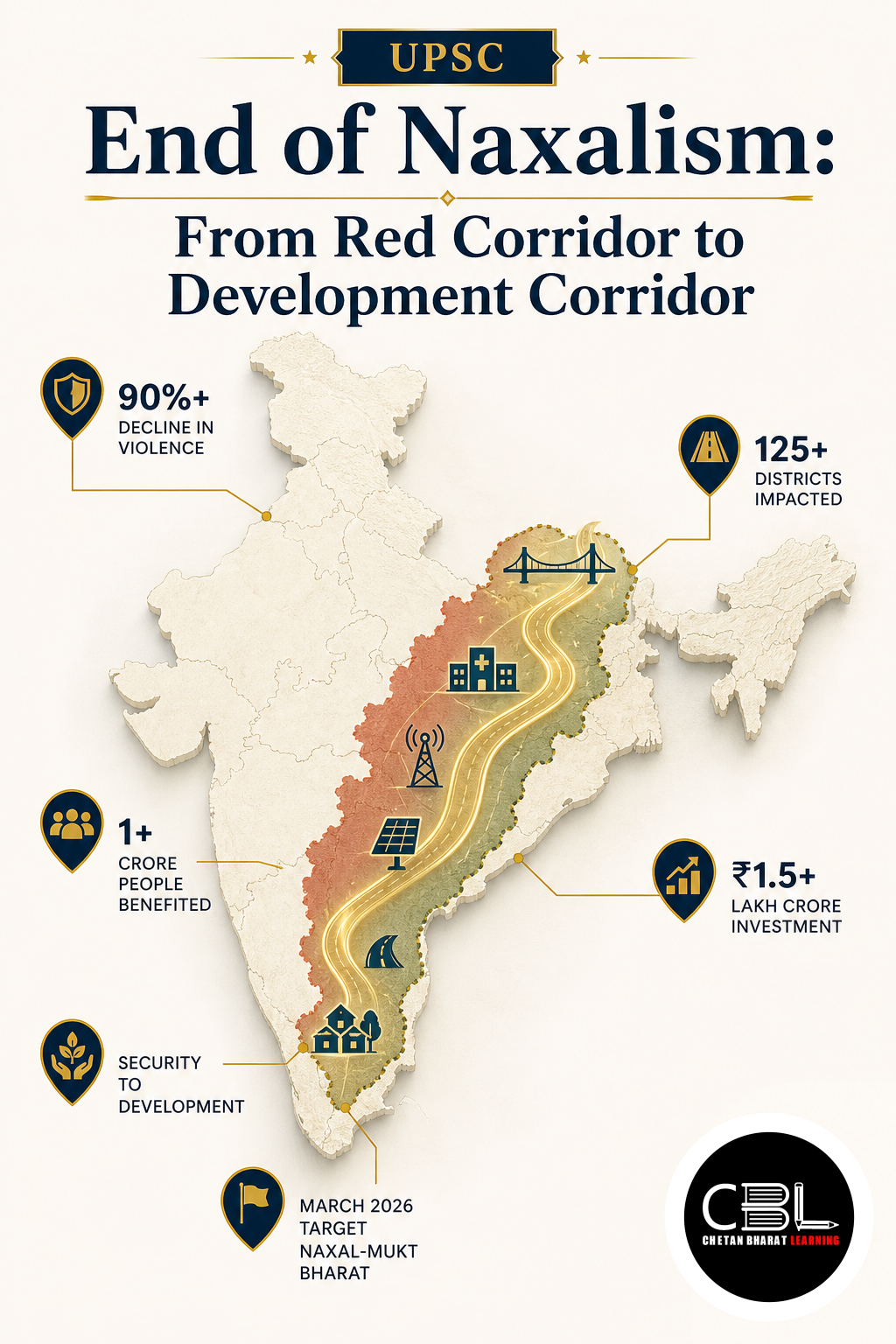
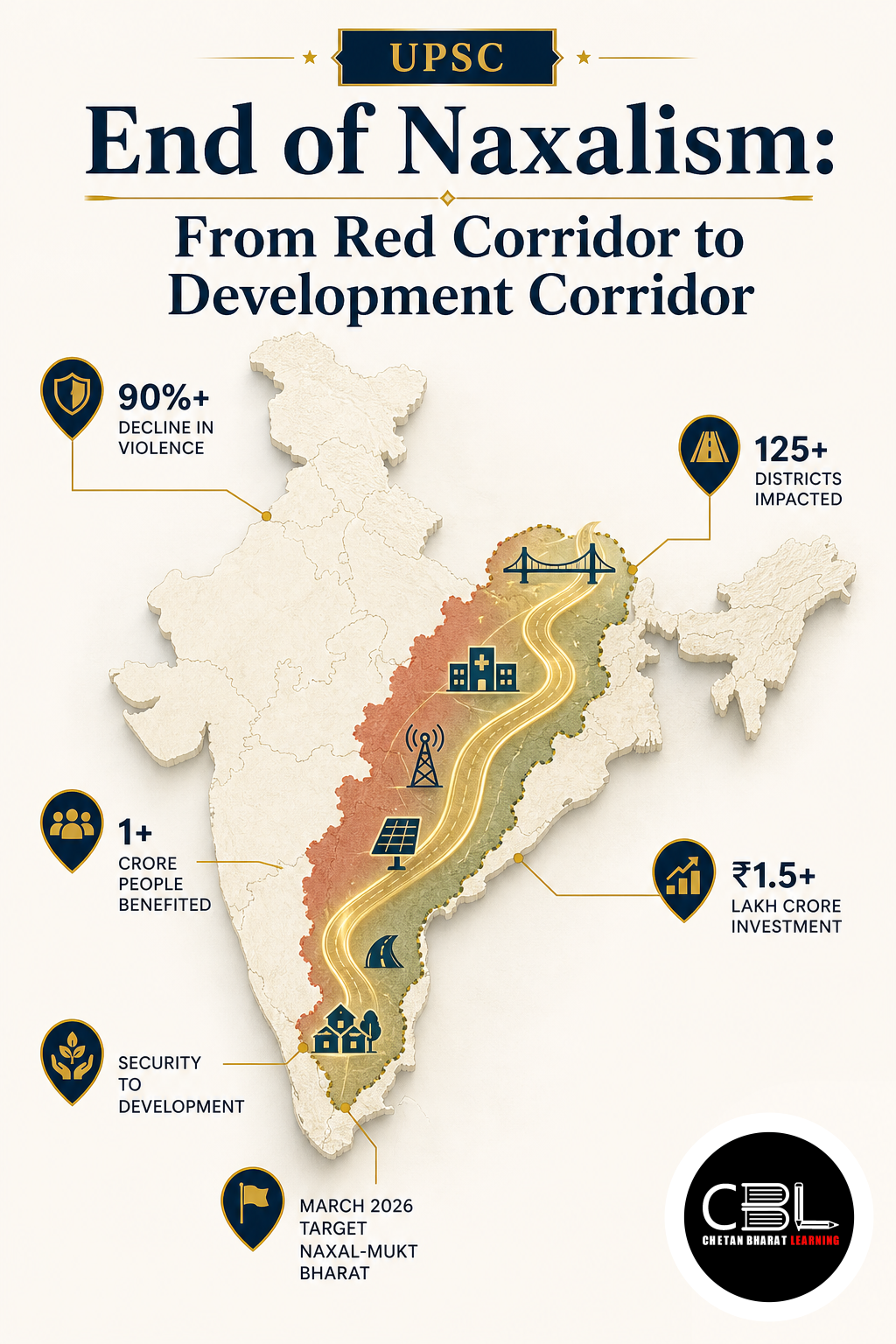
End of Naxalism was declared by the Centre on March 31, 2026, marking a significant milestone in India’s internal security. The government’s approach combined intelligence-led operations, coordination between central and state forces, disruption of Maoist financing, rehabilitation, and infrastructure development. However, the question now is what replaces the Red Corridor. For more such security updates, explore the security archive.
| Declaration Date | 31 March 2026 |
|---|---|
| Security Camps | 408 new camps |
| Roads Constructed | 12,000 km+ |
What is the End of Naxalism?
The End of Naxalism refers to the government’s declaration that Left Wing Extremism (LWE) has been effectively dismantled. The campaign involved intelligence-led operations, the deployment of specialised CoBRA units, and operations like Black Forest, Octopus, Double Bull, and Chakrabandha. The security grid was expanded with 408 new security camps and 597 fortified police stations established in LWE-affected areas.
Infrastructure development has been central: over 12,000 km of roads, 1,804 bank branches, 1,321 ATMs, and 6,025 post offices were added. Mobile connectivity and Eklavya Model Residential Schools have expanded. The challenge now is to ensure these gains are converted into sustained economic activity and institutional presence.
Why is the End of Naxalism in News?
The End of Naxalism is in the news because it marks a significant security achievement, but the focus has shifted to the next phase: development. The question is whether the former Red Corridor will become a genuine development corridor.
Home Minister Amit Shah’s repeated visits to Bastar and security review meetings highlight the government’s commitment. However, sustaining peace requires ensuring that infrastructure generates economic activity, better education, and greater integration with the rest of India. For more details, refer to this PIB release.
Key Features of End of Naxalism
- Security Operations: Intelligence-led operations, CoBRA units, and central-state coordination.
- Infrastructure Push: Over 12,000 km of roads, 597 fortified police stations, 408 new security camps.
- Financial Inclusion: 1,804 bank branches, 1,321 ATMs, 6,025 post offices.
- Rehabilitation: Surrender policies with financial assistance and reintegration support.
- Development Focus: Eklavya schools, ITIs, skill development centres, and mobile connectivity.
Challenges in End of Naxalism
- Sustaining Peace: Preventing resurgence of extremist activities requires continued vigilance.
- Economic Development: Infrastructure must generate sustained economic activity and employment.
- Institutional Presence: Ensuring that state institutions function effectively in these regions.
- Rehabilitation: Former cadres need long-term support for reintegration.
- Centre-State Coordination: Continued cooperation between the Centre and states is essential.
Way Forward for End of Naxalism
To ensure that the End of Naxalism leads to durable peace, the government should focus on a comprehensive development strategy that includes livelihoods, education, and healthcare. Public-private partnerships can accelerate infrastructure and industry development.
Strengthening local governance and ensuring the delivery of welfare schemes is essential. Monitoring and evaluation of development outcomes, with community participation, can build trust. The former Red Corridor must be transformed into a corridor of opportunity. For international best practices, refer to the UNDP.
Prelims Practice Corner
- Q1. When was India declared free from Naxalism?
- (a) 31 March 2025
- (b) 31 March 2026
- (c) 15 August 2026
- (d) 1 January 2026
- Answer: (b) The declaration was made on 31 March 2026.
- Q2. How many new security camps were established in LWE-affected areas since 2014?
- (a) 200
- (b) 408
- (c) 597
- (d) 1,804
- Answer: (b) 408 new security camps were established.
- Q3. How many kilometres of roads were constructed in LWE-affected areas?
- (a) 5,000 km
- (b) 10,000 km
- (c) 12,000 km+
- (d) 15,000 km+
- Answer: (c) Over 12,000 km of roads were constructed.
- Q4. Which specialised force was deployed in anti-Naxal operations?
- (a) NSG
- (b) CoBRA
- (c) RAF
- (d) CISF
- Answer: (b) CoBRA units of the CRPF were deployed.
- Q5. What is the main challenge after the end of Naxalism?
- (a) Preventing new insurgencies
- (b) Converting security gains into development
- (c) Reducing military expenditure
- (d) None of the above
- Answer: (b) The challenge is to ensure sustainable development and institutional presence.
Mains Practice Questions
- Q1. Discuss the government’s strategy to end Naxalism in India and the challenges in transitioning from a security-led approach to a development-led approach. (250 words, 15 marks)
- Answer Structure:
- Intro: Introduce the end of Naxalism and the government’s declaration.
- Body: Discuss security measures, infrastructure development, and rehabilitation. Analyse the challenge of converting security gains into lasting development and institutional presence.
- Conclusion: Emphasise the need for a comprehensive development strategy.
- Answer Structure:
- Q2. What are the root causes of Left Wing Extremism in India, and how can development address them? (150 words, 10 marks)
- Answer Structure:
- Intro: Identify root causes: land alienation, poverty, lack of governance, social exclusion.
- Body: Explain how development—roads, banks, schools, healthcare—can address grievances by providing state presence and economic opportunities.
- Conclusion: Conclude that sustainable peace requires inclusive development.
- Answer Structure:
FAQs on End of Naxalism
- When was India declared free from Naxalism?
- The government declared India free from Naxalism on 31 March 2026.
- What was the government’s strategy to end Naxalism?
- Intelligence-led operations, security grid expansion, infrastructure development, rehabilitation, and centre-state coordination.
- What is the Red Corridor?
- It is the region of India historically affected by Left Wing Extremism, spanning parts of Central and Eastern India.
Related Current Affairs
Preparing for UPSC, PCS or HCS?
Talk to a mentor at Chetan Bharat Learning, Chandigarh. Free guidance on choosing the right exam and building a study plan.
Chat on WhatsAppCall 97793 53345UPSC / IAS / PCS coaching in Chandigarh · Trusted by aspirants across Punjab & Haryana
Leave a Reply
You must be logged in to post a comment.