
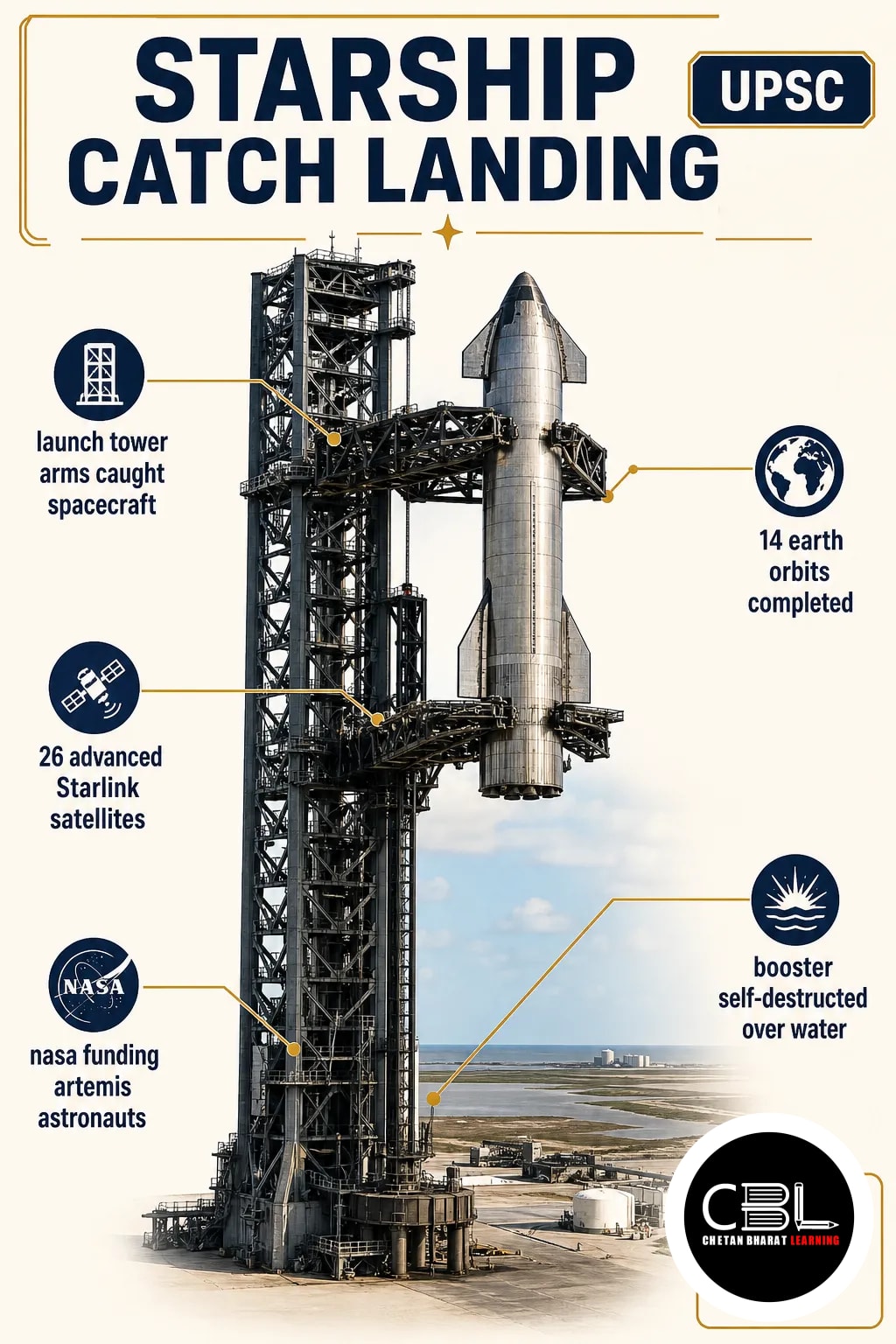
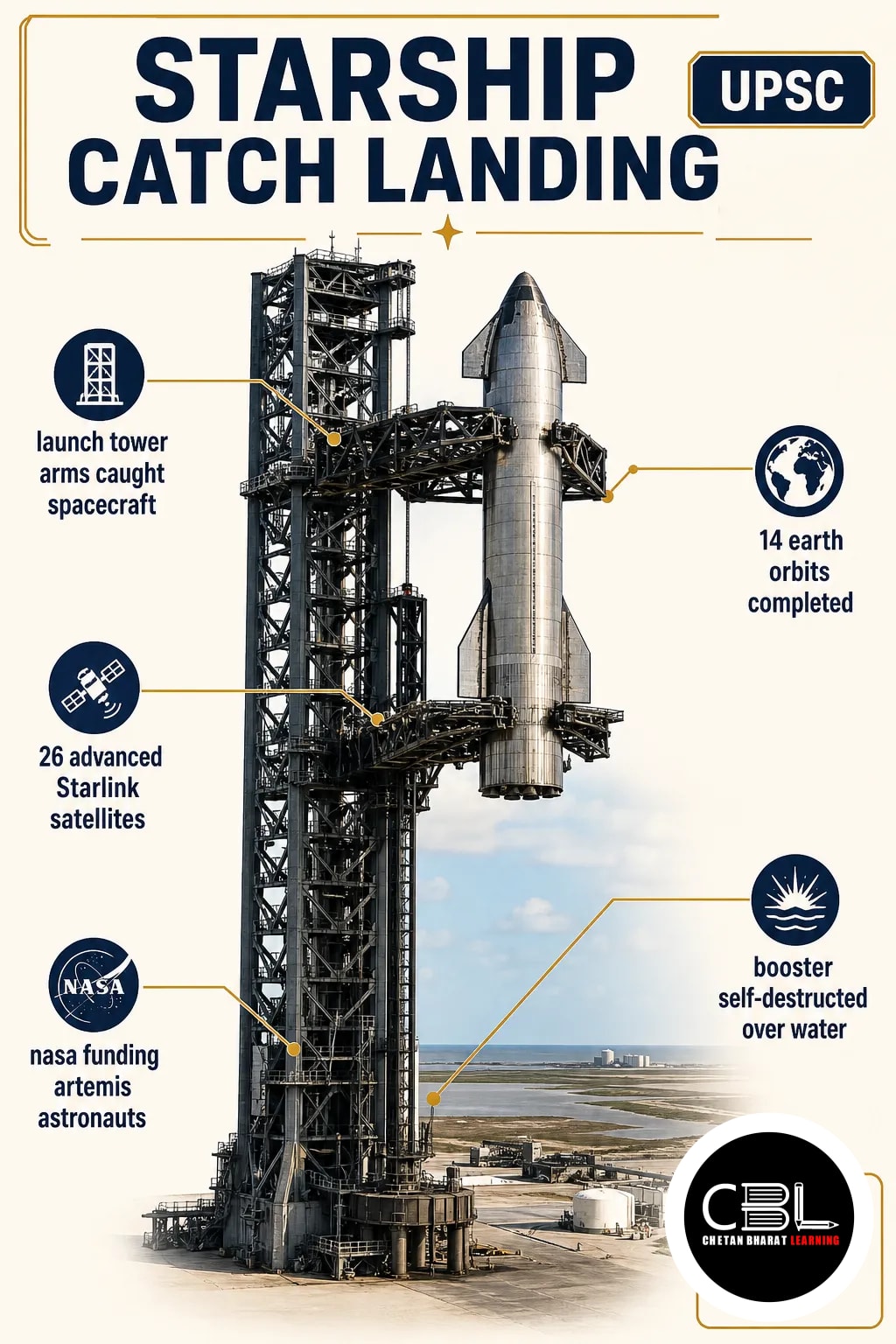
Starship catch landing made spaceflight history on 14 November 2026, when SpaceX captured its returning spacecraft at its Texas launch site. The test adds a new milestone to space technology developments relevant to UPSC.
Quick answer: The Starship catch landing took place at Starbase, Texas, on 14 November 2026. SpaceX used launch tower arms to capture the upper-stage spacecraft after 14 Earth orbits and roughly 22 hours of flight. However, the first-stage booster self-destructed during its return, preventing the planned double catch.
What happened during the Starship catch landing?
SpaceX caught the upper-stage spacecraft with mechanical arms as it descended upright towards its launch pad. The vehicle had lifted off from Starbase near the United States–Mexico border about 22 hours earlier.
First, the spacecraft separated from the booster and entered orbit. It then released 26 advanced Starlink satellites and circled Earth 14 times at about 265 kilometres altitude.
After its return from orbit, the tower arms secured the spacecraft in midair. This was the first capture of a Starship spacecraft returning from space. For background, see CBL’s earlier overview of the Starship system.
Starship test flight: Key facts
The test combined satellite deployment, orbital flight and an upper-stage recovery attempt.
| Feature | Fact |
|---|---|
| Launch site | Starbase, Texas |
| Rocket height | 407 feet or 124 metres |
| Flight duration | About 22 hours |
| Orbital flight | 14 Earth orbits at about 265 kilometres |
| Payload | 26 advanced Starlink satellites |
| Test record | 15th full-scale Starship flight since 2023; second orbital trip |
In contrast, the preceding mission completed only one to two orbits. SpaceX also said the spacecraft’s heat shield performed well during the test.
Why did the booster recovery fail?
The booster’s engines stopped firing too soon during its descent, according to SpaceX. Its guidance system detected an incorrect position and automatically initiated a diversion over water and self-destruction.
Consequently, wreckage remained in the Gulf of Mexico, while the upper stage completed its return. SpaceX had previously caught three boosters, but this flight did not achieve its intended double catch. Engineers are investigating the cause.
The distinction matters: the booster provides initial propulsion, whereas the upper-stage spacecraft continued into orbit. Both stages formed part of the recovery plan, but only the spacecraft was caught on this flight.
Why does the catch matter?
The catch tests a recovery method central to SpaceX’s goal of reusing Starship components. SpaceX officials described the result as demonstrating full reusability; however, the booster was lost on this flight.
The National Aeronautics and Space Administration (NASA) is funding Starship to land Artemis astronauts on the Moon. The spacecraft is also intended for Mars travel. For the wider context, read about reusable rocket recovery.
Meanwhile, SpaceX expects Starship launches from Florida’s Kennedy Space Center within the next few months. NASA targets Artemis IV for a lunar landing as soon as 2028; this remains a target, not an accomplished mission.
Source: The Hindu, 15 November 2026
- Reusable Rockets: China’s Zhuque-3 Recovery and Global Race (21 Aug 2026)
- Starship (21 Apr 2023)
Punjab PCS and Haryana HCS may test this event under science and technology in General Studies. In particular, distinguish the recovered spacecraft from the lost booster and revise the purpose of reusable launch systems.
Prelims Practice Corner
Mains Practice Questions
Frequently Asked Questions
Where did the Starship catch landing take place?
It took place at Starbase in Texas on 14 November 2026. There, launch tower arms caught the returning spacecraft in midair.
Was the Starship booster also caught?
No, because the booster self-destructed after diverting over water. Consequently, SpaceX did not achieve its planned double catch.
How is Starship connected to Artemis?
NASA is funding Starship to land Artemis astronauts on the Moon. However, the November 2026 test was not an Artemis lunar landing.
Related Current Affairs
Preparing for UPSC, PCS or HCS?
Talk to a mentor at Chetan Bharat Learning, Chandigarh. Free guidance on choosing the right exam and building a study plan.
Chat on WhatsAppCall 97793 53345UPSC / IAS / PCS coaching in Chandigarh · Trusted by aspirants across Punjab & Haryana









Leave a Reply
You must be logged in to post a comment.