
Lithium battery recycling faces a policy test after India prohibited exports of battery black mass. The decision connects waste management with critical mineral security and environment current affairs.
Quick answer: On 10 November 2026, India’s Directorate General of Foreign Trade prohibited exports of lithium-ion battery black mass. The Commerce Ministry expects the ban to supply domestic refiners and attract investment. However, effective lithium battery recycling also needs collection, chemical processing capacity and incentives that reward actual material recovery.
What is the recycling policy issue?
India must turn battery waste into usable materials, not merely retain an intermediate product within its borders. Lithium-ion batteries power devices and electric vehicles (EVs); their growth makes end-of-life management a resource and environmental issue.
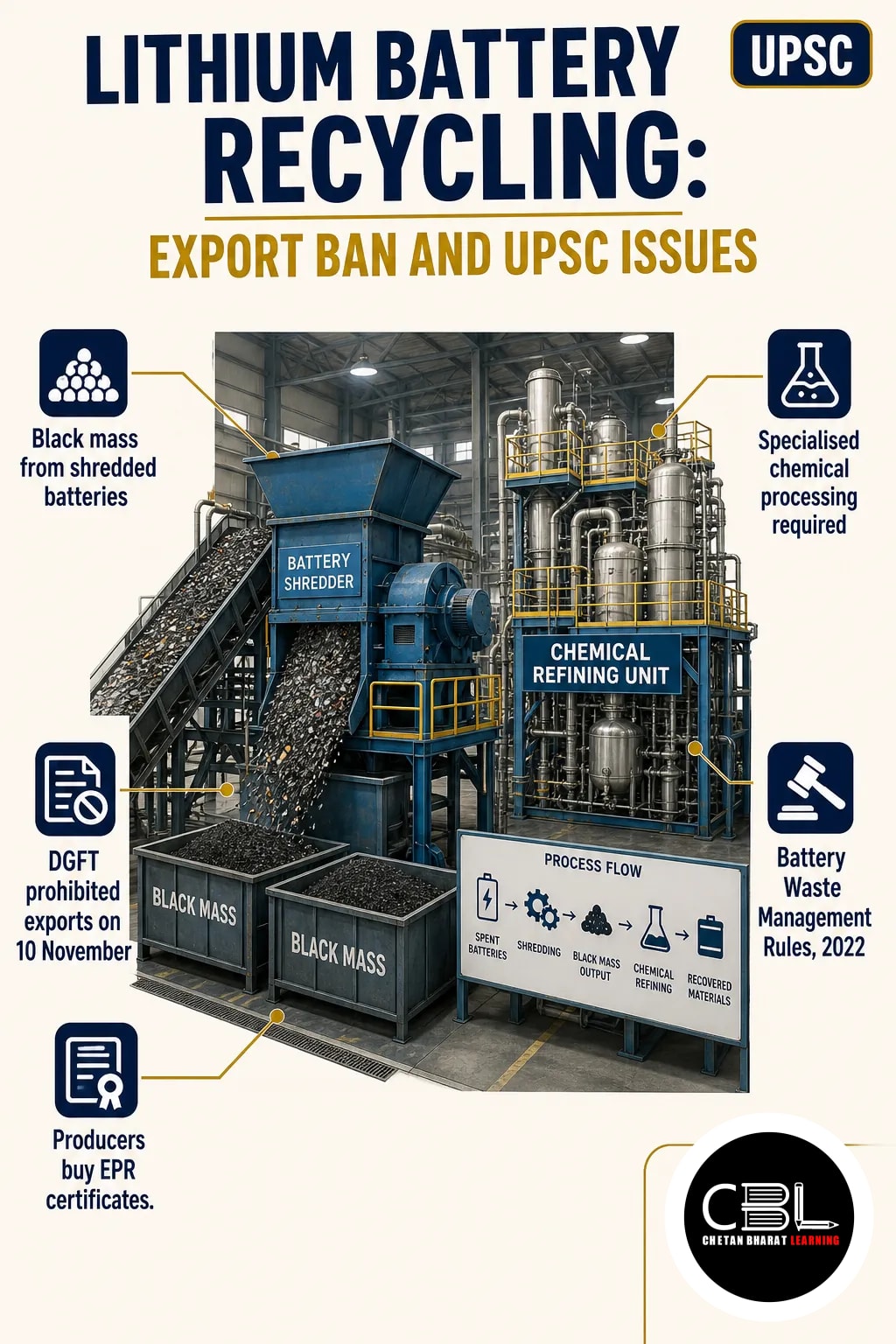
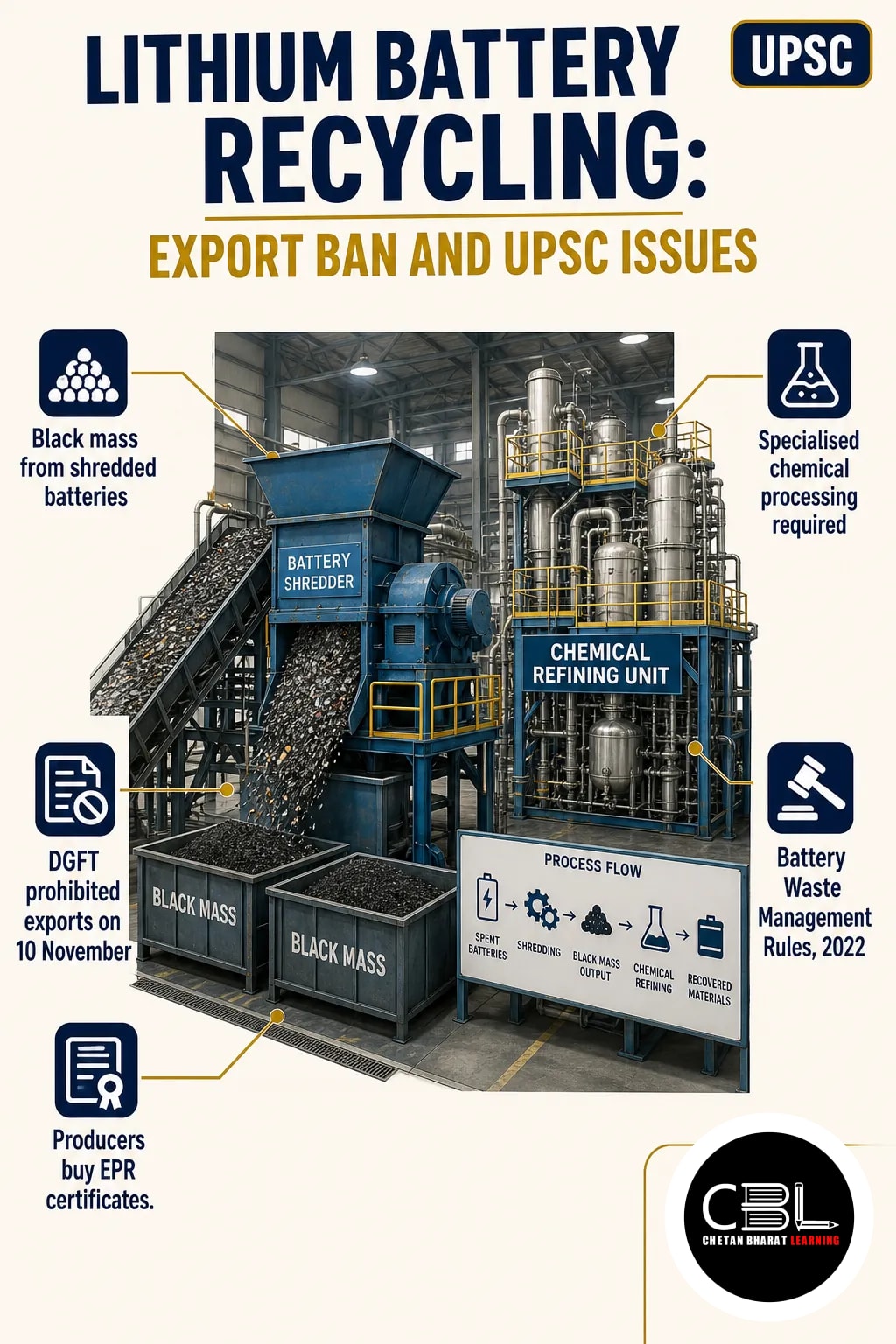
Black mass results from shredding spent batteries and factory scrap. It contains lithium, nickel, cobalt, manganese and graphite. However, producing black mass is largely mechanical; recovering usable materials from it requires specialised chemical processing.
The stages below show why an export restriction alone cannot complete lithium battery recycling.
| Stage | Role in the chain |
|---|---|
| Collection | Directs spent batteries and factory scrap towards recycling. |
| Shredding | Produces black mass through a largely mechanical process. |
| Downstream refining | Uses specialised chemical processes to recover materials. |
| Manufacturing | Can use the output of domestic downstream units as battery inputs. |
Why is the export ban in the news?
The Directorate General of Foreign Trade moved black mass from the free to the prohibited export list on 10 November 2026. The Commerce Ministry expects the measure to ensure feedstock for domestic refiners, improve capacity utilisation and draw investment.
However, lithium-ion recycling remains an emerging segment with only a few dozen licensed operators, according to the editorial. By contrast, India has an established and formalised end-to-end lead-acid battery recycling ecosystem. For the policy decision itself, see CBL’s black mass export ban explainer.
What are the arguments for the ban?
The ban seeks to keep a valuable intermediate material available for domestic processing.
- Feedstock security: Domestic refiners can potentially access black mass that would otherwise leave India.
- Industrial investment: A more secure local supply may encourage investors to build chemical refining capacity.
- Import resilience: Recovered materials could supplement supplies in a country heavily dependent on imports of critical battery minerals.
- Manufacturing linkages: If downstream units operate successfully, their output can feed indigenous battery manufacturing.
Nevertheless, domestic supply does not guarantee commercial recovery. The wider challenge is discussed in CBL’s analysis of critical mineral supply chains.
What are the concerns and trade-offs?
The main concern is that retaining black mass will not automatically create buyers or refining plants.
- Downstream investment: Chemical processing needs more specialised facilities and larger investment than mechanical shredding. Therefore, supply retention must be matched by processing capacity.
- Landfill risk: If black mass has no market, the editorial warns that batteries could end up in landfills. Thus, the policy needs a viable route from collection to recovery.
- Certificate pricing: Under the Battery Waste Management Rules, 2022, producers buy extended producer responsibility (EPR) certificates from recyclers. The editorial argues that undervalued certificates can favour compliance on paper over investment in high-yield recovery.
- Industry economics: A floor price could improve recovery incentives; however, policymakers would also need to consider its effect on producers’ costs.
EPR assigns producers responsibility for managing products after use. In this case, certificate design matters because a recycling market must reward recovery rather than only documented compliance. Moreover, India’s electric mobility transition makes battery end-of-life planning important alongside vehicle adoption.
A related gap: rare earths in electronic waste
Electronic waste presents a separate recovery challenge because valuable rare earth magnets can be missed during processing. For example, a smartphone can contain a neodymium-iron-boron magnet of up to 1% of its weight; the editorial estimates its rare earth content at about 3,000 parts per million.
Moreover, a magnet separated from a phone is about 30% rare earth. Magnets can make up as much as 3% of a hard drive, but must be removed before shredding for data destruction to remain usable. The editorial notes that e-waste rules do not require rare earth separation.
What should the way forward include?
A viable ecosystem must connect collection, refining, verified recovery and demand for recycled materials.
- Support downstream capacity: Policy support should address the higher investment needs of specialised chemical processing, not only shredding.
- Improve EPR incentives: The editorial proposes a certificate floor price covering full recovery costs. However, its design should balance investment incentives with compliance costs.
- Track actual recovery: Digital tracking can help connect collected waste, processing and certificates. Consequently, verification can make paper-only compliance harder.
- Build market linkages: Recyclers and battery manufacturers need dependable channels for recovered inputs. In addition, collection systems must direct spent batteries to appropriate processors.
- Recognise rare earths separately: The editorial proposes a separate EPR category because payment by weight alone does not suit these minerals. Pre-shredding magnet separation would also preserve a recovery opportunity.
Useful for Essay and GS IV: Resource stewardship means designing accountability for a product’s entire life, not just its sale.
Source: The Hindu, 15 November 2026
Asked in UPSC: Previous Year Questions
- UPSC CSE Prelims 2025 (GS Paper I): Which statements are correct: India joined the Minerals Security Partnership; it is resource-rich in all 30 identified critical minerals; and the 2023 mining law amendment empowered exclusive central auctions for certain critical minerals?
UPSC links critical minerals to supply security, international partnerships and mining law.
Punjab PCS and Haryana HCS can test battery waste rules alongside state-level waste management and environmental governance. In addition, candidates should connect collection and safe processing with the circular economy.
Prelims Practice Corner
Mains Practice Questions
Frequently Asked Questions
What is battery black mass?
Black mass is an intermediate product from shredded spent batteries and factory scrap. It contains valuable materials, including lithium and cobalt, but needs further processing.
Why did India prohibit black mass exports?
India prohibited exports to retain feedstock for domestic refiners. The Commerce Ministry also expects better capacity utilisation and investment.
What is EPR in battery waste management?
Extended producer responsibility assigns producers responsibility for managing products after use. Under the 2022 battery waste rules, producers buy EPR certificates from recyclers.
Does the export ban guarantee battery material recovery?
No, because retaining black mass does not itself create chemical refining capacity or a market. Effective recovery also requires investment, collection and suitable incentives.
Related Current Affairs
Preparing for UPSC, PCS or HCS?
Talk to a mentor at Chetan Bharat Learning, Chandigarh. Free guidance on choosing the right exam and building a study plan.
Chat on WhatsAppCall 97793 53345UPSC / IAS / PCS coaching in Chandigarh · Trusted by aspirants across Punjab & Haryana









Leave a Reply
You must be logged in to post a comment.