

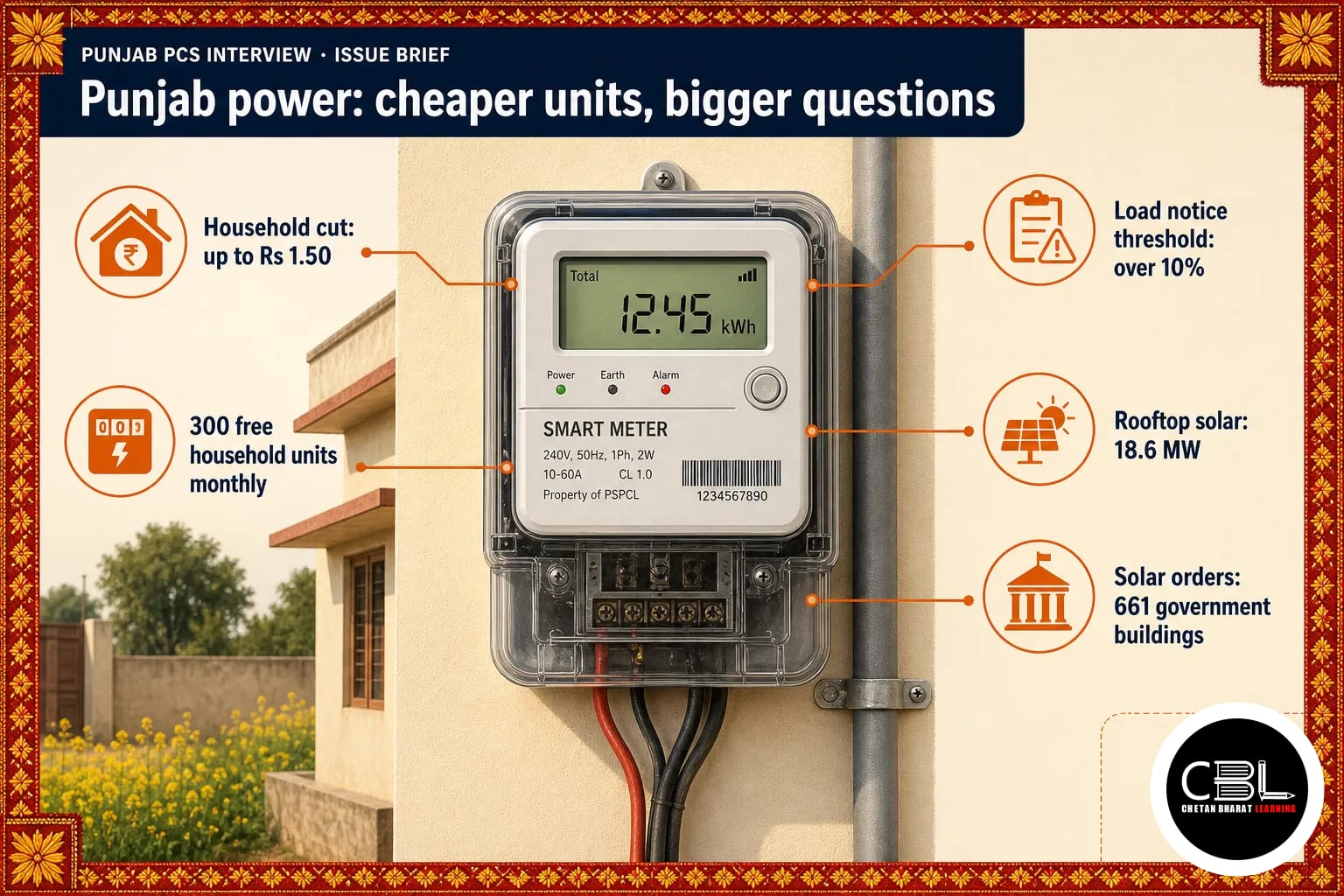
On 6 March 2026, Punjab cut electricity tariffs by up to Rs 1.50 per unit for households, with smaller cuts for commercial and industrial users. The existing provision of 300 free household units a month continued. Unions had protested in February against the Electricity Amendment Bill and smart meters. By June, rooftop solar work orders added another dimension to the debate: affordability, distribution reform and the cost of cleaner power.
Timeline: from reform to rooftop solar
- 2003national lawFramework
The Electricity Act, 2003 provides a framework for electricity regulation.
- 2024generationPlant purchase
Punjab bought the Goindwal plant, linked with Pachhwara coal.
- Feb2026Protests
Unions protested against the Electricity Amendment Bill and chip-based smart meters.
- 6 Mar2026Tariff cut
Household tariffs fell by up to Rs 1.50 per unit.
- May2026Load notices
Consumers exceeding sanctioned load by over 10% receive notices under the amended supply code.
- Jun2026Solar orders
Work orders covered 18.6 MW of rooftop solar on 661 government buildings.
How is Punjab’s electricity system governed?
The Punjab State Electricity Regulatory Commission (PSERC) fixes tariffs. Punjab State Power Corporation Limited (PSPCL) is the state-owned generator and distributor. Electricity is a concurrent subject under Entry 38 of the Constitution’s Concurrent List.
A tariff is the price charged for electricity; a subsidy helps support affordable supply. Smart meters electronically record consumption. Their introduction raises questions about billing, consumer service and data protection.
The two sides
Affordability and modernisation
- Lower tariffs reduce the price of electricity for households and other users.
- Smart meters can support more frequent consumption information and billing.
- Rooftop solar can diversify supply and use government buildings productively.
Employee and public concerns
- Unions protested against the Electricity Amendment Bill and chip-based smart meters.
- Subsidies have a fiscal cost that must be considered alongside affordability.
- Meter changes require attention to billing disputes, privacy and consumer access.
Key data
| Point | Details |
|---|---|
| Household tariff | Cut by up to Rs 1.50 per unit; 300 free units a month continued. |
| Other tariff cuts | Commercial users: 79 paise; industry: 74 paise per unit. |
| Electric vehicle charging | Charging stations were set at Rs 5 per unit. |
| Power subsidy | About Rs 15,550 crore in 2026–27. |
| Sanctioned load | Under PSPCL’s amended Supply Code-2024, notices apply when load exceeds the sanctioned limit by over 10%. |
| Government rooftop solar | Work orders for 18.6 MW across 661 buildings; three lakh solar street lights were planned. |
| Constitutional position | Electricity is in Entry 38, List III, the Concurrent List. |
Way forward
- Transparent tariffs: Explain tariff changes and subsidy costs in accessible bills and public reports.
- Consumer safeguards: Provide meter testing, prompt complaint resolution and clear privacy protections.
- Employee consultation: Discuss proposed reforms with unions and plan training for technological changes.
- Fiscal discipline: Review subsidy spending alongside service quality and the needs of vulnerable consumers.
- Clean supply: Monitor rooftop solar delivery and maintain the installations after commissioning.
Likely interview questions
What changed in Punjab’s electricity tariffs in March 2026?
Answer pointers:
- Household tariffs were cut by up to Rs 1.50 per unit; 300 free units a month continued.
- Commercial and industrial cuts were 79 paise and 74 paise per unit respectively.
- Connect lower prices with transparent subsidy accounting.
Do you think electricity tariff cuts are a sound policy?
Answer pointers:
- They can ease electricity costs for consumers and businesses.
- Subsidy costs and the quality of supply also matter.
- Assess affordability and fiscal sustainability together.
Do you think smart meters should be introduced despite union protests?
Answer pointers:
- They can improve access to consumption information.
- Employee concerns, privacy and billing disputes deserve attention.
- Consult stakeholders and establish accessible safeguards.
As Sub-Divisional Magistrate in Patiala, how would you respond to complaints about smart-meter bills?
Answer pointers:
- Listen to consumers and document disputed bills.
- Coordinate with PSPCL for meter checks and timely complaint handling.
- Communicate the process clearly and review recurring problems.
How does electricity as a concurrent subject affect reform in Punjab?
Answer pointers:
- Entry 38 places electricity in the Concurrent List.
- Both Union and state legislative roles matter; tariff regulation also involves PSERC.
- Favour coordination, lawful implementation and consumer consultation.
Separate the tariff decision, union protests and solar measures. Discuss affordability and fiscal responsibility without assuming that every reform concern has the same cause.
Prelims Practice Corner
Q1. What was the maximum household tariff cut announced in March 2026?
(a) 74 paise per unit (b) 79 paise per unit (c) Rs 1.50 per unit (d) Rs 5 per unit
Show answer
Answer: (c) because household tariffs were cut by up to Rs 1.50 per unit.
Q2. Electricity appears in which constitutional list?
(a) Union List (b) State List (c) Concurrent List (d) None of these
Show answer
Answer: (c) because electricity is covered by Entry 38 of the Concurrent List.
Q3. The June 2026 rooftop solar work orders covered how many government buildings?
(a) 300 (b) 661 (c) 1,500 (d) 3,000
Show answer
Answer: (b) because the work orders covered 661 government buildings.
Frequently Asked Questions
How much was Punjab’s household electricity tariff cut in 2026?
The cut was up to Rs 1.50 per unit. The provision of 300 free household units a month continued.
Why were smart meters discussed in Punjab in 2026?
Unions protested against chip-based smart meters in February 2026. They also protested against the Electricity Amendment Bill.
Who fixes electricity tariffs in Punjab?
PSERC fixes electricity tariffs in Punjab. PSPCL is the state-owned generator and distributor.
Sources: GKToday: March 2026, GKToday: May 2026, GKToday: June 2026
Related Current Affairs
More Punjab interview issues
Preparing for UPSC, PCS or HCS?
Talk to a mentor at Chetan Bharat Learning, Chandigarh. Free guidance on choosing the right exam and building a study plan.
Chat on WhatsAppCall 97793 53345UPSC / IAS / PCS coaching in Chandigarh · Trusted by aspirants across Punjab & Haryana


Leave a Reply
You must be logged in to post a comment.