

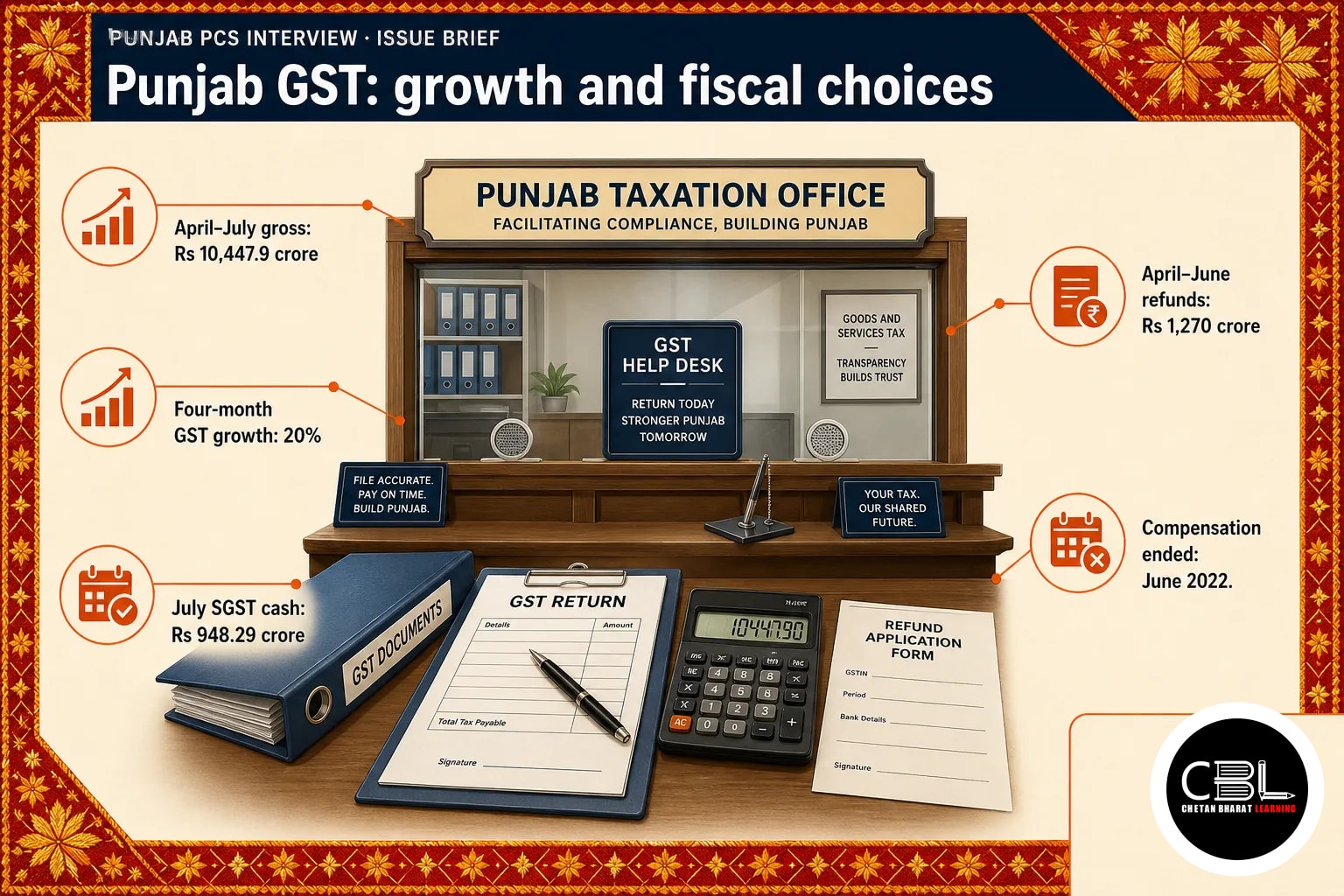
Punjab’s Goods and Services Tax (GST) collections reached Rs 10,447.9 crore in April–July 2026, up 20% year on year. The Finance Minister credited compliance, technology and enforcement. July state GST cash receipts were Rs 948.29 crore, while April–June refunds totalled Rs 1,270 crore. The figures show stronger collections, but gross GST is not the same as the state’s final revenue. Fiscal pressures remain after GST compensation ended in 2022.
Timeline: from GST to growth
- 2016ConstitutionFramework
The 101st Constitutional Amendment provided the framework for GST.
- June2022Compensation
GST compensation to states ended in 2022.
- Apr–June2026Acceleration
Punjab’s GST collections reached Rs 7,833.45 crore, up 24.45% year on year.
- July2026Growth
April–July gross GST reached Rs 10,447.9 crore, up 20% year on year.
What is GST and why does it matter to Punjab?
GST is a destination-based tax on the supply of goods and services. Its components include Central GST (CGST), State GST (SGST) and Integrated GST (IGST). The GST Council, under Article 279A, makes recommendations on GST matters.
Punjab is a consuming and agrarian state with a narrow tax base and high debt. GST compensation to states ended in June 2022, making sustainable revenue important for state finances. Gross collections should be distinguished from the state’s final revenue after relevant refunds and settlements.
The two sides
Punjab government’s position
- Collections grew year on year in April–July 2026.
- Finance Minister Harpal Singh Cheema credited better compliance, technology-based administration and enforcement.
- Higher collections can help support public spending.
Fiscal concerns
- Gross collections do not equal the state’s final revenue.
- Refund obligations must be considered alongside collections.
- A narrow tax base and high debt make sustained revenue important.
Key data
| Point | Details |
|---|---|
| April–June 2026 GST | Rs 7,833.45 crore; up 24.45% year on year |
| April–June refunds | Rs 1,270 crore issued, including Rs 713.70 crore as SGST |
| April–July gross GST | Rs 10,447.9 crore, against Rs 8,708.48 crore a year earlier; up 20% |
| July gross GST | Rs 2,614.45 crore; up 8.31% year on year |
| July SGST cash | Rs 948.29 crore; up 16.23% year on year |
| Debt context | Punjab’s debt is about Rs 4.48 lakh crore. |
| Constitutional framework | Article 279A establishes the GST Council; the 101st Constitutional Amendment was enacted in 2016. |
Way forward
- Clear reporting: Publish gross collections, refunds and state revenue separately.
- Fair compliance: Use risk-based checks while protecting taxpayers from unnecessary disruption.
- Timely refunds: Process eligible claims promptly and verify them proportionately.
- Taxpayer support: Help small businesses understand filing and payment requirements.
- Fiscal planning: Use reliable revenue projections alongside debt management and spending priorities.
Likely interview questions
What is the difference between gross GST collections and Punjab’s final revenue?
Answer pointers:
- Gross collections are not the same as the state’s final receipts.
- Consider tax components, refunds and settlements.
- Report each measure separately for sound fiscal assessment.
Do you think higher GST collections prove that Punjab’s fiscal problems are solved?
Answer pointers:
- Growth can improve the resources available for spending.
- Debt, refunds and the narrow tax base remain relevant.
- Assess sustained net revenue alongside expenditure and debt.
Do you think stronger tax enforcement is always the best way to increase revenue?
Answer pointers:
- Enforcement can deter evasion and improve fairness.
- Excessive checks may burden compliant businesses.
- Combine proportionate enforcement with taxpayer assistance.
As Sub-Divisional Magistrate in Ludhiana, how would you support GST compliance without burdening small businesses?
Answer pointers:
- Coordinate with the competent tax authorities.
- Facilitate awareness and hear business concerns.
- Encourage lawful, risk-based action and timely grievance redress.
How does Punjab’s GST growth relate to fiscal federalism and the GST Council?
Answer pointers:
- GST involves Union and state tax components.
- The Council under Article 279A recommends GST measures.
- Support cooperative decisions that balance revenue and taxpayer needs.
Distinguish gross collections from state revenue before drawing conclusions. Acknowledge growth and fiscal pressures without attributing outcomes to a party.
Prelims Practice Corner
Q1. Which constitutional article provides for the GST Council?
(a) Article 262 (b) Article 279A (c) Article 280 (d) Article 324
Show answer
Answer: (b) because Article 279A establishes the GST Council.
Q2. What was Punjab’s gross GST collection in April–July 2026?
(a) Rs 1,270 crore (b) Rs 7,833.45 crore (c) Rs 8,708.48 crore (d) Rs 10,447.9 crore
Show answer
Answer: (d) because gross GST for those four months was Rs 10,447.9 crore.
Q3. When did GST compensation to states end?
(a) June 2022 (b) June 2016 (c) July 2026 (d) April 2026
Show answer
Answer: (a) because the compensation period ended in June 2022.
Frequently Asked Questions
How much did Punjab GST collections grow in April–July 2026?
Gross GST collections grew by 20% year on year. They reached Rs 10,447.9 crore, compared with Rs 8,708.48 crore a year earlier.
How much GST refund did Punjab issue in April–June 2026?
Refunds totalled Rs 1,270 crore. Of this, Rs 713.70 crore was SGST.
Is gross GST collection the same as Punjab’s final revenue?
No. Tax components, refunds and settlements matter when assessing the state’s final revenue.
Related Current Affairs
More Punjab interview issues
Preparing for UPSC, PCS or HCS?
Talk to a mentor at Chetan Bharat Learning, Chandigarh. Free guidance on choosing the right exam and building a study plan.
Chat on WhatsAppCall 97793 53345UPSC / IAS / PCS coaching in Chandigarh · Trusted by aspirants across Punjab & Haryana


Leave a Reply
You must be logged in to post a comment.