

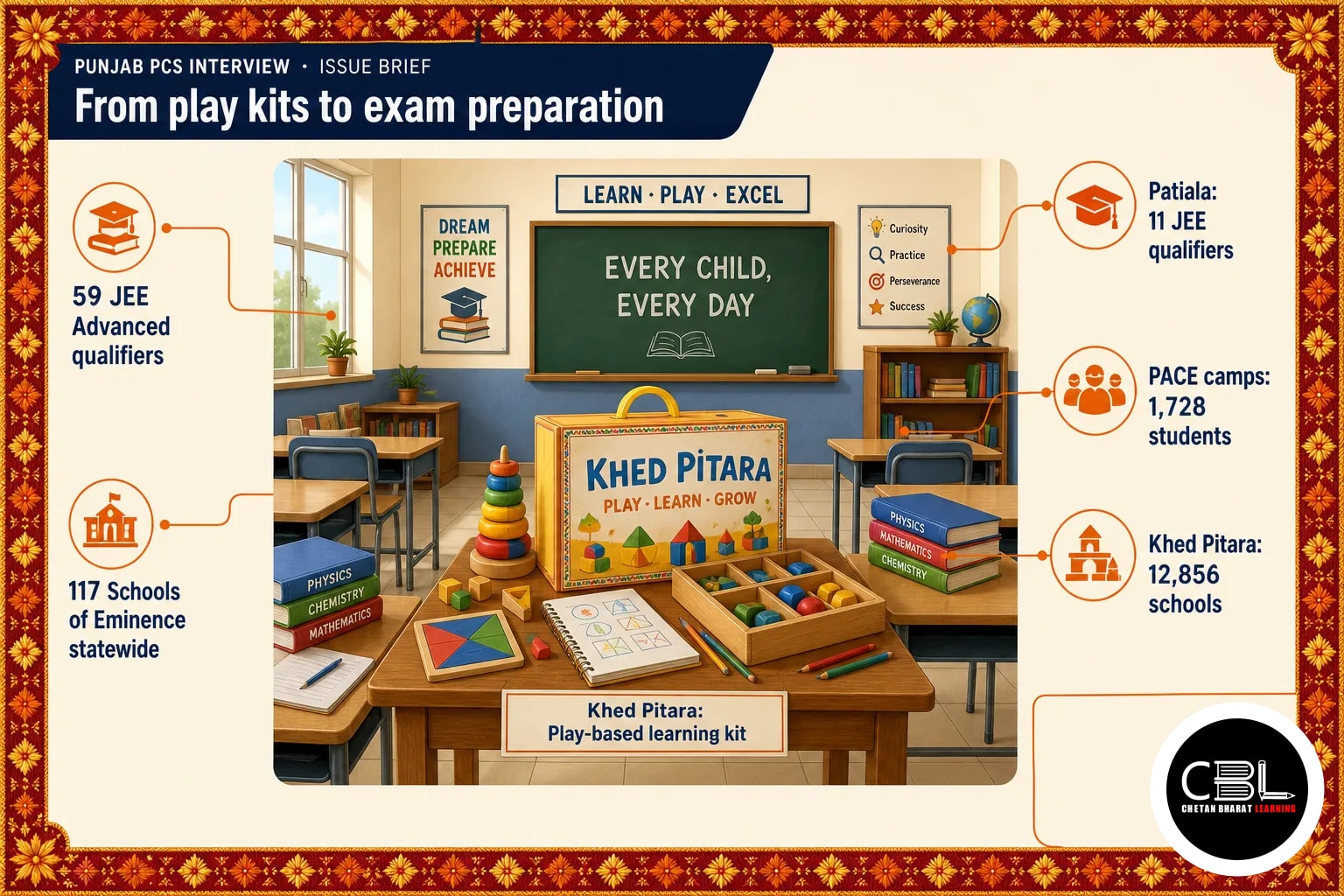
In June 2026, 59 Punjab government-school students qualified for Joint Entrance Examination (JEE) Advanced, up from 44 in 2025. Patiala led with 11. Earlier, PACE residential camps coached students for entrance tests, while Khed Pitara brought play-based kits to primary schools. The initiatives span early learning and competitive examinations. By August 2026, Punjab had 117 Schools of Eminence. The interview issue is how to assess results while ensuring equitable access and foundational learning.
Timeline: from access to opportunity
- 2009national lawRight to education
The Right to Education Act provided a legal framework for free and compulsory elementary education.
- Jan2026PACE camps
Residential camps coached 1,728 government-school students at Bathinda, Ludhiana and Sahibzada Ajit Singh Nagar.
- Mar2026Play kits
Khed Pitara kits reached 12,856 government primary schools for nursery to Class II.
- 2 Jun2026JEE result
59 government-school students qualified for JEE Advanced; Patiala accounted for 11.
- Aug2026School expansion
Two more Schools of Eminence took Ludhiana to 16; Punjab had 117 statewide.
What do these initiatives cover?
PACE winter residential camps coached government-school students for JEE and the National Eligibility cum Entrance Test (NEET). In January 2026, camps ran in Bathinda, Ludhiana and Sahibzada Ajit Singh Nagar. Twenty per cent of seats were for other government-school and drop-year students.
Khed Pitara supplies play-based learning kits for nursery to Class II. The March 2026 rollout covered about 7.5 lakh children at a cost of about Rs 9.3 crore. These measures address different stages of education and should not be judged by a single examination result.
The two sides
Case for the initiatives
- Residential coaching can give government-school students structured exam preparation.
- Play-based kits can support engagement in early learning.
- More students qualified for JEE Advanced in 2026 than in 2025.
Questions for assessment
- Qualification for JEE Advanced is not the same as admission to an engineering institution.
- Exam results alone do not measure learning across all schools and age groups.
- Access, kit use and learning outcomes need to be assessed alongside spending.
Key data
| Point | Details |
|---|---|
| JEE Advanced qualification | 59 government-school students in 2026, against 44 in 2025. |
| District results | Patiala had 11 qualifiers, followed by Sangrur with 7. |
| PACE camps | 1,728 students; 20% of seats for other government-school and drop-year students. |
| Khed Pitara | 12,856 schools; about 7.5 lakh children; about Rs 9.3 crore. |
| Schools of Eminence | 117 statewide by August 2026; 16 in Ludhiana. |
| Legal framework | The Right of Children to Free and Compulsory Education Act, 2009, covers elementary education for children aged 6 to 14. |
Way forward
- Track outcomes: Measure exam participation, qualification and subsequent admissions separately.
- Widen access: Use transparent selection and outreach so eligible students across districts can seek coaching.
- Support teachers: Provide practical guidance on using play kits in age-appropriate activities.
- Review learning: Assess foundational skills and classroom engagement alongside competitive exam outcomes.
- Monitor spending: Review delivery, use and maintenance of materials before planning further expenditure.
Likely interview questions
What are PACE camps and Khed Pitara?
Answer pointers:
- PACE camps provide residential entrance-exam coaching.
- Khed Pitara provides play-based kits for nursery to Class II.
- Assess each initiative against its distinct educational purpose.
Do you think JEE results are a sufficient measure of government-school performance?
Answer pointers:
- They show competitive examination opportunity and achievement.
- They do not capture foundational learning or outcomes for all students.
- Use a broader set of learning and access indicators.
Do you think public funds should support both entrance coaching and play-based learning?
Answer pointers:
- Both can address needs at different educational stages.
- Resources are limited and benefits must be assessed.
- Allocate funds transparently using evidence and equity.
As Deputy Commissioner of Patiala, how would you improve access to such opportunities?
Answer pointers:
- Review school-level awareness and participation with education officials.
- Ensure transparent eligibility information and outreach to underserved students.
- Monitor coaching access and classroom use of kits, then address gaps.
How would you link these initiatives to the right to education and educational equity?
Answer pointers:
- Article 21A provides for free and compulsory education for children aged 6 to 14.
- Equal access also requires attention to learning conditions and opportunity.
- Align implementation with legal duties and monitor inclusion.
Distinguish qualifying for JEE Advanced from securing admission. Recognise progress without treating one result as proof of system-wide improvement.
Prelims Practice Corner
Q1. How many Punjab government-school students qualified for JEE Advanced in 2026?
(a) 44 (b) 59 (c) 117 (d) 1,728
Show answer
Answer: (b) because 59 government-school students qualified for JEE Advanced in 2026.
Q2. Khed Pitara kits are intended for which classes?
(a) Nursery to Class II (b) Classes III to V (c) Classes VI to VIII (d) Classes XI and XII
Show answer
Answer: (a) because Khed Pitara supports play-based learning from nursery to Class II.
Q3. Which constitutional article concerns free and compulsory education for children aged 6 to 14?
(a) Article 14 (b) Article 19 (c) Article 21A (d) Article 262
Show answer
Answer: (c) because Article 21A provides for free and compulsory education for that age group.
Frequently Asked Questions
How many Punjab government-school students qualified for JEE Advanced in 2026?
59 students qualified in 2026. The corresponding figure for 2025 was 44.
Where were the PACE winter camps held in 2026?
They were held in Bathinda, Ludhiana and Sahibzada Ajit Singh Nagar. The camps coached 1,728 government-school students for JEE and NEET.
What is Khed Pitara in Punjab schools?
Khed Pitara provides play-based learning kits for nursery to Class II. The March 2026 rollout covered 12,856 government primary schools.
Sources: GKToday: June 2026, GKToday: January 2026, GKToday: March 2026, GKToday: August 2026
Related Current Affairs
More Punjab interview issues
Preparing for UPSC, PCS or HCS?
Talk to a mentor at Chetan Bharat Learning, Chandigarh. Free guidance on choosing the right exam and building a study plan.
Chat on WhatsAppCall 97793 53345UPSC / IAS / PCS coaching in Chandigarh · Trusted by aspirants across Punjab & Haryana

Leave a Reply
You must be logged in to post a comment.