
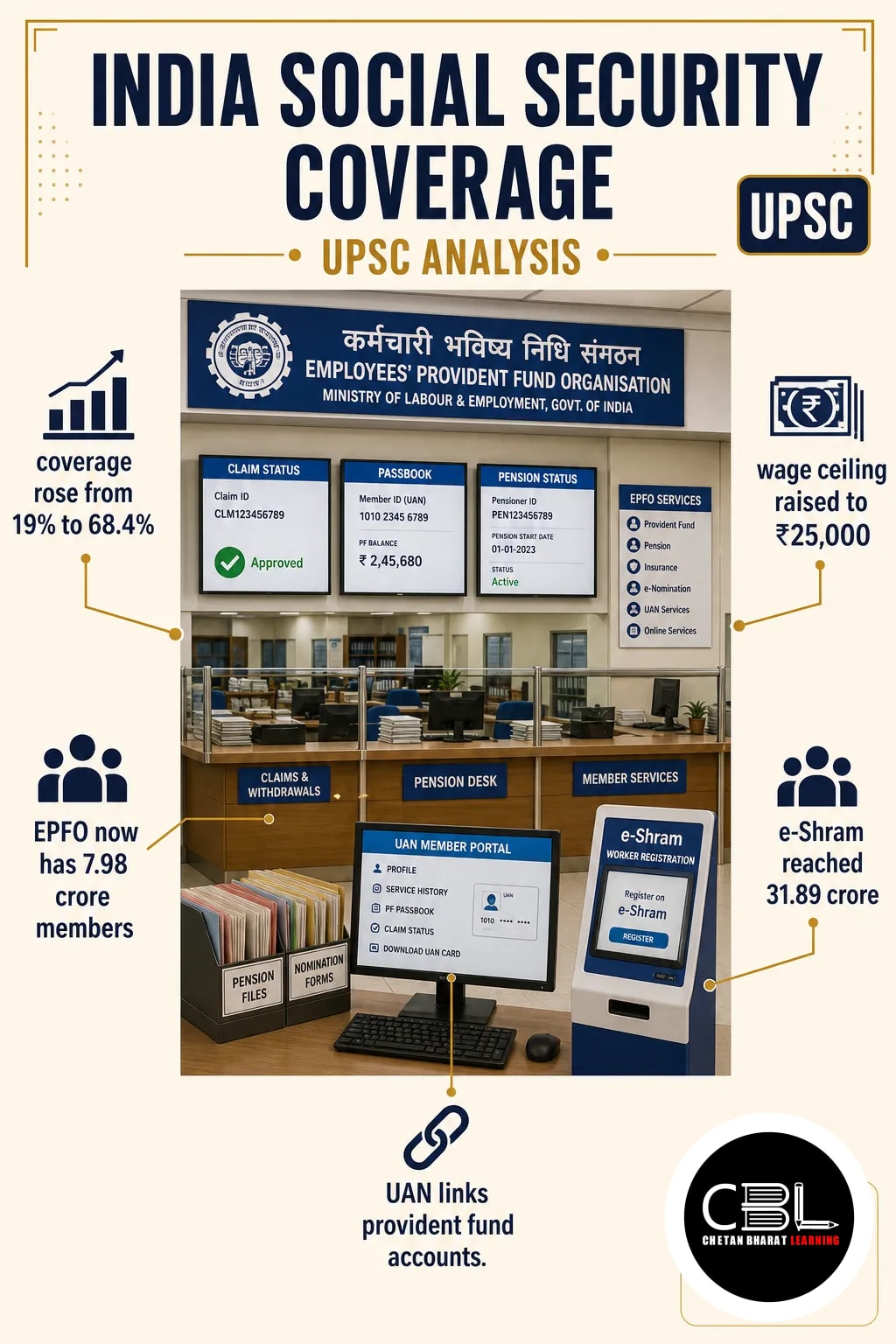
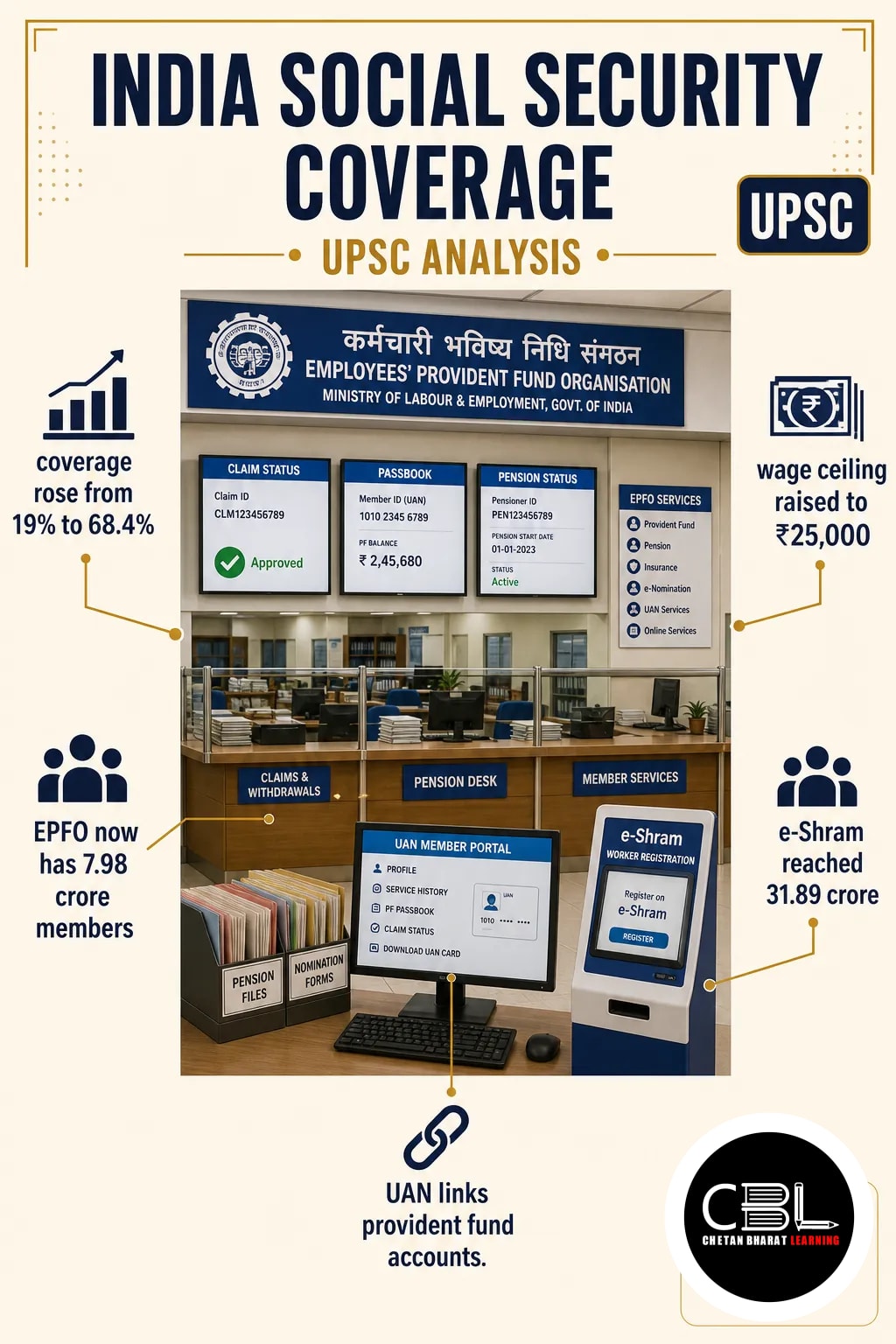
India social security coverage reached 68.4% in 2026, according to a Press Information Bureau (PIB) communication. The expansion raises questions about benefit adequacy and access, central themes in social issues for UPSC.
Quick answer: India social security coverage rose from 19% in 2015 to 68.4% in 2026, according to PIB. The government has also approved raising the mandatory Employees’ Provident Fund Organisation wage ceiling from ₹15,000 to ₹25,000 a month. The change is expected to cover over 51 lakh additional employees.
What is social security?
Social security protects people against income loss and other contingencies across their lives. It can combine contributory savings and insurance with publicly funded social assistance. For example, a pension supports income after retirement, while assistance can reach eligible vulnerable households.
For India social security coverage, the distinction between access and effective protection matters. A person may be counted as covered by one measure without receiving every form of protection. Therefore, coverage figures should be read alongside eligibility, benefit adequacy and actual delivery.
Why is social security in the news?
PIB has highlighted the expansion of coverage, Employees’ Provident Fund Organisation (EPFO) reforms and support for unorganised workers. It says more than one billion people fall within the social security framework. However, the supplied communication does not explain the methodology behind the aggregate coverage figure.
| Indicator | Figure and reference period |
|---|---|
| Overall social security coverage | 19% in 2015; 68.4% in 2026 |
| EPFO contributing members | 3.49 crore in 2014-15; about 7.98 crore on 16 September 2026 |
| EPFO pensioners | 51.04 lakh in 2014-15; about 82 lakh by September 2026 |
| EPFO claims settled | 1.30 crore in 2014-15; 6.42 crore in the one-year period up to October 2026 |
| e-Shram registrations | 31.89 crore by August 2026 |
These indicators measure different things: people covered, contributors, pensioners, claims and registrations. Consequently, they should not be added together or treated as interchangeable.
How is EPFO coverage and delivery changing?
EPFO administers provident fund savings, pension and insurance for eligible members. It is a statutory body under the Ministry of Labour and Employment. In addition, 7.68 lakh establishments were contributing to EPFO by September 2026.
- Wage ceiling: The government approved an increase from ₹15,000 to ₹25,000 per month in September 2026. PIB expects over 51 lakh additional employees to gain mandatory coverage, subject to applicable provisions.
- Partial withdrawals: EPFO consolidated 13 provisions into three categories: essential needs, housing needs and special circumstances. Under the revised framework, eligible members can withdraw up to 75% of their balance, subject to conditions.
- Digital claims: EPFO raised the auto-settlement limit for eligible advance claims to ₹5 lakh. It also removed the cheque-leaf image or attested passbook upload requirement for eligible online claims.
- Portability: A Universal Account Number (UAN) links a member’s provident fund accounts across establishments. Therefore, it can support continuity when a worker changes jobs, subject to verification.
EPFO also allows pension delivery through any bank branch under the Centralised Pension Payment System. Meanwhile, its partnership with India Post Payments Bank provides eligible pensioners free doorstep digital life certificates. For broader context, see the digital life certificate initiative.
What support exists beyond EPFO?
India’s framework also includes worker registration, voluntary pensions, social assistance and statutory provisions for different employment categories.
- e-Shram: Launched in August 2021, it is an Aadhaar-seeded national database of unorganised workers. Its one-stop solution, launched in October 2024, integrates 15 welfare and social security schemes.
- Pradhan Mantri Shram Yogi Maandhan (PM-SYM): This voluntary contributory pension scheme covers eligible unorganised workers aged 18–40 with monthly income up to ₹15,000.
- Social assistance: The National Social Assistance Programme was revised in October 2026. The resulting scheme supports eligible older persons, widows, persons with disabilities and bereaved families, and continues from 2026-27 to 2030-31.
- Social Security Code, 2020: The Code consolidates nine central labour laws and provides for benefits including provident fund, pension and maternity benefit. It also recognises gig and platform workers and provides for welfare schemes supported by a social security fund.
Registration on e-Shram is not the same as receiving a benefit: eligibility and scheme-level delivery still matter. Similarly, the role of institutions deserves attention; see the analysis of social security boards for workers.
What are the main implementation challenges?
The central challenge is translating wider coverage into reliable and adequate benefits across employment categories.
- Irregular livelihoods: Gig and unorganised workers can experience interrupted incomes. Consequently, regular contributions may be difficult to sustain.
- Access barriers: Digital processes can reduce paperwork, but authentication problems or limited digital access can obstruct claims. Therefore, offline assistance remains important.
- Fragmented protection: Different schemes have different eligibility rules and benefits. As a result, a registration count alone cannot establish whether a worker receives adequate protection.
- Compliance and disputes: Employers and administrators must resolve contribution and coverage issues for benefits to reach workers. The related Employees’ State Insurance Corporation amnesty coverage illustrates the wider relevance of compliance mechanisms.
What is the way forward?
Policy should focus on benefit delivery, portability and accountability rather than registration numbers alone.
- Measure outcomes: Publish scheme-wise information on active beneficiaries, claim disposal and benefit adequacy. Also explain the methodology behind aggregate coverage estimates.
- Support mobility: Strengthen portable accounts and pension access across jobs and locations. In addition, provide accessible grievance channels for workers and pensioners.
- Reach informal workers: Connect e-Shram registrants to schemes through clear eligibility information and assisted enrolment. Moreover, design contribution arrangements around irregular earnings.
- Improve coordination: Align Union, state and institutional delivery while protecting personal data. Thus, wider India social security coverage can translate into dependable protection.
Source: Press Information Bureau, 31 October 2026
- Social Security Boards for Workers: UPSC Analysis (30 Oct 2026)
- ESIC Amnesty Scheme Extended: UPSC Facts (29 Oct 2026)
Punjab PCS and Haryana HCS may test central welfare schemes, eligibility and worker registration in General Studies. In addition, state-level answers can examine administrative coordination and access for mobile and unorganised workers.
Prelims Practice Corner
Mains Practice Questions
Frequently Asked Questions
What is India’s reported social security coverage in 2026?
It is 68.4%, according to PIB. The communication also reports 19% coverage in 2015.
What is the approved EPFO wage ceiling?
The approved ceiling is ₹25,000 per month, up from ₹15,000. PIB expects the change to bring over 51 lakh additional employees under mandatory coverage, subject to applicable provisions.
Does e-Shram registration guarantee all social security benefits?
No, because registration and benefit receipt are distinct. Individual schemes also apply their own eligibility and delivery conditions.
Who can join PM-SYM?
Eligible unorganised workers aged 18–40 with monthly income up to ₹15,000 can join. The pension scheme is voluntary and contributory.
Related Current Affairs
Preparing for UPSC, PCS or HCS?
Talk to a mentor at Chetan Bharat Learning, Chandigarh. Free guidance on choosing the right exam and building a study plan.
Chat on WhatsAppCall 97793 53345UPSC / IAS / PCS coaching in Chandigarh · Trusted by aspirants across Punjab & Haryana

 Ananya RanaIAS · AIR 60
 Aditya SharmaIAS · AIR 70
 Ria Kaur SethiIPS · AIR 89
 Aman AloonIRS · AIR 295
 Sumer Singh VirkIRS · AIR 335
 Shivani PanchalIAS

Leave a Reply
You must be logged in to post a comment.