
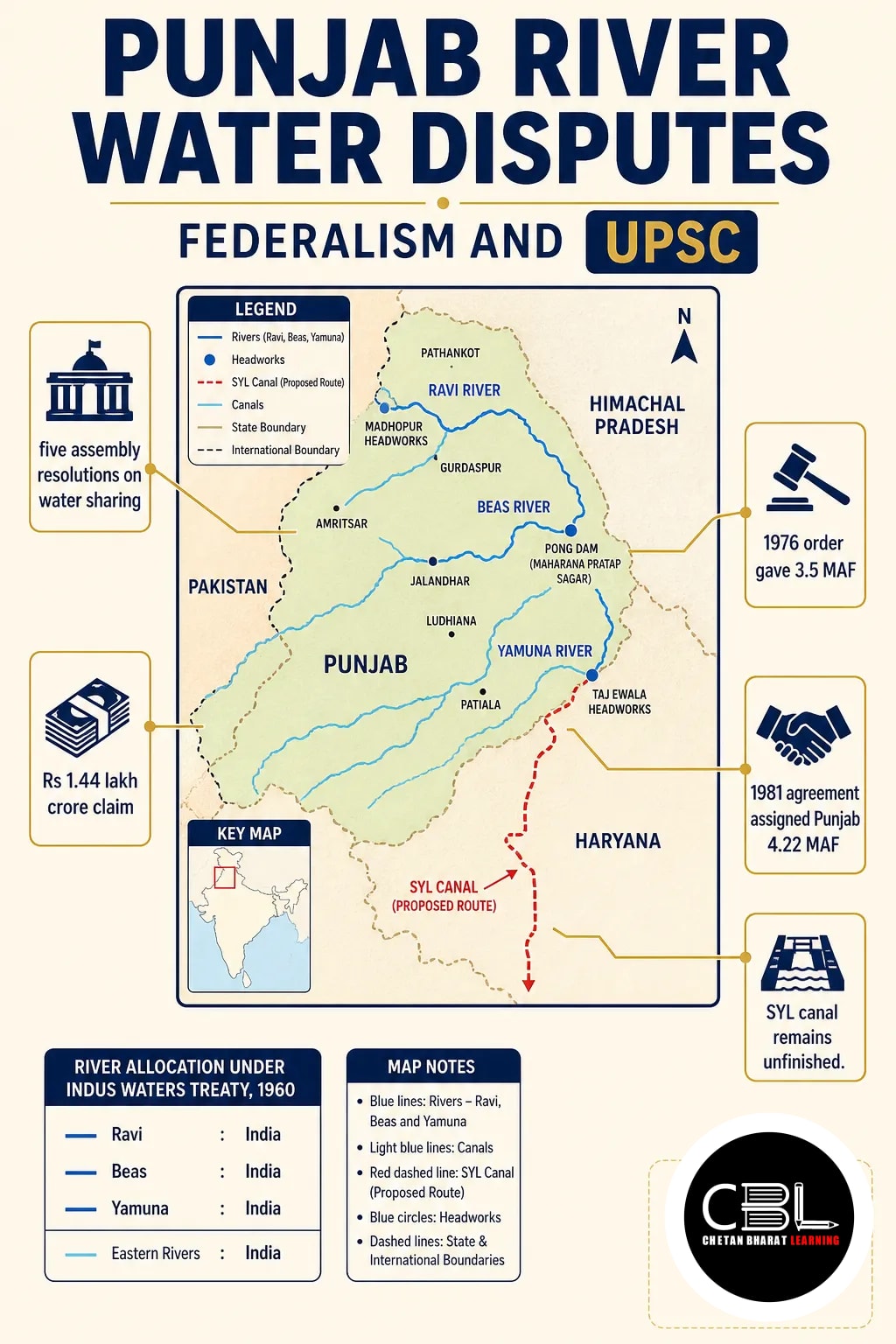

Punjab river water disputes returned to the Assembly on 27 October 2026, when legislators passed five resolutions on water sharing and management. The debate links Indian federalism and inter-state disputes to Punjab’s reorganisation.
Quick answer: Punjab river water disputes concern competing claims over the Ravi, Beas and Yamuna. On 27 October 2026, the Punjab Assembly sought a Yamuna share, Rs 1.44 lakh crore from Rajasthan and changes to water management. However, resolutions cannot by themselves amend Central law or overturn existing legal decisions.
What did the Punjab Assembly seek?
The Assembly’s five resolutions seek changes to water allocation, infrastructure control and dam governance. They followed a 7 September assurance to farmers who had protested near Chandigarh for a week.
- Yamuna share: Punjab sought an equitable allocation, arguing that it was excluded from subsequent arrangements.
- Rajasthan royalty: It demanded Rs 1.44 lakh crore for the use of Sutlej, Ravi and Beas waters.
- Management and projects: It sought control over key headworks, repeal of the Dam Safety Act, 2021, and projects to use Ravi waters flowing towards Pakistan.
The government had also promised to seek a review or repeal of Sections 78, 79 and 80 of the Punjab Reorganisation Act, 1966. It additionally undertook to revisit water agreements and Punjab’s claims based on riparian principles.
How did the Ravi-Beas dispute develop?
The dispute grew from pre-reorganisation allocations and the division of Punjab in 1966. In January 1955, an estimated 15.85 million acre-feet (MAF) of surplus Ravi-Beas water was allocated: 8 MAF to Rajasthan, 7.2 MAF to undivided Punjab and 0.65 MAF to Jammu and Kashmir.
Undivided Punjab’s share included the former Patiala and East Punjab States Union. The allocation also reflected the Centre’s effort to establish Indian use before negotiations on the Indus Waters Treaty. For context, see how state reorganisation reshaped India’s boundaries.
| Year | Allocation or development |
|---|---|
| 1966 | Haryana emerged from Punjab; the reorganisation law provided a framework for sharing and project management. |
| 1976 | The Centre allocated 3.5 MAF each to Punjab and Haryana and recommended 0.08 MAF for Delhi. |
| 1981 | An agreement assigned Punjab 4.22, Haryana 3.5, Rajasthan 8.6, Jammu and Kashmir 0.65 and Delhi 0.2 MAF. |
| 1986–87 | The Eradi Tribunal was constituted in 1986; its 1987 report recommended 5 MAF for Punjab and 3.83 MAF for Haryana. |
The 1981 agreement envisaged the Sutlej-Yamuna Link (SYL) canal carrying Haryana’s share. However, opposition followed, and the canal remains unfinished. The formation of Haryana is therefore central to the dispute’s history.
What did the Supreme Court hold?
In its advisory opinion of 10 November 2016, the Supreme Court held Punjab’s 2004 termination law unconstitutional. Punjab could not unilaterally terminate the 1981 agreement or nullify the Court’s earlier SYL decree.
Consequently, an Assembly resolution expresses a political demand but does not itself amend a Central Act. Punjab may ask Parliament to change the law or challenge its provisions before a competent court.
Which constitutional and legal provisions matter?
Article 262 and parliamentary legislation provide the framework for adjudicating inter-state river disputes. The reorganisation law separately addresses water shares and project management.
| Provision | Relevance |
|---|---|
| Article 262 | Parliament may provide for adjudication of inter-state river disputes and exclude court jurisdiction as specified by law. |
| Punjab Reorganisation Act, Section 78 | Provided for agreement on sharing; failing agreement, the Centre could determine shares by order. |
| Sections 79 and 80 | Addressed the Bhakra Management Board and construction of the Beas Project, respectively. |
| Inter-State River Water Disputes Act, 1956, Section 7 | Restricts charges on another state merely because inter-state river works lie within a state’s territory. |
Why are Punjab’s Yamuna and royalty claims contested?
Punjab argues that undivided Punjab had a connection to the Yamuna, yet the reorganised state was excluded from later sharing arrangements. It cites a 1954 agreement with Uttar Pradesh and the 1972 Irrigation Commission report.
Punjab did not sign the 12 May 1994 Yamuna memorandum of understanding. In April 2025, it asked the Union Jal Shakti Ministry for a tribunal. It argues that it should receive half of Haryana’s nearly 6 MAF share; however, this is a claim, not an established allocation.
For Rajasthan, Punjab points to historical charges paid by Bikaner for water through the Gang Canal from Ferozepur headworks. However, Section 7 makes a royalty demand based merely on the location of inter-state river works legally difficult. Historical payments alone do not establish the present claim.
What are the federal implications and way forward?
The dispute tests how India balances basin geography, existing allocations and the needs of different states. Punjab invokes riparian principles, while the 1976 order cited Haryana’s drought-prone areas and limited alternative sources.
- Shared evidence: States should examine water availability and use transparently before negotiating changes.
- Legal clarity: Any revision must account for existing agreements, judicial decisions and statutory procedures.
- Cooperative management: Dialogue on headworks and infrastructure can address operational concerns alongside allocation claims.
- Efficient use: Better irrigation management can complement, but cannot replace, a lawful settlement of competing claims.
Overall, Punjab river water disputes require both federal negotiation and respect for binding legal processes. A political resolution can frame a demand; a durable settlement needs agreement or an appropriate legal outcome.
Source: Indian Express Explained, 1 November 2026
- Bihar Ganga Water Treaty: Water Security for UPSC (31 Oct 2026)
Punjab PCS and Haryana HCS aspirants should connect the 1966 reorganisation with Ravi-Beas allocations and the SYL canal. Also revise the respective claims and the legal limits on unilateral changes.
Prelims Practice Corner
Mains Practice Questions
Frequently Asked Questions
What are Punjab’s main river water claims?
Punjab seeks a Yamuna share and a review of Ravi-Beas arrangements. It also demands royalty from Rajasthan and changes to water infrastructure management.
Can Punjab’s Assembly resolutions change a Central law?
No, because a resolution does not itself amend a Central Act. Punjab can, however, request parliamentary action or pursue an appropriate legal challenge.
What did the Eradi Tribunal recommend?
The tribunal recommended 5 MAF for Punjab and 3.83 MAF for Haryana. Its 1987 report also retained Rajasthan’s 8.6 MAF allocation.
Why is the SYL canal disputed?
The SYL canal was intended to carry Haryana’s Ravi-Beas share under the 1981 agreement. However, opposition and continuing legal disputes have left it unfinished.
Related Current Affairs
Preparing for UPSC, PCS or HCS?
Talk to a mentor at Chetan Bharat Learning, Chandigarh. Free guidance on choosing the right exam and building a study plan.
Chat on WhatsAppCall 97793 53345UPSC / IAS / PCS coaching in Chandigarh · Trusted by aspirants across Punjab & Haryana

 Ananya RanaIAS · AIR 60
 Aditya SharmaIAS · AIR 70
 Ria Kaur SethiIPS · AIR 89
 Aman AloonIRS · AIR 295
 Sumer Singh VirkIRS · AIR 335
 Shivani PanchalIAS

Leave a Reply
You must be logged in to post a comment.