
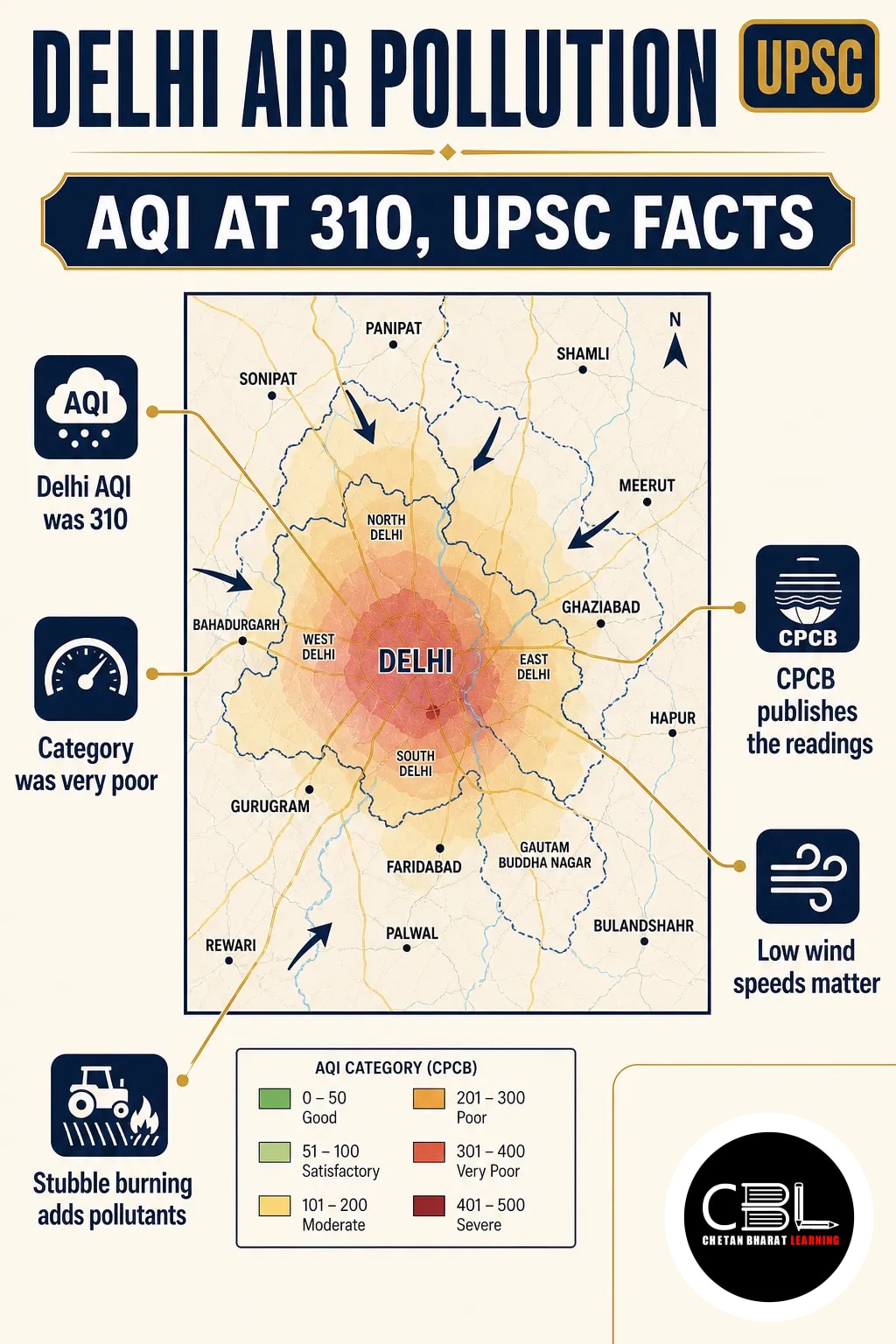

Delhi air pollution entered the ‘very poor’ category on 2 November 2026, with a 24-hour average Air Quality Index of 310 at 8 a.m. For related topics, explore CBL’s geography and environment coverage.
Quick answer: Delhi air pollution reached an Air Quality Index (AQI) of 310 at 8 a.m. on 2 November 2026, according to Central Pollution Control Board data. Noida, Kaithal and Hapur also recorded ‘very poor’ air quality. Low wind speeds, falling temperatures and emissions contribute to winter pollution.
What do the latest AQI readings show?
Delhi’s AQI rose from the moderate to the very poor category over the reported period. The Central Pollution Control Board (CPCB) publishes the readings; its daily bulletin treats the 4 p.m. reading as the day’s AQI.
| Reading | 24-hour average AQI and category |
|---|---|
| 31 October 2026, Saturday | 117 — moderate |
| 1 November, Sunday, 4 p.m. | 261 — poor |
| 2 November, Monday, 8 a.m. | 310 — very poor |
The Monday figure is a morning reading, not the 4 p.m. daily bulletin value. Meanwhile, Noida, Kaithal and Hapur also experienced very poor air quality.
What does the Air Quality Index measure?
The AQI communicates air quality through a numerical value and an associated category. A higher index generally indicates poorer air quality and greater health concern.
In India, an AQI of 301–400 falls in the very poor category; 201–300 is poor and 101–200 is moderate. Thus, the 310 reading crossed into the very poor band.
The CPCB is a statutory body established under the Water (Prevention and Control of Pollution) Act, 1974. In addition, it has functions relating to air quality under the Air (Prevention and Control of Pollution) Act, 1981.
Why does pollution rise in winter?
Winter pollution in Delhi and the wider Indo-Gangetic Plains reflects both weather conditions and emissions.
- Meteorology: Lower wind speeds and falling temperatures can limit pollutant dispersal.
- Seasonal emissions: Stubble burning in October and November and festive firecrackers add pollutants.
- Existing sources: Vehicle emissions and dust also contribute to the pollution load.
For regional context, see the Punjab stubble management review. The listed sources and weather conditions explain the seasonal pattern; the report does not quantify their individual contributions to this reading.
Why do the forecast and regional spread matter?
The Central government’s Air Quality Early Warning System for Delhi expects poor to very poor conditions for about five to six days. Consequently, forecasting can help authorities and residents anticipate continued exposure.
The affected locations extend beyond Delhi, making regional air quality relevant to state-level preparation. For further context, read CBL’s explainer on air pollution forecasting in Delhi.
Source: The Hindu, 2 November 2026
- AI Air Pollution Forecasting: UPSC Analysis (22 Jul 2026)
Asked in UPSC: Previous Year Questions
- UPSC CSE Prelims 2018 (GS Paper I): How does the National Green Tribunal differ from the Central Pollution Control Board in legal origin and environmental functions?
UPSC also tests the statutory basis and functions of environmental institutions.
Kaithal in Haryana was among the places with very poor air quality. Punjab PCS and Haryana HCS candidates should also revise stubble burning, winter weather and regional pollution management.
Prelims Practice Corner
Mains Practice Questions
Frequently Asked Questions
What was Delhi’s AQI on 2 November 2026?
Delhi’s 24-hour average AQI was 310 at 8 a.m. Therefore, it fell in the very poor category.
Which other places recorded very poor air quality?
Noida, Kaithal and Hapur also recorded very poor air quality. Thus, the reported deterioration extended beyond Delhi.
How long was poor air quality forecast to continue?
About five to six days, according to the Air Quality Early Warning System for Delhi. It forecast conditions ranging from poor to very poor.
Related Current Affairs
Preparing for UPSC, PCS or HCS?
Talk to a mentor at Chetan Bharat Learning, Chandigarh. Free guidance on choosing the right exam and building a study plan.
Chat on WhatsAppCall 97793 53345UPSC / IAS / PCS coaching in Chandigarh · Trusted by aspirants across Punjab & Haryana

 Ananya RanaIAS · AIR 60
 Aditya SharmaIAS · AIR 70
 Ria Kaur SethiIPS · AIR 89
 Aman AloonIRS · AIR 295
 Sumer Singh VirkIRS · AIR 335
 Shivani PanchalIAS

Leave a Reply
You must be logged in to post a comment.