
Dalai Lama asylum returned to the news after a central Delhi bungalow was provided to the Tibetan spiritual leader. The decision recalls a defining episode in India’s foreign relations: Jawaharlal Nehru’s response to his escape from Tibet in 1959.
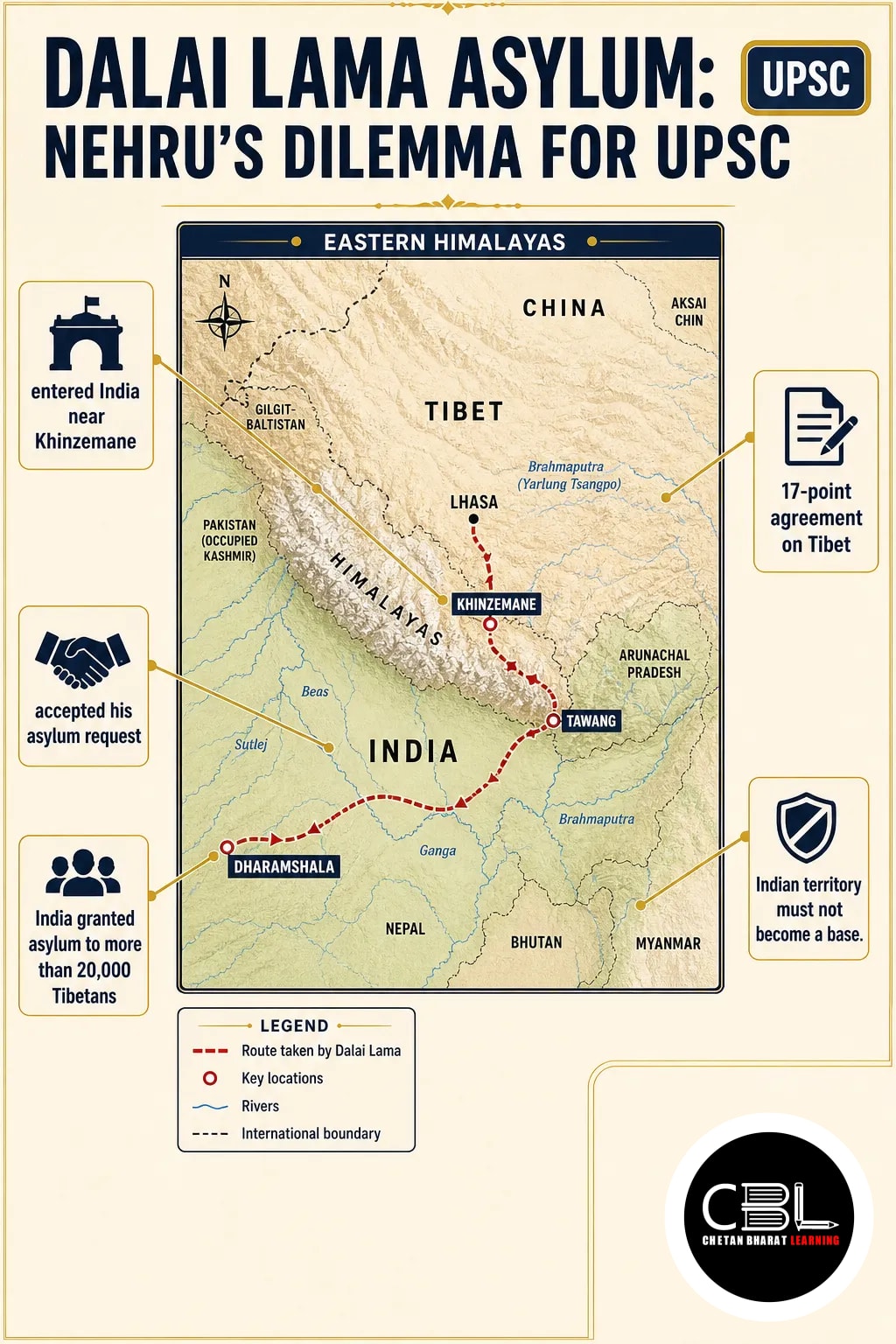
Quick answer: Dalai Lama asylum began after the Tibetan leader crossed into India near Khinzemane on 31 March 1959. India accepted his request the next day, following an uprising in Tibet. Nehru balanced humanitarian protection with relations with China; he later insisted that Indian territory not be used for hostile activities against China.
What happened in 1959?
The Dalai Lama fled Tibet during an uprising against Chinese rule and sought refuge in India. Continued Chinese presence and rumours of a planned kidnapping of the spiritual leader helped trigger the uprising. Chinese forces suppressed the protests, killing tens of thousands, according to the source.
On 17 March, the Dalai Lama left Lhasa with family members, bodyguards and other Tibetans. Khampa Tibetan soldiers escorted him through rebel-held areas. According to political commentator Inder Malhotra’s account, he also received help from the United States Central Intelligence Agency.
He crossed into India near Khinzemane, in present-day Tawang district of Arunachal Pradesh, on 31 March. India formally accepted his asylum request on 1 April. The Tibetan government-in-exile is based in Dharamshala; CBL’s Kangra district profile provides geographical context.
Why is the decision in the news?
A central Delhi bungalow provided to the Dalai Lama has renewed attention on India’s long association with him. The Indian Express reported the accommodation on 24 November 2026.
His succession is also a current question. A United States-China Economic and Security Review Commission report said China was preparing for an international contest over succession legitimacy. The report identified India as central to that dispute because it hosts the Dalai Lama and the Tibetan government-in-exile, and shares a disputed border with China.
China considers Tibet an autonomous region of its own and has described the Dharamshala-based government-in-exile as separatist. Therefore, the asylum episode remains relevant to both humanitarian protection and India-China diplomacy.
How did Tibet become a diplomatic issue?
Tibet’s changing political status brought a former buffer between India and China into their bilateral relationship. China asserted historical claims and viewed Tibet as strategically important to its frontier and political authority. Tibetan leaders, however, pointed to long periods of self-rule and disputed those claims.
Chinese forces entered Tibet in 1950. The following year, Tibetan representatives and China signed a 17-point agreement, which recognised Tibet as an autonomous region while allowing the entry of the People’s Liberation Army. The Dalai Lama later said the agreement had been signed under duress.
In 1956, the Dalai Lama visited India for the 2,500th anniversary of the Buddha’s parinirvana. Chinese Premier Zhou Enlai also visited India that year and feared that the Tibetan leader might stay. Nehru persuaded the Dalai Lama to return, according to former Indian ambassador V. V. Paranjpe’s account.
Key timeline of Tibet and asylum
The timeline shows how a diplomatic concern became an immediate asylum decision.
| Year or date | Event |
|---|---|
| 1950 | Chinese forces entered Tibet; Vallabhbhai Patel warned Nehru about Chinese ambitions. |
| 1951 | China and Tibetan representatives signed the 17-point agreement. |
| 1956 | The Dalai Lama visited India; Nehru persuaded him to return. |
| 17 March–1 April 1959 | He fled Tibet, entered India and received acceptance of his asylum request. |
| August 1960 | Nehru wrote about rehabilitation and the condition against hostile activities from Indian soil. |
| 1962 | India and China fought a war after tensions that included, but were not limited to, the Tibet issue. |
What dilemma did Nehru face?
Nehru had to reconcile refuge for the Dalai Lama with the diplomatic costs of China’s opposition. The Dalai Lama asylum decision drew criticism from China and also generated debate within India.
- Humanitarian responsibility: Nehru regarded receiving Tibetans and helping them rehabilitate as a duty. In August 1960, he wrote that India had granted asylum to more than 20,000 Tibetans.
- Diplomatic restraint: Nehru said Indian territory must not become a base for hostile propaganda or activities against China. Thus, protection did not mean unrestricted political activity from Indian soil.
- Domestic disagreement: Defence Minister V. K. Krishna Menon objected to the decision. Bharatiya Jan Sangh leader Deendayal Upadhyay also criticised it, arguing that it obstructed support for Tibetan independence.
- Democratic expression: Historian Ramachandra Guha noted that public sympathy for the spiritual leader was natural in India’s democratic setting. However, such expression could complicate relations with China.
These competing concerns show why asylum and recognition of a claim to independence are distinct policy choices. They also show that a humanitarian decision can have strategic consequences without being the sole cause of a later conflict.
What is the significance for India today?
The episode illustrates the need to protect vulnerable people while managing a sensitive relationship with a neighbouring power. For a balanced analysis, aspirants should distinguish the 1959 decision from the separate border dispute and the succession question.
First, a host country must consider rehabilitation alongside the immediate grant of refuge. Second, it must communicate the limits placed on hostile activity without treating all public sympathy as hostility. Finally, sustained diplomatic engagement can reduce misunderstanding, though it cannot by itself settle competing territorial or political claims.
Tibet was one among several disagreements that contributed to the conditions leading to the 1962 war. For present-day geographical context, see CBL’s explanation of India-China border talks and the Arunachal frontier.
Source: Indian Express Explained, 27 November 2026
- Kangra district profile: Himachal GK for HPAS & HP exams (15 Nov 2026)
Punjab PCS and Haryana HCS General Studies may test the chronology of the Tibetan leader’s entry into India and its foreign-policy context. Also revise Khinzemane, Tawang and Dharamshala as geographical references.
Prelims Practice Corner
Mains Practice Questions
Frequently Asked Questions
When did India grant the Dalai Lama asylum?
India accepted his request on 1 April 1959. He had entered India near Khinzemane the previous day.
Why did the Dalai Lama leave Tibet?
He fled during the 1959 uprising and its suppression by Chinese forces. The uprising followed continued Chinese presence and rumours of a planned kidnapping.
What condition did Nehru attach to asylum?
Indian territory could not be used for hostile propaganda or activities against China. Nehru stated this condition in his August 1960 letter to the Dalai Lama.
Related Current Affairs
Preparing for UPSC, PCS or HCS?
Talk to a mentor at Chetan Bharat Learning, Chandigarh. Free guidance on choosing the right exam and building a study plan.
Chat on WhatsAppCall 97793 53345UPSC / IAS / PCS coaching in Chandigarh · Trusted by aspirants across Punjab & Haryana






Leave a Reply
You must be logged in to post a comment.