
Little Stint migration brings a tiny Arctic shorebird to Indian wetlands each winter. Its journey highlights the importance of wetland habitats and migratory routes.
Quick answer: Little Stint migration connects Arctic breeding grounds with wintering wetlands in India, including Point Calimere in Tamil Nadu. The shorebird weighs about 25 grams and usually leaves between March and April. However, shrinking mudflats threaten the feeding and resting sites it needs throughout its journey.
Where does the Little Stint travel?
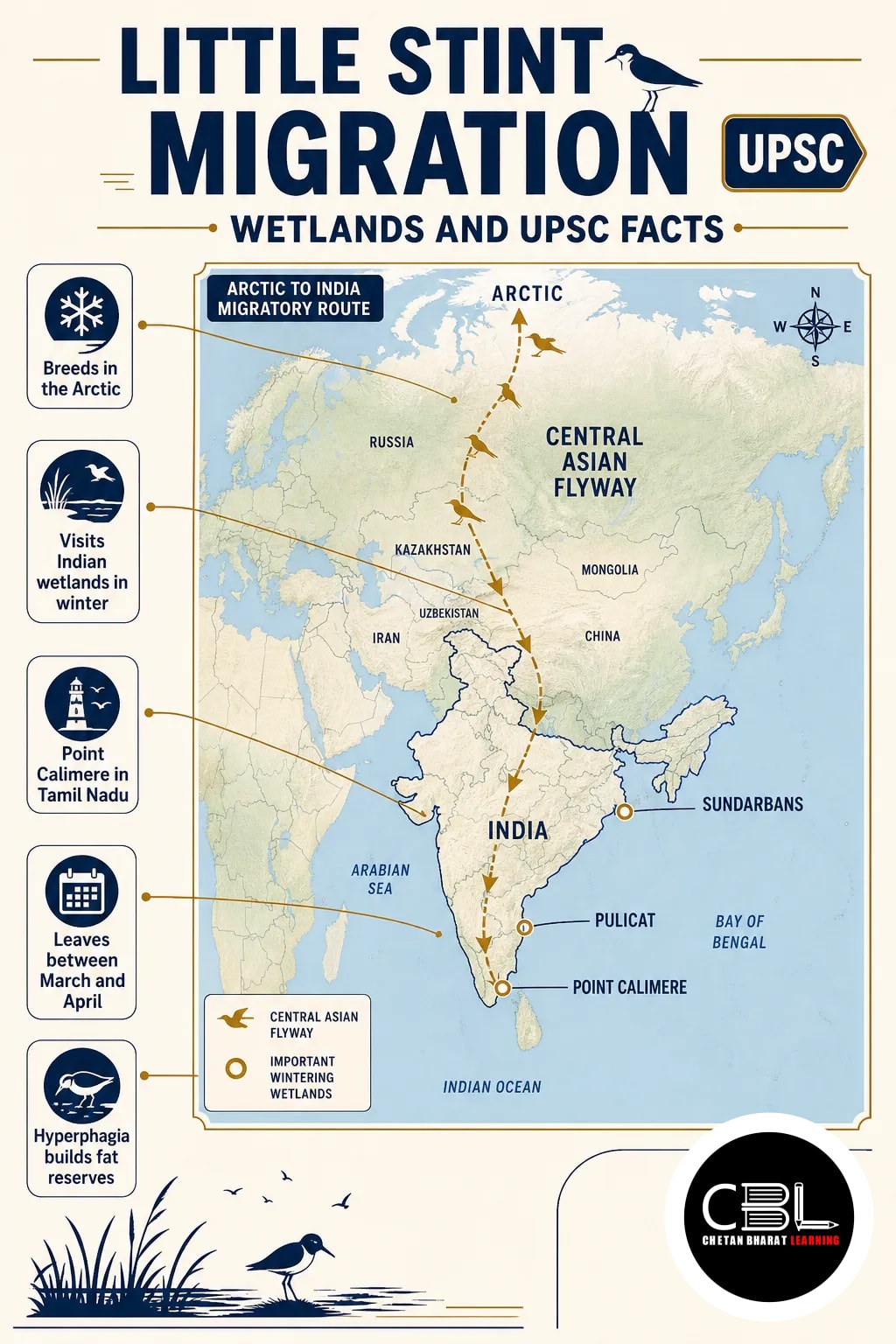
The Little Stint breeds in the Arctic and travels thousands of kilometres to wintering habitats, including Indian wetlands. It uses multiple stopovers for food and rest; India is an important destination along the Central Asian Flyway.
| Feature | Key fact |
|---|---|
| Bird type | Small migratory shorebird |
| Breeding grounds | Arctic |
| Indian wintering site | Point Calimere, Tamil Nadu |
| Typical departure | March–April; sometimes May |
| Pre-flight preparation | Intense feeding builds fat reserves |
Why is the shorebird in the news?
A report in The Hindu examines the bird’s annual journey and the risks facing its wetland habitats. According to shorebird researcher S. Sivakumar, Point Calimere still hosts over a lakh Little Stints.
He also notes that monitored shorebird populations in the Gulf of Mannar region have fallen by 60% over more than four decades. This figure covers the monitored shorebird population, not the Little Stint alone.
How does the bird prepare for migration?
Before departure, the Little Stint feeds intensely in a phase called hyperphagia. This builds fat reserves for flight and can increase its body weight by 50–75%.
As Arctic temperatures fall and food becomes scarce, the birds move towards warmer regions. Their journey includes landscapes around Kazakhstan, Uzbekistan, the Caspian Sea and Tibet.
Why do wetlands matter for the Little Stint?
Wetlands provide feeding and resting sites that make Little Stint migration possible. Besides Point Calimere, the bird occurs at Pulicat, the Sundarbans and mudflats in Gujarat and Maharashtra.
However, reclamation, pollution and habitat loss threaten stopover and wintering sites. Ringing studies show site fidelity: some birds return to a familiar site, making habitat loss particularly consequential.
Protecting mudflats, salt pans and estuaries can therefore support the species. In addition, its numbers and distribution can help researchers track changes in wetland habitats.
Source: The Hindu Sci-Tech, 27 November 2026
Asked in UPSC: Previous Year Questions
- UPSC CSE Mains 2023 (GS Paper III): Comment on the National Wetland Conservation Programme and name a few Indian wetlands of international importance included in the Ramsar Sites.
UPSC links wetland conservation to international designations, so revise both habitats and conservation frameworks.
Punjab PCS and Haryana HCS General Studies can test migratory birds, wetland habitats and flyways. Also revise the location and ecological role of wetlands in each state.
Prelims Practice Corner
Mains Practice Questions
Frequently Asked Questions
Where does the Little Stint breed?
The Little Stint breeds in the Arctic. It then travels to warmer wintering habitats, including Indian wetlands.
When does the Little Stint leave India?
It usually departs between March and April. However, some birds leave later, in May.
Why are mudflats important for the Little Stint?
Mudflats provide feeding sites during migration and winter. Therefore, their loss can disrupt the bird’s access to energy along its route.
Related Current Affairs
Preparing for UPSC, PCS or HCS?
Talk to a mentor at Chetan Bharat Learning, Chandigarh. Free guidance on choosing the right exam and building a study plan.
Chat on WhatsAppCall 97793 53345UPSC / IAS / PCS coaching in Chandigarh · Trusted by aspirants across Punjab & Haryana






Leave a Reply
You must be logged in to post a comment.