
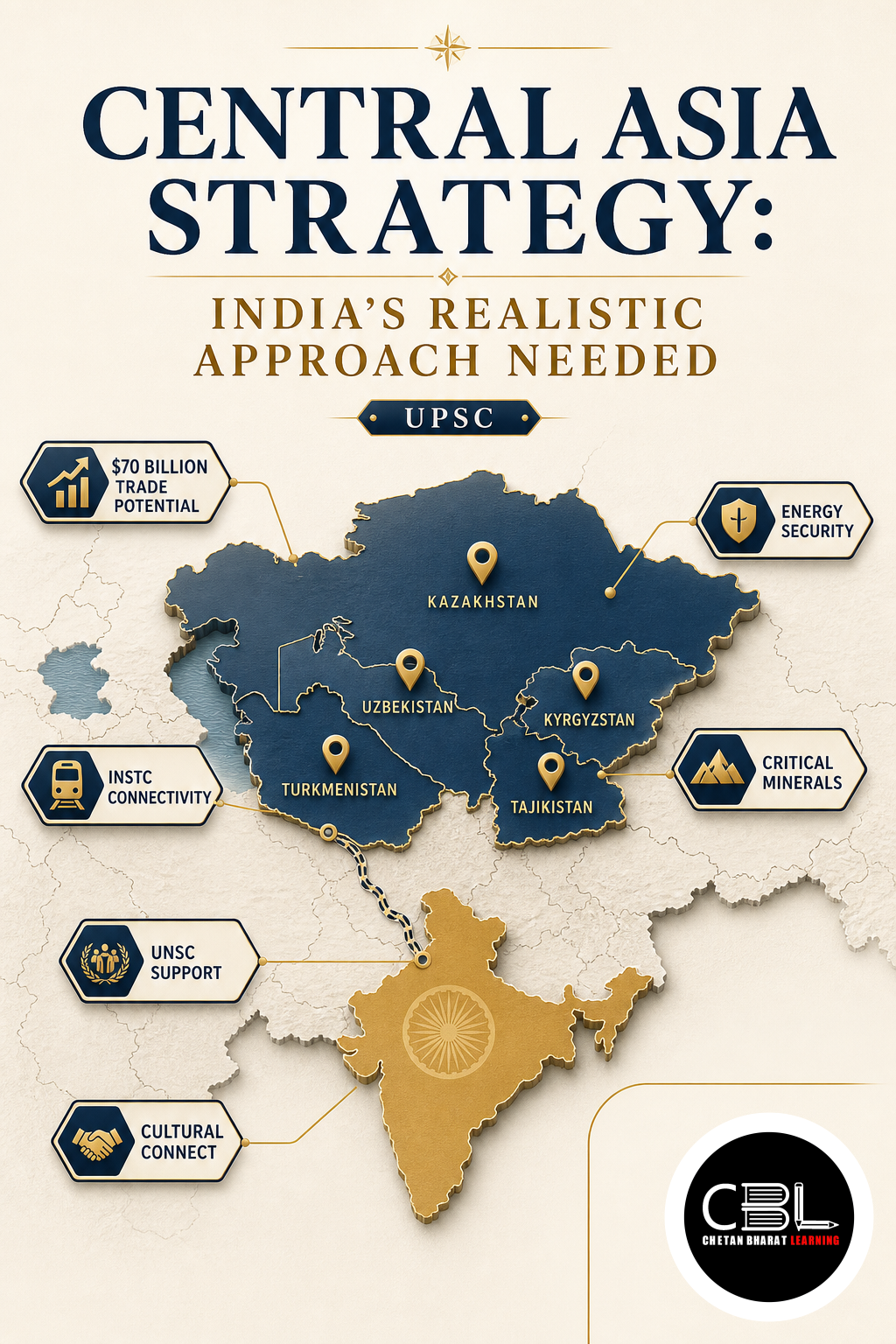

UPSC Mapping
| Exam | Topic |
|---|---|
| Prelims | International Relations |
| Mains | GS Paper 2 |
| Central Asian Republics | Kazakhstan, Kyrgyzstan, Tajikistan, Turkmenistan, Uzbekistan |
|---|---|
| Key Connectivity Routes | Chabahar, INSTC, Pakistan-blocked overland routes |
What is India’s Central Asia Strategy?
India’s central asia strategy aims to deepen political, economic, and cultural ties with the five post-Soviet republics—Kazakhstan, Kyrgyzstan, Tajikistan, Turkmenistan, and Uzbekistan. The strategy is driven by historical connections, energy security concerns, and the need to counter Chinese influence.
However, India’s approach has been constrained by geography, limited capabilities, and persistent geopolitical headwinds, including the India-Pakistan conflict and Afghanistan’s instability. A more realistic and modest approach is now advocated by strategic analysts.
Why is Central Asia Strategy in News?
Prime Minister Narendra Modi’s visit to Uzbekistan and the SCO summit in Kyrgyzstan has renewed focus on India’s central asia strategy. The region has changed significantly since his 2015 tour, with four broad trends emerging: growing geopolitical agency of Central Asia, diversification of great power relations, entanglement with the Greater Middle East, and the diminution of the Afghan question.
According to an MEA statement, India enjoys considerable goodwill but geography continues to constrain its ambitions. The growing conflict between Iran and the US has further complicated connectivity prospects.
Key Features of India’s Central Asia Engagement
India’s engagement with Central Asia has several distinctive features:
- Historical and Cultural Ties: Deep historical connections through the Silk Route and shared cultural heritage.
- Strategic Location: Central Asia’s proximity to India and its role in regional security dynamics.
- Energy Security: Access to hydrocarbon resources and critical minerals.
- Countering Chinese Influence: Balancing China’s growing presence through the BRI and other initiatives.
- Multi-Vector Engagement: Central Asian states pursue partnerships with multiple powers, not exclusive relationships.
Challenges in India’s Central Asia Strategy
Several challenges hinder India’s central asia strategy. For a broader understanding of India’s foreign policy, refer to our analysis on India’s foreign policy challenges.
- Connectivity Bottlenecks: Pakistan blocks the overland route; Afghanistan remains unstable; Chabahar and INSTC face complications.
- China’s Structural Advantage: China’s BRI investment, rail and road networks, and energy pipelines give it a significant edge.
- Limited Resources: India cannot match China’s infrastructure spending or Russia’s geographic advantages.
- Regional Dynamics: Central Asian states are increasingly confident of playing their own game, seeking multiple partnerships.
- Competing Interests: Turkey, Europe, and others are expanding their engagement, adding to regional complexity.
Way Forward for India’s Central Asia Strategy
India needs a less romantic and more modest approach focusing on specialised partnerships rather than grand spending. Sustained political attention should be matched by a practical economic agenda focused on areas where India can contribute, such as IT, pharmaceuticals, education, and capacity building.
Delhi must also consider whether greater diplomatic flexibility towards Pakistan, Turkey, and Azerbaijan can improve its room for manoeuvre. As suggested by an ORF analysis, India should recognise Central Asian states’ desire for multiple partnerships that expand their room for manoeuvre.
Prelims Practice Corner
Q1. Which of the following is NOT a Central Asian republic?
- (a) Kazakhstan
- (b) Kyrgyzstan
- (c) Azerbaijan
- (d) Uzbekistan
Answer: (c) Azerbaijan is in the Caucasus region, not Central Asia.
Q2. What is the primary connectivity challenge for India’s engagement with Central Asia?
- (a) Lack of diplomatic relations
- (b) Pakistan blocking overland routes
- (c) Cultural differences
- (d) Economic competition
Answer: (b) Pakistan blocks the overland route, and Afghanistan remains unstable.
Q3. Which initiative has given China a structural advantage in Central Asia?
- (a) Chabahar Port
- (b) International North-South Transport Corridor
- (c) Belt and Road Initiative
- (d) QUAD
Answer: (c) The Belt and Road Initiative (BRI) gives China a structural advantage in Central Asia.
Q4. What is the ‘multi-vector’ strategy adopted by Central Asian states?
- (a) Aligning exclusively with Russia
- (b) Engaging all powers without exclusive commitment
- (c) Focusing only on China
- (d) Isolating from global powers
Answer: (b) Central Asian states engage all powers and commit exclusively to none.
Q5. Which Indian initiative offers an alternative connectivity route to Central Asia?
- (a) Sagarmala Project
- (b) Chabahar Port
- (c) Bharatmala Project
- (d) UDAN Scheme
Answer: (b) Chabahar Port, along with the INSTC, offers an alternative connectivity route.
Mains Practice Questions
Q1. “India’s Central Asia strategy needs less romance and more realism.” Discuss the challenges and opportunities for India’s engagement with Central Asia. (15 Marks)
Answer Structure
- Intro: Contextualize India’s historical ties and strategic interests in Central Asia.
- Body: Discuss challenges (connectivity, China’s influence, resource constraints) and opportunities (goodwill, specialised partnerships, strategic autonomy). Evaluate the evolving regional dynamics.
- Conclusion: Recommend a practical, modest, and sustained approach to engagement.
Q2. Examine the geopolitical significance of Central Asia for India and the factors that constrain India’s engagement. (10 Marks)
Answer Structure
- Intro: Briefly describe Central Asia’s strategic location and importance.
- Body: Discuss geopolitical significance (energy, security, counter-balancing China) and constraints (lack of direct access, Pakistan factor, resource limitations).
- Conclusion: Suggest a realistic policy approach focusing on India’s comparative advantages.
FAQs on Central Asia Strategy
What is India’s Central Asia strategy?
India’s Central Asia strategy aims to deepen political, economic, and cultural ties with the five Central Asian republics, driven by historical connections, energy security, and strategic considerations.
What are the main challenges for India in Central Asia?
Challenges include lack of direct land access, Pakistan blocking overland routes, Afghanistan’s instability, China’s structural advantage through BRI, and limited resources compared to other powers.
How is the Central Asian region changing?
Central Asia is acquiring greater geopolitical agency, diversifying relations with major powers, becoming entangled with the Greater Middle East, and the Afghan question is diminishing in salience.
Related Current Affairs
Preparing for UPSC, PCS or HCS?
Talk to a mentor at Chetan Bharat Learning, Chandigarh. Free guidance on choosing the right exam and building a study plan.
Chat on WhatsAppCall 97793 53345UPSC / IAS / PCS coaching in Chandigarh · Trusted by aspirants across Punjab & Haryana
Leave a Reply
You must be logged in to post a comment.