
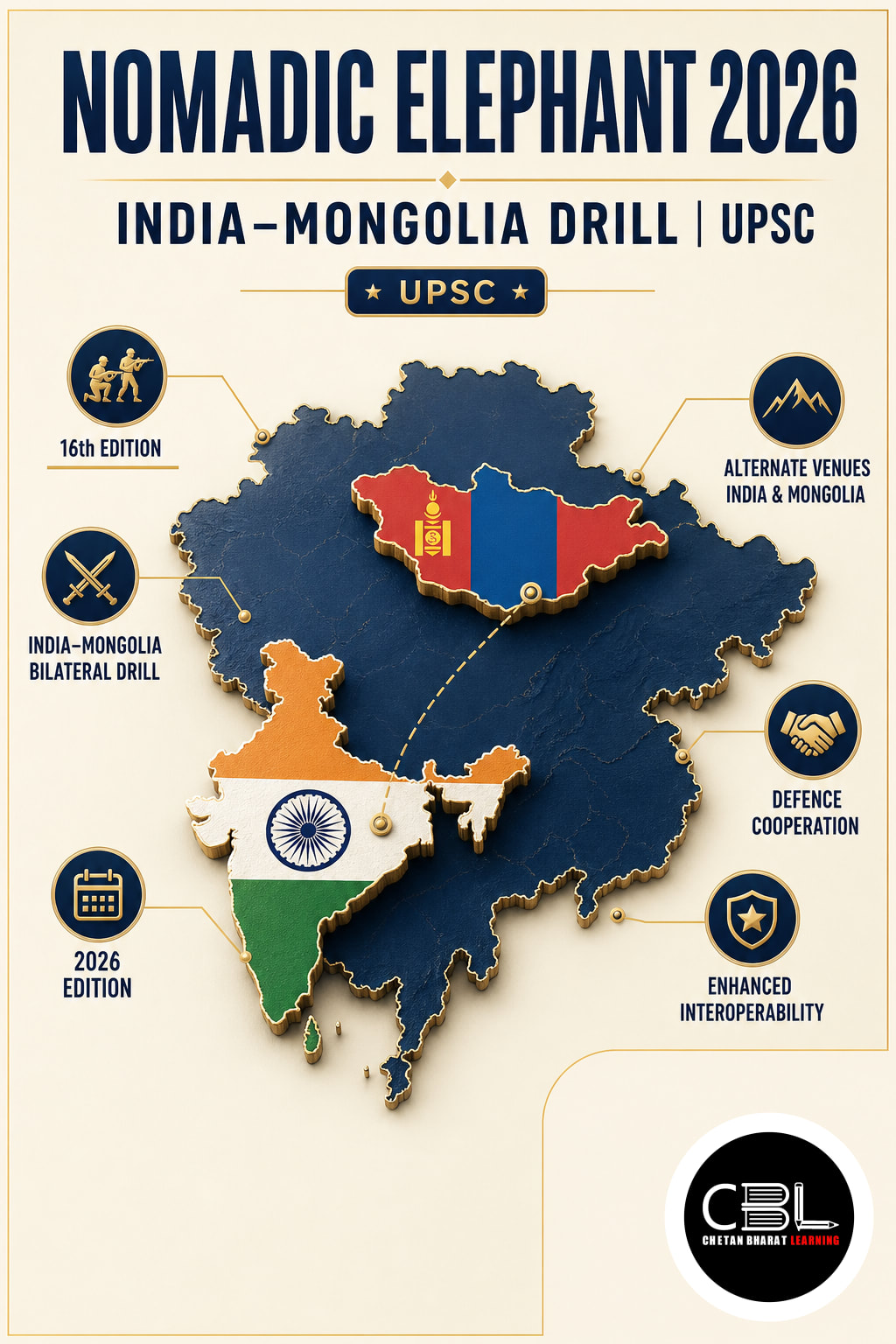

UPSC Mapping
Prelims
Joint Military Exercises and India–Mongolia Relations
Mains
GS Paper II and GS Paper III
Article
Nomadic Elephant 2026 began in Uttarakhand as India and Mongolia renewed their annual joint military training. The exercise brings soldiers from both countries together for counter-insurgency drills in semi-urban and mountainous terrain. Its training programme also covers helicopters, cyber security, drones and counter-drone systems. For UPSC, the event connects a factual defence exercise with wider questions about military interoperability and bilateral relations. Chetan Bharat Learning’s current affairs coverage provides context for similar international developments.
Quick Facts
| Edition | 18th |
|---|---|
| Dates | 21 September–3 October 2026 |
| Venue | Pithoragarh, Uttarakhand |
| Participants | 45 personnel from each country |
What is Nomadic Elephant 2026?
Nomadic Elephant 2026 is the 18th edition of an annual platoon-level exercise between the Indian Army and the Mongolian Armed Forces. The two countries host it alternately, giving their soldiers opportunities to train under different local conditions. Its stated aim is to strengthen their ability to undertake counter-insurgency operations in semi-urban and mountainous terrain under a United Nations mandate. That mandate describes the training scenario; participation does not mean the exercise itself is a deployed UN mission. The soldiers practise together so they can understand each other’s procedures.
A joint exercise creates a controlled setting for rehearsing tasks that require close coordination. Soldiers can compare how their units plan movements, share information and respond to problems during an operation. The training covers both familiar field drills and newer technological demands, including cyber security and unmanned systems. These activities build practical knowledge that meetings alone cannot provide. They also help commanders identify differences in equipment, communication and tactics before any future joint assignment requires them to work together.
Why is Nomadic Elephant 2026 in News?
The 18th edition commenced on 21 September 2026 at the Foreign Training Node in Pithoragarh, Uttarakhand. The Indian Army and the Mongolian Armed Forces each sent 45 personnel for training scheduled through 3 October. The Ministry of Defence release identifies the location, schedule, participants and training activities. These details make the exercise useful for Prelims questions on partner countries, venues and the nature of bilateral drills.
The previous edition took place in Ulaanbaatar, Mongolia, in May–June 2025, illustrating the alternating host arrangement. The 2026 programme includes cordon and search operations, room intervention, special heliborne operations and drone-related training. Its combination of established field procedures with cyber and counter-drone elements reflects the range of skills the armies intend to practise. The official description also links the event to stronger defence cooperation and mutual trust between India and Mongolia. Those are intended outcomes of the training, rather than measured results announced at its start.
Key Features
- Alternating host countries: India hosts the 2026 edition after Mongolia hosted the previous one, exposing participating troops to different training facilities and local conditions.
- Counter-insurgency focus: The two armies train for operations in semi-urban and mountainous terrain, where movement, communication and coordination demand careful planning.
- Ground-level drills: Cordon and search operations and room intervention allow soldiers to compare procedures while practising coordinated tactical decisions.
- Specialised operations: Heliborne training adds an aviation-supported element to the exercise and requires troops to coordinate movements across different operational roles.
- Emerging threats: Cyber security sessions and the use of drones and counter-drone systems broaden training beyond conventional ground exercises.
Challenges
- Different procedures: Soldiers may use different planning methods and tactical terms, so instructors must establish a shared understanding before complex drills begin.
- Communication needs: Teams must convey instructions clearly across units and equipment while preserving security during fast-moving field and technology-based scenarios.
- Terrain and logistics: Mountainous settings can complicate movement, weather planning and support arrangements, requiring careful preparation for realistic and safe training.
- Technology integration: Drone and counter-drone drills require participants to coordinate observation, reporting and responses within the limits of an exercise setting.
- Carrying lessons forward: Both armies need to review results after the exercise and apply useful lessons to later training; compare another bilateral drill in CBL’s Dharma Guardian coverage.
Way Forward
India and Mongolia can use the scheduled drills to identify where their units coordinate well and where instructions need greater clarity. Commanders can review performance in ground, heliborne and unmanned-system scenarios before updating future training plans. Sharing appropriate practices can help both sides preserve useful lessons after personnel return to their units. The annual format offers a regular opportunity to check progress, while the alternating venues give participants experience in both countries. Such follow-up would turn exercise experience into more durable professional cooperation.
The 2026 edition should be assessed through its announced aim: improving the ability of the two armies to operate jointly in the specified training scenario. The earlier Ministry of Defence announcement for the 2025 edition provides a useful reference for the recurring, alternating format. For UPSC, remember the India–Mongolia pairing, Pithoragarh venue and counter-insurgency focus. In Mains, explain how repeated joint drills can support interoperability and defence ties without claiming that training alone proves readiness for every real-world operation.
Prelims Practice Corner
Q1. Exercise NOMADIC ELEPHANT is conducted between India and which country?
- (a) Japan
- (b) Mongolia
- (c) Nepal
- (d) Kazakhstan
Answer: (b) Mongolia
Q2. Where did the 18th edition commence in September 2026?
- (a) Ulaanbaatar
- (b) Jaisalmer
- (c) Pithoragarh
- (d) Leh
Answer: (c) Pithoragarh
Q3. Which forces participate in this exercise?
- (a) The two navies
- (b) The two air forces
- (c) The Indian Army and Mongolian Armed Forces
- (d) Border police only
Answer: (c) The Indian Army and Mongolian Armed Forces
Q4. Which activity forms part of the announced 2026 training curriculum?
- (a) Submarine rescue
- (b) Cordon and search operations
- (c) Aircraft-carrier landings
- (d) Deep-sea mining
Answer: (b) Cordon and search operations
Q5. Which statement about the exercise is correct?
- (a) It is hosted only by India
- (b) It is an annual platoon-level exercise hosted alternately
- (c) It is a UN peacekeeping deployment
- (d) It began for the first time in 2026
Answer: (b) It is an annual platoon-level exercise hosted alternately
Mains Practice Questions
Q1. How do bilateral military exercises contribute to interoperability? Explain with reference to the India–Mongolia exercise. (10 marks)
Answer Structure:
- Intro: Identify the annual India–Mongolia platoon-level training exercise.
- Body: Discuss shared procedures, communication, field drills, technology training and the value of alternating venues.
- Conclusion: Link regular practice and review to stronger operational coordination.
Q2. Discuss the role and limitations of joint military training in strengthening India’s bilateral defence partnerships. (15 marks)
Answer Structure:
- Intro: Frame exercises as a means of practical defence engagement.
- Body: Cover interoperability, professional exchanges and trust, alongside communication, logistics, technology and follow-up challenges.
- Conclusion: Recommend regular assessment and continued institutional cooperation.
FAQs on Nomadic Elephant 2026
Which countries take part in Exercise NOMADIC ELEPHANT?
India and Mongolia take part. Their armies conduct the annual platoon-level exercise alternately in the two countries.
How many personnel joined the 2026 edition?
The Indian Army and the Mongolian Armed Forces each sent 45 personnel. The exercise was scheduled from 21 September to 3 October 2026.
Is the exercise itself a United Nations mission?
No. The Ministry of Defence describes counter-insurgency operations under a UN mandate as the training scenario. The event is a bilateral India–Mongolia military exercise.
Related Current Affairs
Preparing for UPSC, PCS or HCS?
Talk to a mentor at Chetan Bharat Learning, Chandigarh. Free guidance on choosing the right exam and building a study plan.
Chat on WhatsAppCall 97793 53345UPSC / IAS / PCS coaching in Chandigarh · Trusted by aspirants across Punjab & Haryana
Leave a Reply
You must be logged in to post a comment.