
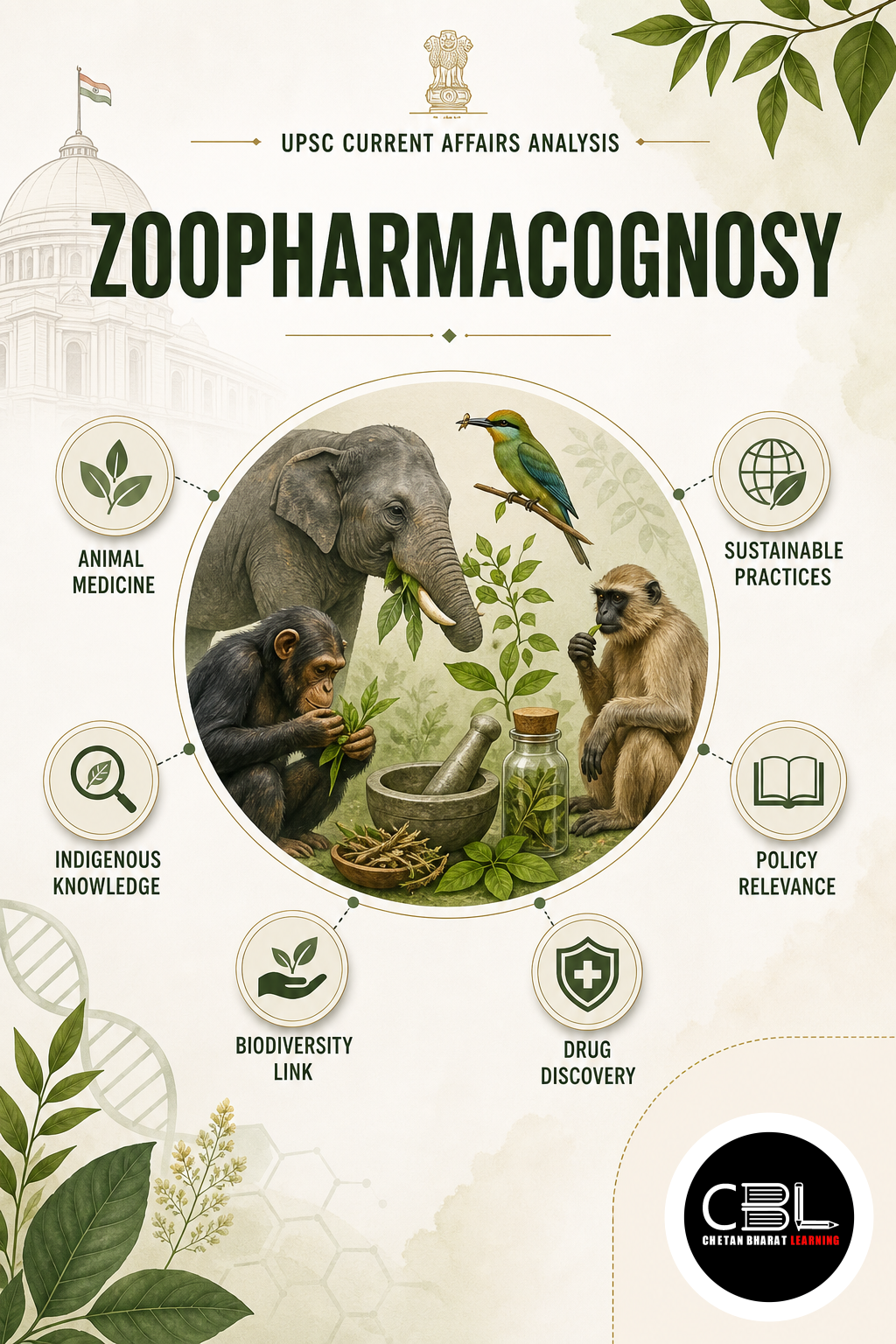
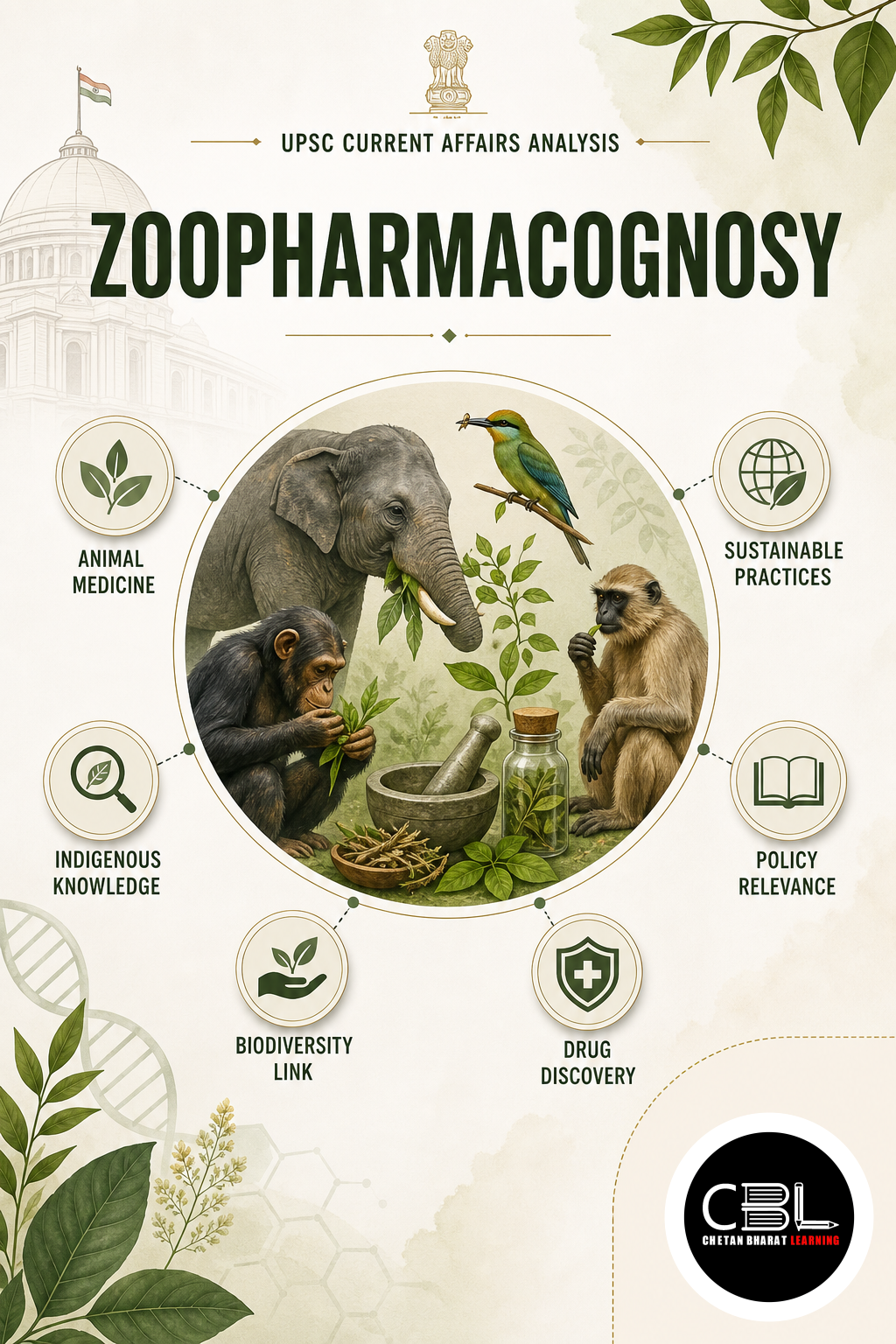
Zoopharmacognosy has attracted scientific attention after recent studies highlighted how wild animals instinctively use medicinal plants to treat diseases and protect themselves from parasites. The topic is important for UPSC Prelims under environment, biodiversity and animal behaviour. Read more environment updates in the daily current affairs archive.
UPSC Mapping
| Prelims | Biodiversity, Animal Behaviour and Infrastructure |
|---|---|
| Mains | GS Paper III – Environment and Infrastructure Development |
Quick Facts
| Scientific Term | Animal Self-Medication |
|---|---|
| Study | Scientific Reports |
| Related Topic | Animal Behaviour |
What is Zoopharmacognosy?
Zoopharmacognosy is the study of how animals identify and use natural substances with medicinal properties to prevent or treat diseases. The word combines the Greek terms ‘zoo’ (animal), ‘pharmaco’ (medicine) and ‘gnosy’ (knowledge).
It describes the behaviour through which wild animals consume, chew, rub or swallow specific plants and other natural substances to combat parasites, infections or physical discomfort without human intervention.
Why is Zoopharmacognosy in News?
Zoopharmacognosy has come into focus after research published in Scientific Reports documented several examples of self-medication among wild animals, reinforcing evidence that many species instinctively use medicinal plants for survival.
These findings improve scientific understanding of animal behaviour and may contribute to future research on medicines and biodiversity conservation.
Key Examples of Zoopharmacognosy
- Orangutans (Indonesia): Orangutans in the Sebangau Forest mix saliva with leaves of Dracaena plants to relieve muscle pain and joint discomfort.
- Chimpanzees (Nigeria): Chimpanzees swallow leaves of Desmodium gangeticum (Shalaparni) to eliminate parasites affecting their bodies.
- Elephants: Common elephants chew oregano leaves to obtain relief from phlegm.
- Monkeys, sheep, dogs and cats: These animals often consume grass to expel intestinal parasites such as worms and amoeba.
Significance
- Biodiversity conservation: Demonstrates the ecological value of medicinal plant diversity.
- Drug discovery: Animal behaviour may guide future pharmaceutical research.
- Behavioural ecology: Provides insights into evolutionary adaptations for survival.
- Wildlife health: Improves understanding of disease management in natural ecosystems.
Sri City Dry Port Proposal
Sri City, located in Tirupati district of Andhra Pradesh, is under consideration for designation as a Dry Port (Inland Container Depot). The proposal is being examined by an Inter-Ministerial Committee.
Sri City is a multi-product integrated business zone comprising a Special Economic Zone (SEZ), Domestic Tariff Zone (DTZ), Free Trade Warehousing Zone (FTWZ) and Electronics Manufacturing Cluster (EMC).
The proposed dry port would enable on-site customs clearance, reduce transportation costs and improve export logistics.
What is a Dry Port?
- Provides customs clearance for export and import cargo.
- Offers temporary storage of containers and goods.
- Reduces congestion at seaports.
- Improves logistics efficiency for inland industries.
- Supports international trade through integrated cargo handling.
Key Criteria for Establishing Dry Ports
- CBIC Guidelines: New dry ports are generally permitted within 200 km of a seaport or 100 km of an existing inland depot.
- Green-zone States: Receive explicit relaxations under the policy.
- Blue-zone States: Andhra Pradesh may qualify where major trade hubs require additional logistics infrastructure.
Way Forward
Research on animal self-medication highlights the importance of conserving biodiversity and medicinal plant resources. Continued scientific investigation may improve understanding of natural therapeutic behaviour.
Similarly, developing logistics infrastructure such as dry ports can strengthen India’s export competitiveness by reducing costs and improving supply-chain efficiency. More information is available through the Central Board of Indirect Taxes and Customs.
Prelims Practice Corner
- Q1. Zoopharmacognosy refers to: (a) Animal migration (b) Animal self-medication (c) Animal reproduction (d) Animal communication
Answer: (b). It refers to the use of natural substances by animals for medicinal purposes. - Q2. Desmodium gangeticum is used by: (a) Orangutans (b) Chimpanzees (c) Elephants (d) Tigers
Answer: (b). - Q3. A Dry Port is also known as: (a) Inland Container Depot (b) Fishing Harbour (c) Inland Water Terminal (d) Container Ship
Answer: (a). - Q4. Sri City is located in: (a) Karnataka (b) Tamil Nadu (c) Andhra Pradesh (d) Telangana
Answer: (c). - Q5. The CBIC is primarily associated with: (a) Agricultural research (b) Taxation and customs administration (c) Environmental regulation (d) Banking supervision
Answer: (b).
Mains Practice Questions
-
Q1. Explain the significance of biodiversity in advancing scientific research with suitable examples from animal behaviour. (10 marks)
Answer Structure:
- Intro: Define biodiversity and Zoopharmacognosy.
- Body: Animal self-medication, medicinal plants, conservation and research benefits.
- Conclusion: Highlight biodiversity conservation for sustainable scientific advancement.
-
Q2. Discuss the role of dry ports in improving India’s logistics efficiency and export competitiveness. (15 marks)
Answer Structure:
- Intro: Define dry ports.
- Body: Customs clearance, multimodal logistics, trade facilitation, Sri City proposal and implementation challenges.
- Conclusion: Emphasise integrated logistics infrastructure for economic growth.
FAQs on Zoopharmacognosy
What is Zoopharmacognosy?
Zoopharmacognosy is the behaviour through which animals use naturally occurring medicinal substances to prevent or treat diseases and parasites.
What is a Dry Port?
A Dry Port, or Inland Container Depot, is an inland logistics terminal connected to a seaport that provides customs clearance, cargo handling and storage facilities.
Why are these topics important for UPSC?
Zoopharmacognosy is relevant for biodiversity and animal behaviour, while the Sri City Dry Port proposal is important for logistics infrastructure, trade facilitation and economic geography.
Related Current Affairs
Preparing for UPSC, PCS or HCS?
Talk to a mentor at Chetan Bharat Learning, Chandigarh. Free guidance on choosing the right exam and building a study plan.
Chat on WhatsAppCall 97793 53345UPSC / IAS / PCS coaching in Chandigarh · Trusted by aspirants across Punjab & Haryana
Leave a Reply
You must be logged in to post a comment.