

UPSC Mapping
Prelims
Economy & Energy
Mains
GS Paper 3 (Economic Development & Energy)
| Farm Subsidies (FY25) | DISCOM Losses | DISCOM Borrowings |
|---|---|---|
| ₹1.3 lakh crore | ₹6.77 lakh crore | ₹7.11 lakh crore |
What are Agricultural Power Subsidies?
Agricultural Power Subsidies refer to the difference between the cost of supplying electricity to farmers and the tariff they pay. Agriculture accounts for nearly one-fifth of electricity consumption and is the most heavily subsidised consumer category. With tariffs often below the cost of supply, DISCOMs rely on state subsidies and cross-subsidies from commercial and industrial consumers.
Public sector DISCOMs have accumulated losses of ₹6.77 lakh crore and borrowings of ₹7.11 lakh crore. According to the Comptroller and Auditor General of India, state governments spent nearly ₹1.9 lakh crore on energy subsidies in 2024-25, making power the largest component of their subsidy bill.
Why are Agricultural Power Subsidies in News?
Agricultural Power Subsidies are in the news because Telangana, Maharashtra, and Haryana are pursuing plans to segregate agricultural consumers into separate DISCOMs. Telangana and Maharashtra have created separate agricultural DISCOMs, though they are not yet fully operational. Haryana’s proposal was deferred due to opposition from power sector employees.
The move aims to clean up the balance sheets of existing DISCOMs, making them attractive for privatisation or public offerings. However, critics argue that agricultural DISCOMs could become heavily dependent on government subsidies, with no commercial viability.
Key Features of Agricultural Power Subsidies
- Low/Zero Tariffs: Farmers pay heavily subsidised tariffs, often unmetered, for irrigation.
- Revenue Gap: The gap between cost (₹5/unit) and tariff (₹1/unit) is financed by direct subsidies, cross-subsidies, or DISCOM losses.
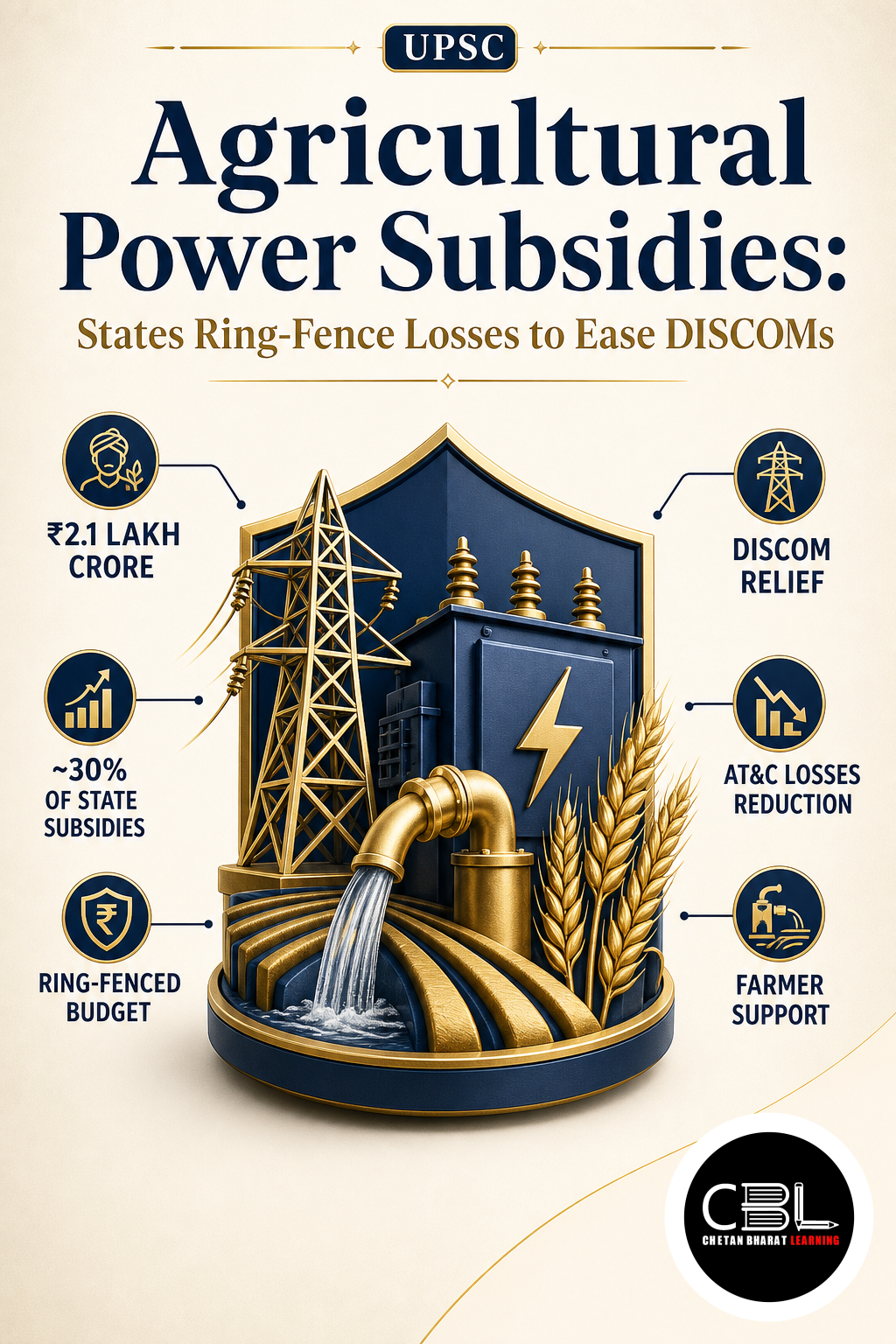
- Ring-Fencing: States are segregating agricultural losses into separate entities to improve DISCOM financial health.
- Large Scale: 13 major agrarian states, accounting for 99% of India’s agricultural electricity sales, incurred over ₹1.3 lakh crore in farm power subsidies in FY25.
- Water-Power-Agriculture Nexus: Subsidised power encourages groundwater over-extraction, leading to water scarcity.
Challenges in Agricultural Power Subsidies
- Financial Stress: DISCOMs rely on state subsidies and cross-subsidies, making them vulnerable to delayed subsidy payments and cash-flow crises.
- Metering Issues: Unmetered connections make it difficult to assess consumption and losses accurately.
- Cross-Subsidy Burden: Commercial and industrial consumers bear the cost of subsidising agriculture, affecting industrial competitiveness.
- Environmental Impact: Cheap power encourages inefficient irrigation and groundwater depletion.
- Fiscal Burden: Agricultural subsidies constitute the largest component of state subsidy bills, straining state budgets.
Way Forward for Agricultural Power Subsidies
To address Agricultural Power Subsidies, a comprehensive reform approach is needed. Solarising agricultural feeders can reduce reliance on grid power and curb subsidies, while targeted subsidies—direct benefit transfers to farmers—can replace blanket subsidies. Metering agricultural connections, with smart meters, can improve accuracy and reduce losses.
Strengthening DISCOM finances through tariff rationalisation and reducing cross-subsidies is essential. States should adopt the Ujwal DISCOM Assurance Yojana (UDAY)-type reforms to improve operational efficiency. The objective should not be to eliminate support, but to make it fiscally and environmentally sustainable.
Prelims Practice Corner
Q1. How much did 13 major agrarian states spend on farm power subsidies in FY25?
- (a) ₹50,000 crore
- (b) ₹1.3 lakh crore
- (c) ₹1.9 lakh crore
- (d) ₹6.77 lakh crore
Answer: (b) They incurred over ₹1.3 lakh crore in farm power subsidies.
Q2. What is the total accumulated loss of public sector DISCOMs?
- (a) ₹3 lakh crore
- (b) ₹6.77 lakh crore
- (c) ₹7.11 lakh crore
- (d) ₹10 lakh crore
Answer: (b) DISCOMs have accumulated losses of ₹6.77 lakh crore.
Q3. Which states are creating separate agricultural DISCOMs?
- (a) Uttar Pradesh, Bihar, West Bengal
- (b) Telangana, Maharashtra, Haryana
- (c) Gujarat, Rajasthan, Madhya Pradesh
- (d) Tamil Nadu, Karnataka, Andhra Pradesh
Answer: (b) Telangana, Maharashtra, and Haryana are pursuing this plan.
Q4. What percentage of electricity consumption is attributed to agriculture?
- (a) 10%
- (b) 20%
- (c) 30%
- (d) 40%
Answer: (b) Agriculture accounts for nearly one-fifth (20%) of electricity consumption.
Q5. What is a key environmental concern associated with agricultural power subsidies?
- (a) Air pollution
- (b) Groundwater depletion
- (c) Deforestation
- (d) Soil erosion
Answer: (b) Subsidised power encourages groundwater over-extraction, depleting water resources.
Mains Practice Questions
Q1. Discuss the financial challenges faced by DISCOMs in India and the role of agricultural power subsidies in their financial stress. Suggest reforms for a sustainable power sector. (250 words, 15 marks)
Answer Structure:
- Intro: Introduce DISCOM financial stress and the role of agricultural subsidies.
- Body: Discuss the scale of subsidies, DISCOM losses, and ring-fencing efforts. Analyse challenges: delayed subsidies, cross-subsidy burden, water-power nexus. Suggest reforms: solarisation, metering, targeted subsidies, tariff rationalisation.
- Conclusion: Emphasise a balanced approach—financial sustainability without burdening farmers.
Q2. What is the water-power-agriculture nexus, and why is it important for sustainable development? (150 words, 10 marks)
Answer Structure:
- Intro: Define the nexus as the interlinkage between water, energy, and agriculture.
- Body: Explain that subsidised power leads to excessive groundwater pumping, causing depletion. This in turn affects agricultural sustainability and energy demand. Sustainable solutions include solar irrigation and efficient water use.
- Conclusion: Conclude that integrated policy is needed to address the nexus holistically.
FAQs on Agricultural Power Subsidies
What are agricultural power subsidies?
They are the difference between the cost of supplying electricity to farmers and the subsidised tariff they pay, financed by state subsidies, cross-subsidies, or DISCOM losses.
Why are states ring-fencing agricultural losses?
To clean up DISCOM balance sheets, making them financially viable for privatisation or public offerings, and to segregate losses from profitable segments.
What is the water-power-agriculture nexus?
It is the interlinkage where subsidised power for irrigation leads to excessive groundwater pumping, causing water scarcity and affecting agricultural sustainability.
Related Current Affairs
Preparing for UPSC, PCS or HCS?
Talk to a mentor at Chetan Bharat Learning, Chandigarh. Free guidance on choosing the right exam and building a study plan.
Chat on WhatsAppCall 97793 53345UPSC / IAS / PCS coaching in Chandigarh · Trusted by aspirants across Punjab & Haryana
Leave a Reply
You must be logged in to post a comment.