
UPSC Mapping
- Prelims: Government Acts, Examination Reforms and Institutions
- Mains: GS Paper II – Governance, Transparency and Accountability
Quick Facts
| Original Act | 2024 |
|---|---|
| Amendment | 2026 Bill |
| Coverage | Central Public Examinations |
| Objective | Fairness and Credibility |
What is the Public Examinations Amendment Bill?
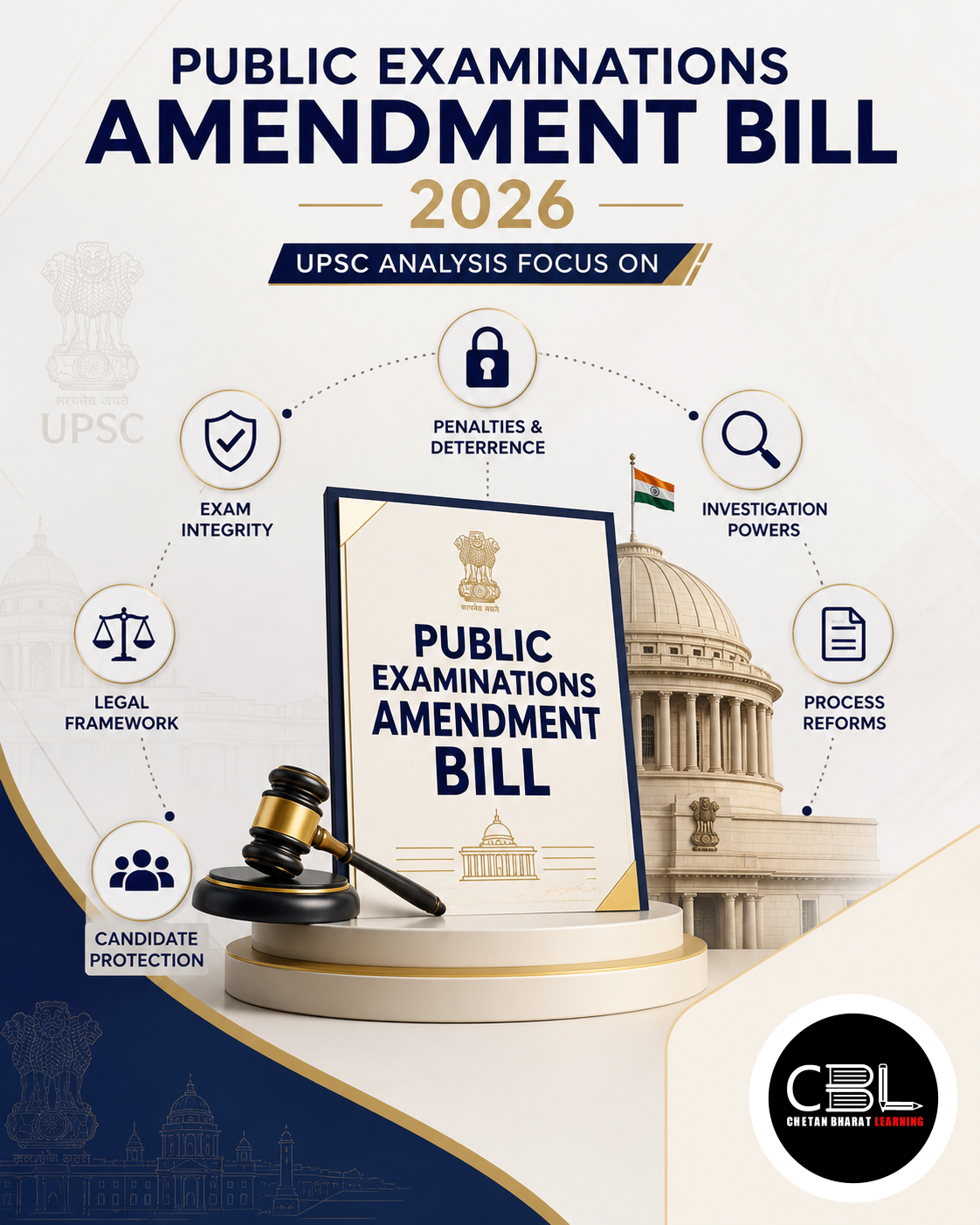
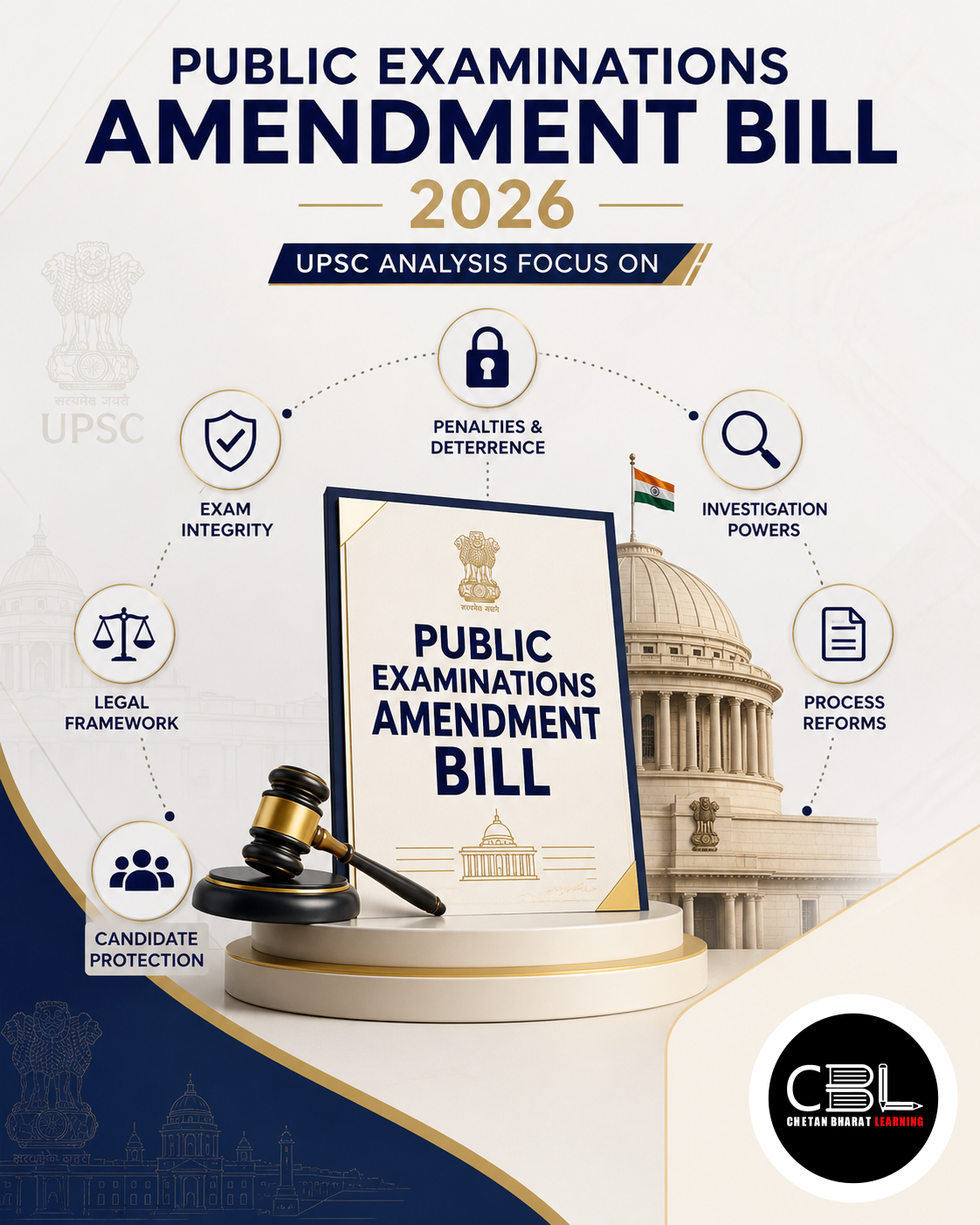
The Public Examinations Amendment Bill seeks to strengthen the legal framework established by the Public Examinations (Prevention of Unfair Means) Act, 2024. Its primary objective is to curb examination malpractices, ensure transparent recruitment and restore public confidence in competitive examinations.
The legislation applies to examinations conducted by institutions such as the UPSC, Staff Selection Commission (SSC), Railway Recruitment Boards (RRBs), National Testing Agency (NTA), Institute of Banking Personnel Selection (IBPS) and any other examination notified by the Central Government.
Why is the Public Examinations Amendment Bill in News?
The Public Examinations Amendment Bill was introduced following concerns over repeated examination paper leaks and organised cheating networks. The proposed amendments focus on faster investigations, stricter penalties and dedicated judicial mechanisms for examination-related offences.
The government has also announced a High-Powered Task Force on examination reforms headed by Nandan Nilekani to recommend technology-driven improvements in the examination ecosystem. Official updates are available through the PIB.
Key Features of the Public Examinations Amendment Bill
The Bill introduces several institutional and procedural reforms.
- Coverage of examinations: Applies to UPSC, SSC, RRBs, NTA, IBPS and other notified public examinations.
- Special Task Forces (STFs): Empowers the Central Government to establish dedicated investigation teams for examination-related offences.
- Time-bound investigations: All investigations must be completed within 60 days, irrespective of the investigating agency.
- Fast Track Courts: States and Union Territories will designate Special Fast Track Courts to conclude trials within three months of filing the chargesheet.
- Restrictions on adjournments: Courts may not grant adjournments beyond the next working day except for recorded exceptional reasons.
- Special Public Prosecutors: States and UTs may appoint dedicated prosecutors for offences under the Act.
- Time-bound appeals: Appeals against bail, conviction or sentence must ordinarily be filed within 30 days, with a maximum extension of 90 days.
Enhanced Punishments
The Bill significantly increases penalties to deter organised examination fraud.
- General offences: Punishment increased from 3–5 years to 5–10 years imprisonment and fine up to ₹50 lakh.
- Service providers: Institutional penalty enhanced from ₹1 crore to ₹5 crore.
- Directors and management: Existing imprisonment retained at 3–10 years while maximum fine rises to ₹5 crore.
- In-charge personnel: Minimum imprisonment enhanced to 5 years with fine up to ₹5 crore.
- Organised crime: Minimum imprisonment increased from 5 years to 7 years, while maximum fine rises to ₹10 crore.
High-Powered Task Force on Examination Reforms
The Union Government has constituted a High-Powered Task Force chaired by technology expert Nandan Nilekani. The committee has been tasked with recommending structural and technological reforms to strengthen the integrity of public examinations.
Other members include Tapan Deka, S. Somnath, V. Kamakoti, Anita Karwal and Amrit Lal Meena, representing expertise in security, technology, education and governance.
Challenges
Implementation will require strong coordination among multiple agencies.
- Capacity constraints: Fast investigations demand adequate manpower and forensic capabilities.
- Inter-agency coordination: Police, investigating agencies and courts must function seamlessly.
- Technology adoption: Examination bodies require secure digital infrastructure.
- Federal cooperation: States must establish dedicated courts and prosecutors promptly.
- Balancing deterrence and fairness: Strict penalties should be accompanied by due process safeguards.
Way Forward
The proposed amendments strengthen the legal response to examination fraud by combining tougher punishments with time-bound investigation and trial. Effective implementation will depend on institutional capacity, technological safeguards and coordination between the Centre and States.
Continuous examination reforms, secure digital systems and transparent recruitment processes can improve public trust in competitive examinations.
Prelims Practice Corner
Q1. The Public Examinations (Prevention of Unfair Means) Act was enacted in:
(a) 2022 (b) 2023 (c) 2024 (d) 2025
Answer: (c) 2024.
Q2. Under the proposed amendment, investigations must ordinarily be completed within:
(a) 30 days (b) 45 days (c) 60 days (d) 90 days
Answer: (c) 60 days.
Q3. The High-Powered Task Force on examination reforms is chaired by:
(a) S. Somnath (b) Nandan Nilekani (c) Tapan Deka (d) V. Kamakoti
Answer: (b) Nandan Nilekani.
Q4. Which of the following examinations is covered under the Act?
(a) UPSC (b) SSC (c) NTA examinations (d) All of the above
Answer: (d) All of the above.
Q5. Appeals under the amended framework are to be heard by:
(a) Single Judge Bench (b) District Court (c) Division Bench of the High Court (d) Supreme Court directly
Answer: (c) Division Bench of the High Court.
Mains Practice Questions
Q1. Examine the significance of the Public Examinations Amendment Bill, 2026 in strengthening transparency and accountability in public recruitment. (10 marks)
Answer Structure:
- Intro: State the objective of the amendment.
- Body: Faster investigation, dedicated courts, enhanced penalties, institutional reforms, implementation challenges.
- Conclusion: Link examination integrity with good governance.
Q2. Discuss the role of technology and institutional reforms in ensuring fair and credible public examinations in India. (15 marks)
Answer Structure:
- Intro: Highlight recent examination challenges.
- Body: Digital security, legal reforms, governance mechanisms, accountability and technology.
- Conclusion: Emphasise transparent and merit-based recruitment.
FAQs on Public Examinations Amendment Bill
What is the objective of the Public Examinations Amendment Bill?
The Bill aims to strengthen the 2024 Act by ensuring fair public examinations through stricter penalties, faster investigations and dedicated judicial mechanisms.
Which examinations are covered under the Act?
It covers examinations conducted by UPSC, SSC, Railway Recruitment Boards, NTA, IBPS and other examinations notified by the Central Government.
Why is the Bill important for UPSC?
It is relevant for GS Paper II under governance, transparency, accountability, public administration and institutional reforms in India’s examination system.
Related Current Affairs
Preparing for UPSC, PCS or HCS?
Talk to a mentor at Chetan Bharat Learning, Chandigarh. Free guidance on choosing the right exam and building a study plan.
Chat on WhatsAppCall 97793 53345UPSC / IAS / PCS coaching in Chandigarh · Trusted by aspirants across Punjab & Haryana
Leave a Reply
You must be logged in to post a comment.