

UPSC Mapping
| Exam Component | Details |
|---|---|
| Prelims | Science & Technology |
| Mains | GS Paper 3 (Science & Technology) |
Article
What are Reusable Rockets?
Reusable Rockets are launch vehicles designed to return to Earth substantially intact and be launched multiple times. They deploy controlled descent technologies, including landing legs, grid fins for atmospheric control, and advanced guidance systems. Reusability significantly reduces the cost of access to space, as traditional expendable rockets are used only once.
SpaceX’s Falcon 9 is the world’s first orbital-class reusable rocket. India’s Reusable Launch Vehicle – Technology Demonstrator (RLV-TD) is an effort towards developing essential technologies for a fully reusable launch vehicle. Reusable rockets also reduce space junk, as they do not leave spent stages in orbit.
Why are Reusable Rockets in News?
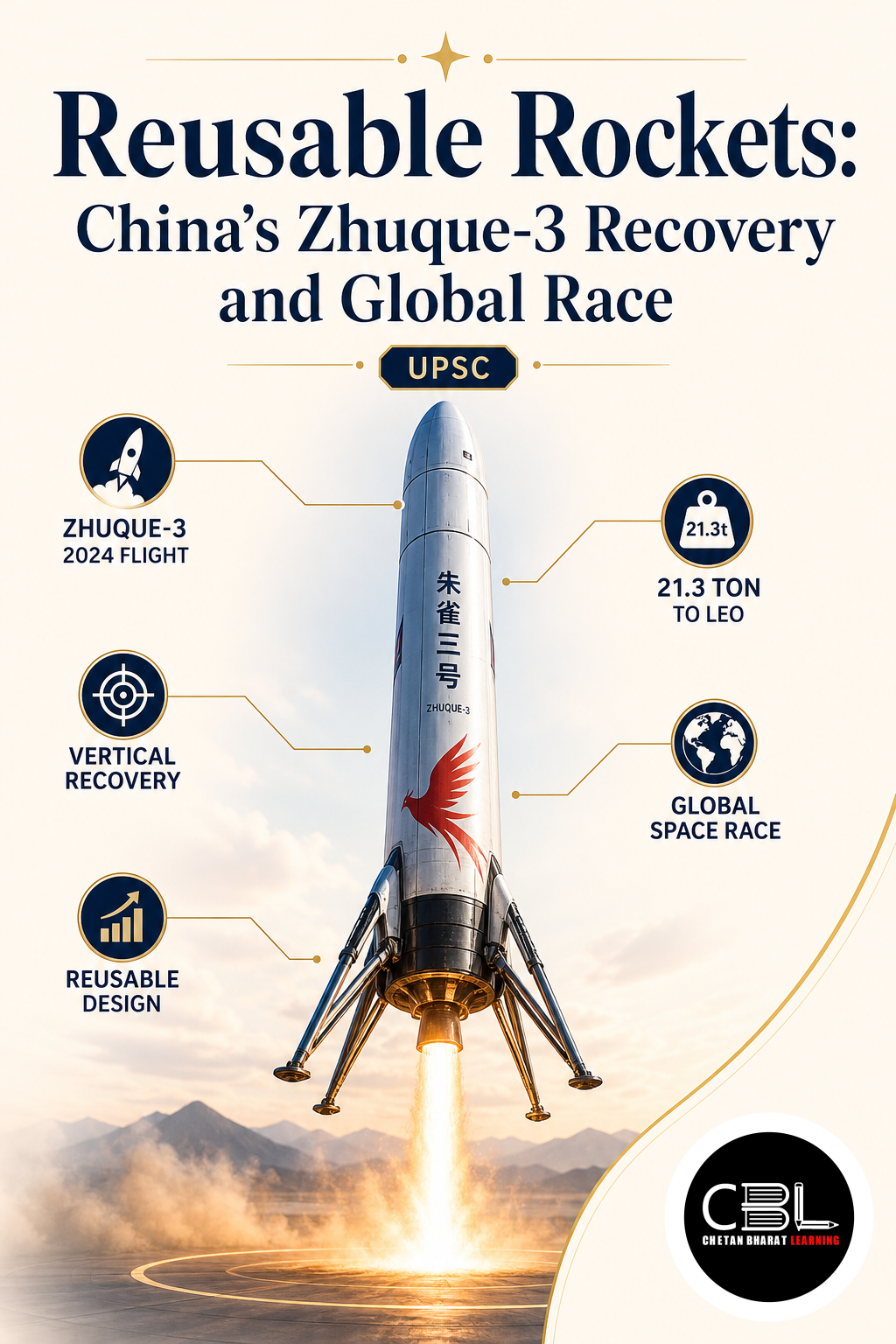
Reusable Rockets are in the news because China successfully recovered the first stage of its Zhuque-3 rocket on land, marking a significant achievement in its reusable rocket programme. This follows a successful sea-platform recovery in July, indicating rapid progress in China’s space capabilities.
The global race for reusable rockets is intensifying, with SpaceX, China, and India all developing technologies. ISRO’s RLV-TD is a key step towards achieving India’s reusable launch vehicle capability. For more details, refer to this PIB release.
Key Features of Reusable Rockets
Reusable Rockets have several distinctive features:
- Controlled Descent: Uses landing legs, grid fins, and guidance systems for recovery.
- Cost Reduction: Reusability significantly lowers launch costs.
- Reduced Space Junk: Does not leave spent stages in orbit.
- Advanced Materials: Uses composite materials for high efficiency.
- Global Race: SpaceX, China, and ISRO are developing reusable systems.
Challenges in Reusable Rockets
Reusable Rockets face several challenges:
- Technical Complexity: Re-entry and landing are technologically challenging.
- Cost of Development: R&D for reusable systems is expensive.
- Maintenance: Reusable rockets require refurbishment after each flight.
- Payload Penalty: Reusability reduces payload capacity compared to expendable rockets.
- Reliability: Ensuring consistent and safe recovery is critical.
Way Forward for Reusable Rockets
To advance Reusable Rockets, continued investment in R&D and testing is essential. International collaboration can accelerate technology development and share costs. Clear regulatory frameworks for reusable launch vehicles can facilitate commercialisation.
India should accelerate its RLV-TD programme with a clear roadmap and adequate funding. Learning from SpaceX’s iterative approach can inform India’s strategy. For international best practices, refer to NASA.
Quick Facts
| Key Example | India’s Effort |
|---|---|
| Falcon 9 (SpaceX) | RLV-TD |
Prelims Practice Corner
Q1. What is the world’s first orbital-class reusable rocket?
(a) Zhuque-3 (b) Falcon 9 (c) RLV-TD (d) Starship
Answer: (b) Falcon 9 is the first orbital-class reusable rocket.
Q2. Which Chinese rocket achieved land recovery?
(a) Long March 5 (b) Zhuque-3 (c) Kuaizhou (d) Ceres-1
Answer: (b) Zhuque-3 achieved land recovery.
Q3. What is ISRO’s reusable rocket technology demonstrator called?
(a) GSLV (b) PSLV (c) RLV-TD (d) SSLV
Answer: (c) ISRO’s RLV-TD is the reusable technology demonstrator.
Q4. What is a major advantage of reusable rockets?
(a) Higher speed (b) Lower cost per launch (c) Larger payload (d) Simpler design
Answer: (b) Reusability significantly reduces launch costs.
Q5. What do reusable rockets help reduce?
(a) Fuel consumption (b) Space junk (c) Launch time (d) Ground infrastructure
Answer: (b) They reduce space junk by not leaving spent stages in orbit.
Mains Practice Questions
Q1. Discuss the significance of reusable rocket technology for space exploration and commercial space activities. (250 words, 15 marks)
- Intro: Introduce reusable rockets and their importance.
- Body: Discuss the technology, cost benefits, and reduced space junk. Analyse the global race, with examples from SpaceX, China, and ISRO. Address challenges and the need for sustained investment.
- Conclusion: Emphasise the transformative potential of reusability.
Q2. What is ISRO’s Reusable Launch Vehicle – Technology Demonstrator (RLV-TD) programme? (150 words, 10 marks)
- Intro: Define the RLV-TD programme.
- Body: Explain its objective: to develop essential technologies for a fully reusable launch vehicle. Mention the test flights and their significance for India’s space ambitions.
- Conclusion: Conclude that RLV-TD is a step towards cost-effective space access.
FAQs on Reusable Rockets
What are reusable rockets?
They are launch vehicles designed to be recovered and reused for multiple launches.
What is the benefit of reusable rockets?
They reduce the cost of access to space and minimise space debris.
What is India’s reusable rocket programme?
ISRO’s Reusable Launch Vehicle – Technology Demonstrator (RLV-TD) programme.
Related Current Affairs
Preparing for UPSC, PCS or HCS?
Talk to a mentor at Chetan Bharat Learning, Chandigarh. Free guidance on choosing the right exam and building a study plan.
Chat on WhatsAppCall 97793 53345UPSC / IAS / PCS coaching in Chandigarh · Trusted by aspirants across Punjab & Haryana
Leave a Reply
You must be logged in to post a comment.