
UPSC Mapping
| Exam | Topics |
|---|---|
| Prelims | Environment, Pollution and Waste Management |
| Mains | GS Paper III – Environmental Pollution and Conservation |
Quick Facts
| Major Source | Key Pollutants | Pollution Indicators | Regulatory Framework |
|---|---|---|---|
| Municipal Landfills | Ammonia, Organics and Heavy Metals | BOD and COD | SWM Rules, 2026 |
Article
What is Landfill Leachate?
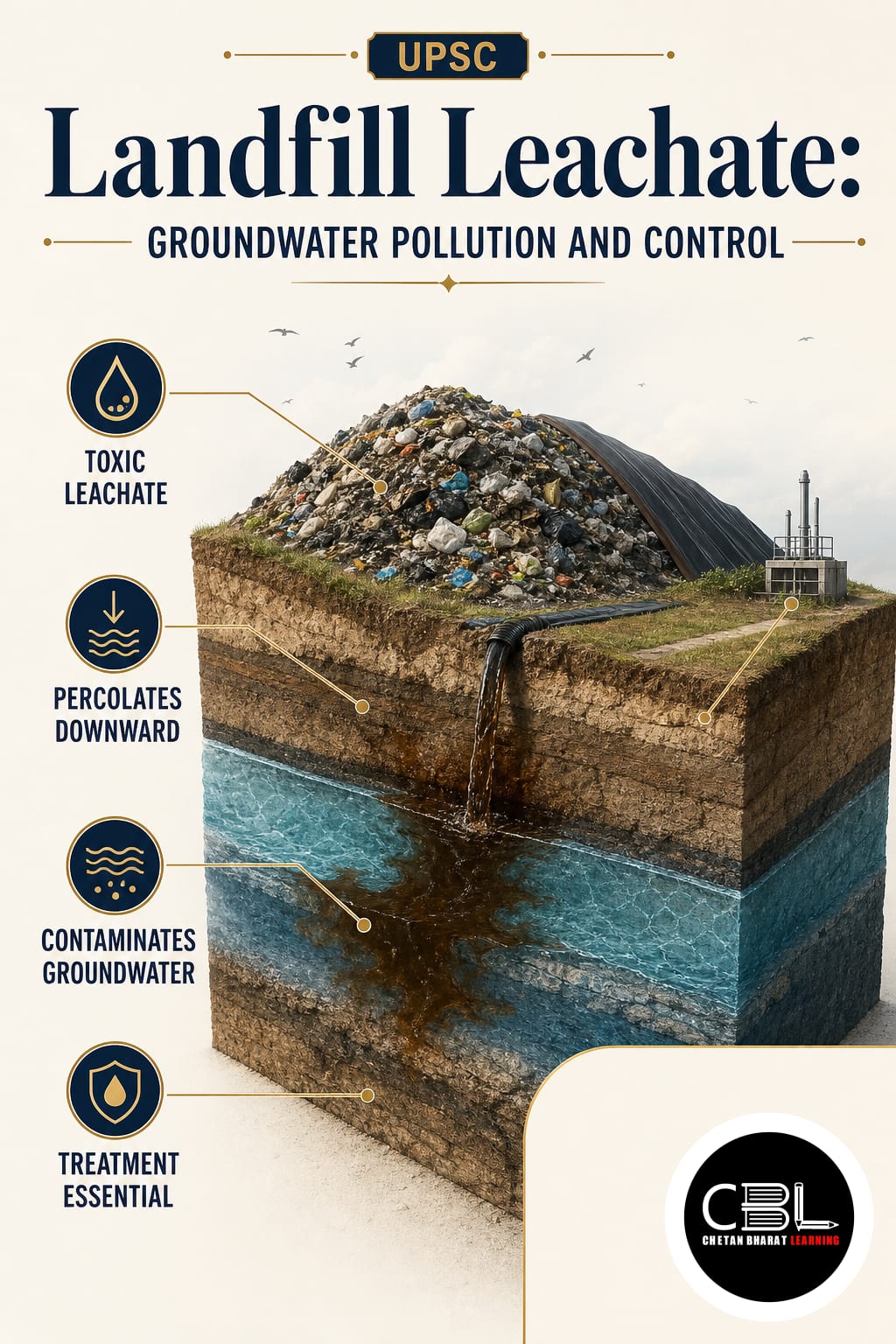
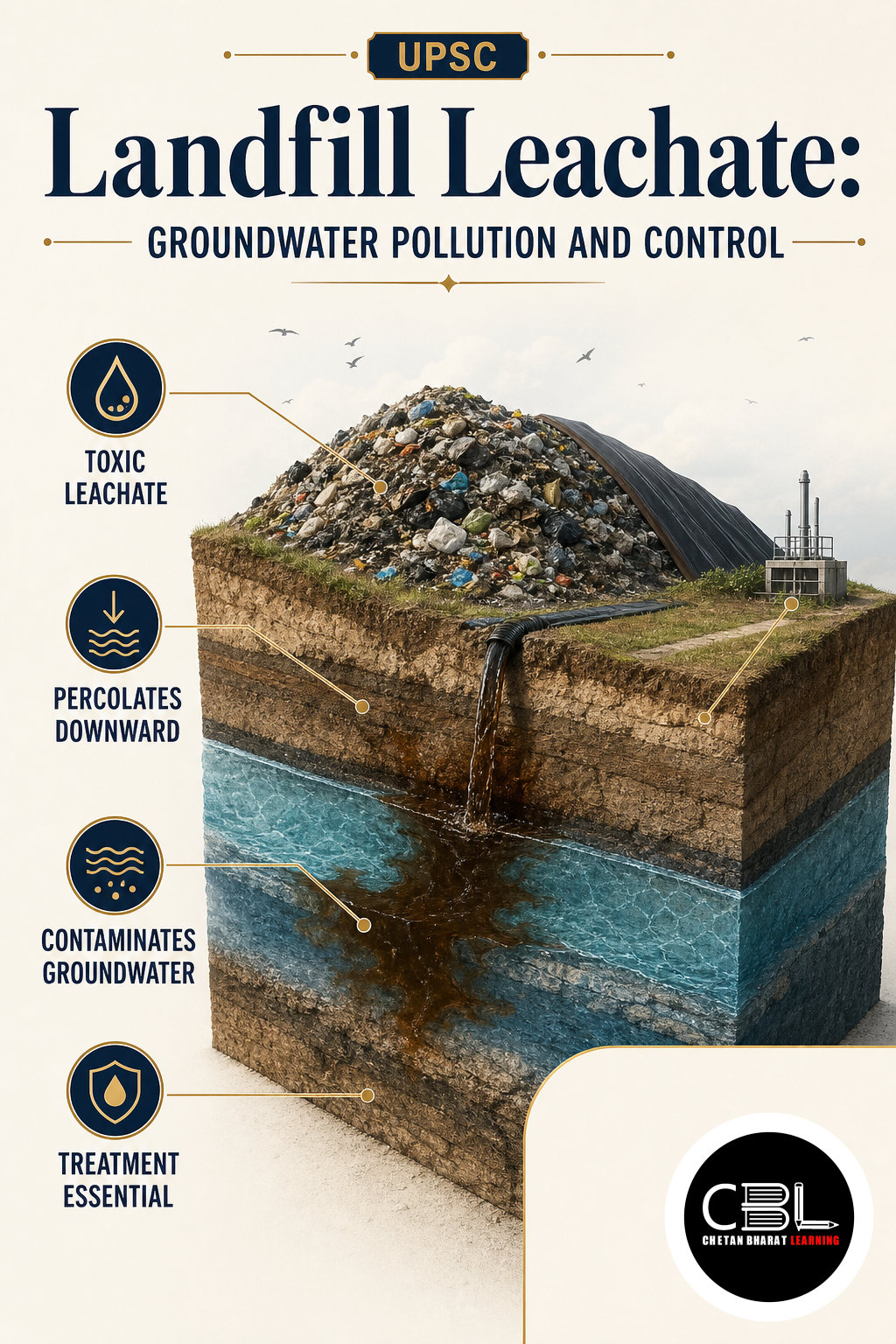
Landfill leachate is a potentially toxic liquid produced when rainwater and moisture pass through decomposing solid waste, dissolving organic and inorganic pollutants and carrying them into the surrounding environment.
Leachate commonly contains ammonia, dissolved organic matter, salts, heavy metals and other chemical contaminants. Its composition depends on waste type, landfill age, moisture content, temperature and biological activity.
As oxygen becomes depleted, anaerobic microorganisms break down biodegradable materials, generating methane, volatile fatty acids and dissolved organic carbon. Water percolating through the waste carries these substances into soil and groundwater.
Young leachate generally has high concentrations of biodegradable organic pollutants with elevated Biochemical Oxygen Demand (BOD) and Chemical Oxygen Demand (COD). Mature leachate typically contains higher ammoniacal nitrogen and humic substances, with a declining BOD-to-COD ratio as easily degradable material decreases.
Why in News?
A recent assessment detected hazardous substances, including cadmium, in groundwater near Delhi’s Ghazipur landfill—concentrations exceeded drinking-water limits at some sites. Untreated leachate from landfills can migrate through soil and aquifers, especially during rainfall and groundwater flow.
The Down To Earth report (1 Oct 2026) also highlighted overflow of untreated leachate at Haryana’s Bandhwari landfill. These findings underscore the need for engineered landfills, continuous monitoring and adequate treatment facilities.
Key Features
- Formation process: Rainwater and moisture dissolve pollutants as they percolate through decomposing waste.
- Biochemical Oxygen Demand (BOD): Oxygen required by microorganisms to decompose biodegradable organics.
- Chemical Oxygen Demand (COD): Oxygen equivalent needed to chemically oxidise organic pollutants.
- Young landfill: High biodegradable organics, elevated BOD and COD.
- Mature landfill: Higher ammoniacal nitrogen and humic compounds, lower BOD-to-COD ratio.
- Heavy metals: Cadmium, lead, chromium, copper, zinc—mobility depends on pH and chemical conditions.
- Groundwater risk: Unlined or poorly maintained sites allow leachate infiltration into aquifers.
- Emerging contaminants: Pharmaceuticals, microplastics and persistent industrial chemicals may be present.
Challenges
- Groundwater pollution: Requires costly, long-term remediation.
- Inadequate infrastructure: Many older dumps lack liners, drains and treatment facilities.
- Variable composition: Leachate characteristics change with landfill age, season and waste mix.
- High treatment costs: Advanced technologies and monitoring demand significant investment.
- Monsoon impact: Heavy rainfall increases leachate generation and overflow risk.
- Ecological damage: Contaminated liquid harms soil, wetlands and aquatic life.
- Poor segregation: Mixed waste complicates treatment and reduces resource recovery.
Way Forward
India should adopt scientifically engineered landfills with impermeable liners, drainage systems, leachate collection and treatment. Regular inspections and preventive maintenance are essential.
Treatment technologies—biological, chemical and membrane processes—must suit leachate composition. Groundwater monitoring should measure BOD, COD, ammoniacal nitrogen, dissolved solids and heavy metals.
The Solid Waste Management Rules, 2026 mandate leachate collection and treatment and prohibit untreated discharge. They also strengthen waste segregation into wet, dry, sanitary and special categories.
Municipal bodies must accelerate legacy waste remediation, improve stormwater handling and enforce compliance. Effective control of landfill leachate combines prevention, segregation, treatment infrastructure and continuous monitoring to protect groundwater and support sustainable urban development.
Prelims Practice Corner
Q1. What is the primary process responsible for the formation of leachate in municipal landfills?
- (a) Condensation of atmospheric gases
- (b) Water percolating through decomposing waste
- (c) Evaporation of groundwater
- (d) Combustion of organic material
Answer: (b) Water percolating through decomposing waste dissolves organic and inorganic contaminants.
Q2. Consider the following statements regarding landfill leachate:
1. Young leachate generally has high concentrations of biodegradable organic matter.
2. Mature leachate often contains relatively high ammoniacal nitrogen concentrations.
3. The BOD-to-COD ratio generally increases as leachate matures.
Which statements are correct?
- (a) 1 and 3 only
- (b) 2 and 3 only
- (c) 1 and 2 only
- (d) 1, 2 and 3
Answer: (c) Statements 1 and 2 are correct. The BOD-to-COD ratio generally decreases as biodegradable organics decline.
Q3. Which of the following heavy metals was highlighted in reports of groundwater contamination near Delhi’s Ghazipur landfill?
- (a) Cadmium
- (b) Sodium
- (c) Calcium
- (d) Magnesium
Answer: (a) Cadmium.
Q4. Consider the following statements about the Solid Waste Management Rules, 2026:
1. They came into effect on 1 April 2026.
2. They require arrangements for leachate collection and treatment at landfills.
3. They allow untreated leachate to be discharged during heavy rainfall.
Which statements are correct?
- (a) 1 only
- (b) 2 and 3 only
- (c) 1, 2 and 3
- (d) 1 and 2 only
Answer: (d) Statements 1 and 2 are correct. Untreated discharge is prohibited.
Q5. Which statement correctly distinguishes BOD from COD?
- (a) BOD measures heavy metals, while COD measures soil acidity.
- (b) Both exclusively measure dissolved oxygen already present in water.
- (c) BOD reflects microbial oxygen demand, while COD measures chemically oxidisable substances.
- (d) COD measures only nitrogen compounds in drinking water.
Answer: (c) BOD indicates biological oxygen demand; COD measures chemically oxidisable substances.
Mains Practice Questions
Q1. Landfill leachate poses significant threats to groundwater quality and environmental sustainability in Indian cities. Discuss its formation, environmental impacts and management challenges. (15 marks)
Answer Structure:
- Introduction: Define landfill leachate and explain its formation process.
- Body: Cover anaerobic decomposition, BOD/COD, heavy metal contamination, groundwater pollution, infrastructure gaps, monsoon risks and treatment challenges.
- Conclusion: Recommend engineered landfills, scientific waste segregation, treatment facilities and groundwater monitoring.
Q2. Examine the importance of scientific solid waste management in preventing groundwater contamination, with reference to the Solid Waste Management Rules, 2026. (10 marks)
Answer Structure:
- Introduction: Highlight the link between waste disposal and groundwater pollution.
- Body: Explain segregation, engineered liners, leachate collection/treatment, monitoring, municipal roles and implementation challenges.
- Conclusion: Emphasise stronger local governance, investment in infrastructure and enforcement of rules.
Frequently Asked Questions
What is landfill leachate and why is it harmful?
Landfill leachate is contaminated liquid generated when water moves through decomposing waste. It carries organic pollutants, ammonia and heavy metals into soil and groundwater, posing environmental and health risks.
What is the difference between young and mature leachate?
Young leachate has high biodegradable organics and elevated BOD/COD. Mature leachate shows a lower BOD-to-COD ratio, with higher ammoniacal nitrogen and persistent organic compounds.
How can groundwater pollution from landfill leachate be prevented?
Prevention requires engineered landfill liners, leachate collection and treatment, effective drainage and regular groundwater monitoring. Waste segregation and compliance with the Solid Waste Management Rules, 2026 are also crucial.
Related Current Affairs
Preparing for UPSC, PCS or HCS?
Talk to a mentor at Chetan Bharat Learning, Chandigarh. Free guidance on choosing the right exam and building a study plan.
Chat on WhatsAppCall 97793 53345UPSC / IAS / PCS coaching in Chandigarh · Trusted by aspirants across Punjab & Haryana
Leave a Reply
You must be logged in to post a comment.