
UPSC Mapping
| Prelims | Environment and Ecology |
|---|---|
| Mains | GS Paper 3 (Environment & Economy) |
| Nodal Ministry | Ministry of Power |
|---|---|
| Administrator | Bureau of Energy Efficiency |
| Global Link | U.K. CBAM |
What is the Carbon Credit Scheme?
The Carbon Credit Scheme is India’s domestic market-based mechanism designed to decarbonize the national economy systematically. It establishes a comprehensive regulatory framework for trading carbon credits among high-emission industrial sectors, directly supporting India’s Panchamrit goals and the net-zero emissions target by 2070.
The scheme mandates emission caps for sectors like steel, cement and aluminium. Entities exceeding their reduction targets can purchase credits from those achieving surplus reductions. This market-driven approach ensures cost-effective emission reductions. It evolves from the earlier Perform, Achieve and Trade (PAT) scheme, shifting focus from energy efficiency targets to absolute carbon caps, with rigorous verification by accredited auditors and a central registry to prevent double-counting.
Why is the Carbon Credit Scheme in News?
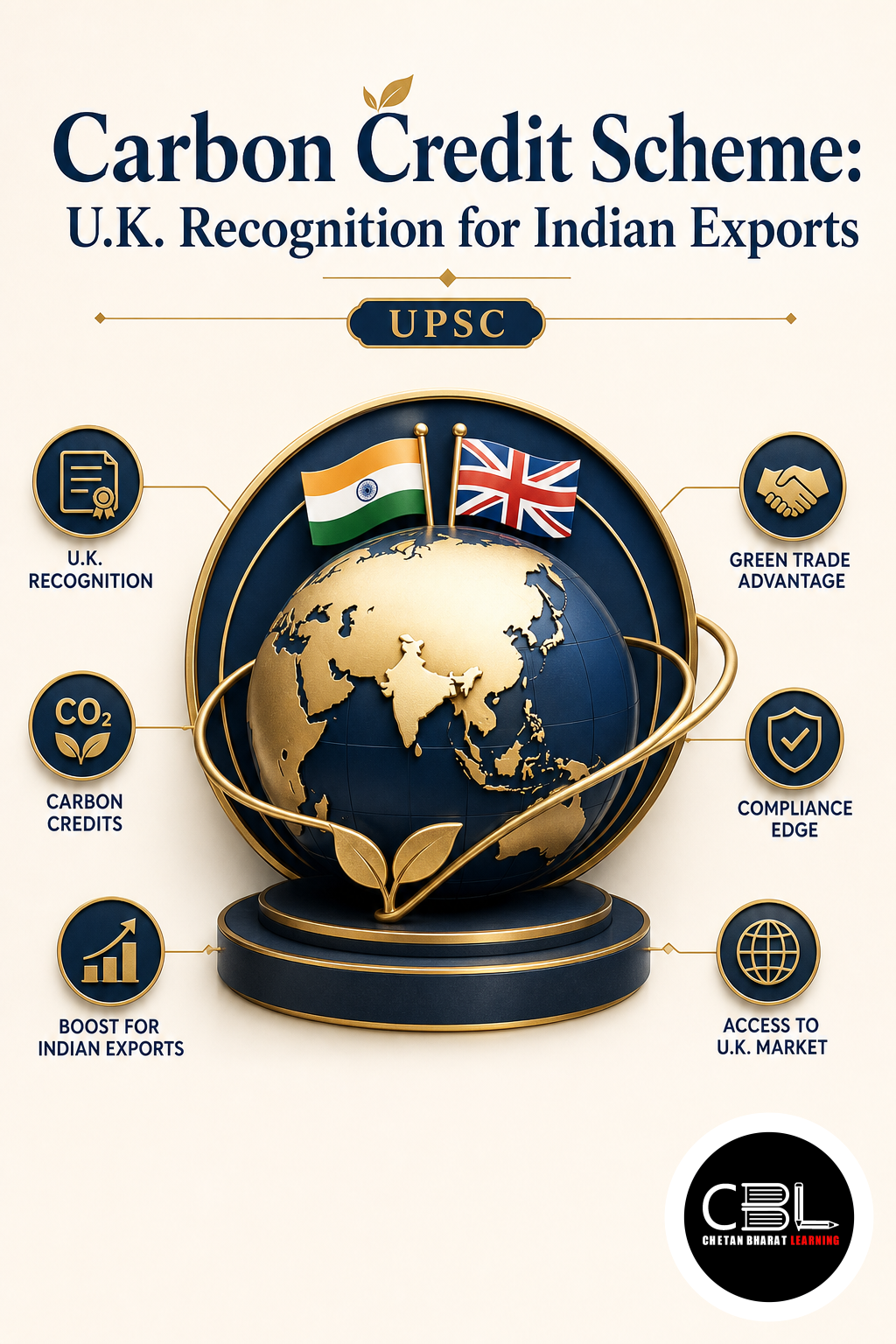
The United Kingdom recently included the Indian Carbon Credit Scheme in its indicative list of qualifying overseas carbon-pricing mechanisms under its Carbon Border Adjustment Mechanism. Indian exporters can now claim legitimate carbon-price relief for emissions priced domestically, preventing double taxation on goods entering the U.K. market.
This recognition validates India’s robust domestic carbon accounting standards, protecting profit margins of exporters and attracting green finance. It sets a precedent for mutual recognition agreements with other trading partners.
Key Features of the Carbon Credit Scheme
- Regulatory Oversight: Administered by the Bureau of Energy Efficiency with transparent trading protocols.
- Sectoral Coverage: Targets high-emission industries such as steel, cement and aluminium.
- Market Mechanism: Creates a platform where verified emission reductions are tradable assets.
- International Alignment: Facilitates mutual recognition with systems like the EU ETS and U.K. CBAM.
- Revenue Generation: Proceeds fund energy-efficient upgrades and green technologies.
- Phased Implementation: Allows industries time to adapt reporting requirements.
- Penalty Mechanisms: Imposes strict fines for non-compliance.
Challenges in Implementation
- Measurement Complexities: Accurate verification across diverse sectors is resource-intensive.
- Market Liquidity: Low trading volumes limit price discovery.
- Compliance Costs: SMEs may lack funds for monitoring and reporting.
- Data Integrity: Preventing greenwashing is critical for credibility.
- Policy Uncertainty: Frequent regulatory changes can disrupt long-term planning.
- Technological Barriers: Limited access to advanced low-carbon technologies.
- Global Trade Frictions: Varying carbon-pricing standards may cause disputes.
Way Forward
Expanding sectoral coverage will boost market liquidity and stabilize carbon prices. Investing in digital monitoring systems enhances transparency and accuracy. International collaboration to harmonize domestic standards with global best practices is essential. A just transition must protect vulnerable workers in carbon-intensive industries.
Prelims Practice Corner
Q1. Consider the following statements regarding the Carbon Credit Scheme (CCTS):
- It is administered by the Bureau of Energy Efficiency.
- It primarily targets the agricultural sector for emission reductions.
Answer: (a) 1 only. The CCTS targets high-emission industries like steel and cement, not agriculture.
Q2. The recent U.K. recognition of India’s carbon pricing framework is primarily relevant to which mechanism?
- (a) Paris Agreement
- (b) Carbon Border Adjustment Mechanism (CBAM)
- (c) Kyoto Protocol
- (d) Montreal Protocol
Answer: (b) Carbon Border Adjustment Mechanism.
Q3. Which ministry oversees the Bureau of Energy Efficiency in India?
- (a) Ministry of Environment, Forest and Climate Change
- (b) Ministry of Power
- (c) Ministry of New and Renewable Energy
- (d) Ministry of Heavy Industries
Answer: (b) Ministry of Power.
Q4. What is the primary purpose of a central registry in a carbon credit system?
- (a) To collect carbon taxes from citizens
- (b) To track issued and retired credits to prevent double-counting
- (c) To subsidize fossil fuel production
- (d) To ban all industrial emissions
Answer: (b) To track issued and retired credits and prevent double-counting.
Q5. The Indian Carbon Credit Scheme is an evolution of which earlier energy efficiency program?
- (a) National Solar Mission
- (b) Perform, Achieve and Trade (PAT)
- (c) UJALA
- (d) FAME India
Answer: (b) Perform, Achieve and Trade (PAT).
Mains Practice Questions
Q1. Discuss the significance of international recognition for India’s Carbon Credit Scheme in the context of global trade. (150 words, 10 marks)
Answer Structure:
- Intro: Define the Carbon Credit Scheme and mention recent U.K. recognition.
- Body: Significance – prevents double taxation via CBAM relief; boosts export competitiveness; validates domestic accounting; attracts green FDI; challenges – market liquidity; compliance costs.
- Conclusion: Continuous alignment with global standards is needed to sustain trade advantages.
Q2. “Market-based mechanisms are essential for achieving India’s net-zero targets without compromising economic growth.” Critically examine. (250 words, 15 marks)
Answer Structure:
- Intro: Context – India’s net-zero by 2070 goal; role of market instruments like CCTS.
- Body: Advantages – cost-effective decarbonization; revenue for green tech; global trade alignment; criticisms – risk of greenwashing; measurement complexities; MSME burden; mitigation – strong oversight; phased roll-out; capacity building.
- Conclusion: Well-regulated market mechanisms are indispensable for sustainable industrial growth.
FAQs on Carbon Credit Scheme
What is the primary objective of the Carbon Credit Scheme?
The primary objective is to decarbonize the Indian economy by creating a market-based mechanism that incentivizes high-emission industries to reduce their carbon footprint cost-effectively.
How does U.K. recognition benefit Indian exporters?
It allows Indian exporters to claim carbon-price relief under the U.K.’s Carbon Border Adjustment Mechanism, preventing double taxation and maintaining their competitiveness.
Which government body administers the Carbon Credit Scheme?
The Bureau of Energy Efficiency, under the Ministry of Power, acts as the central administrator of the scheme.
Related Current Affairs
Preparing for UPSC, PCS or HCS?
Talk to a mentor at Chetan Bharat Learning, Chandigarh. Free guidance on choosing the right exam and building a study plan.
Chat on WhatsAppCall 97793 53345UPSC / IAS / PCS coaching in Chandigarh · Trusted by aspirants across Punjab & Haryana
Leave a Reply
You must be logged in to post a comment.