

UPSC Syllabus Mapping
- GS Paper: GS-II & GS-III
- Subject: International Relations and Security — Global Groupings, India’s Interests, Defence Technology and Indigenisation
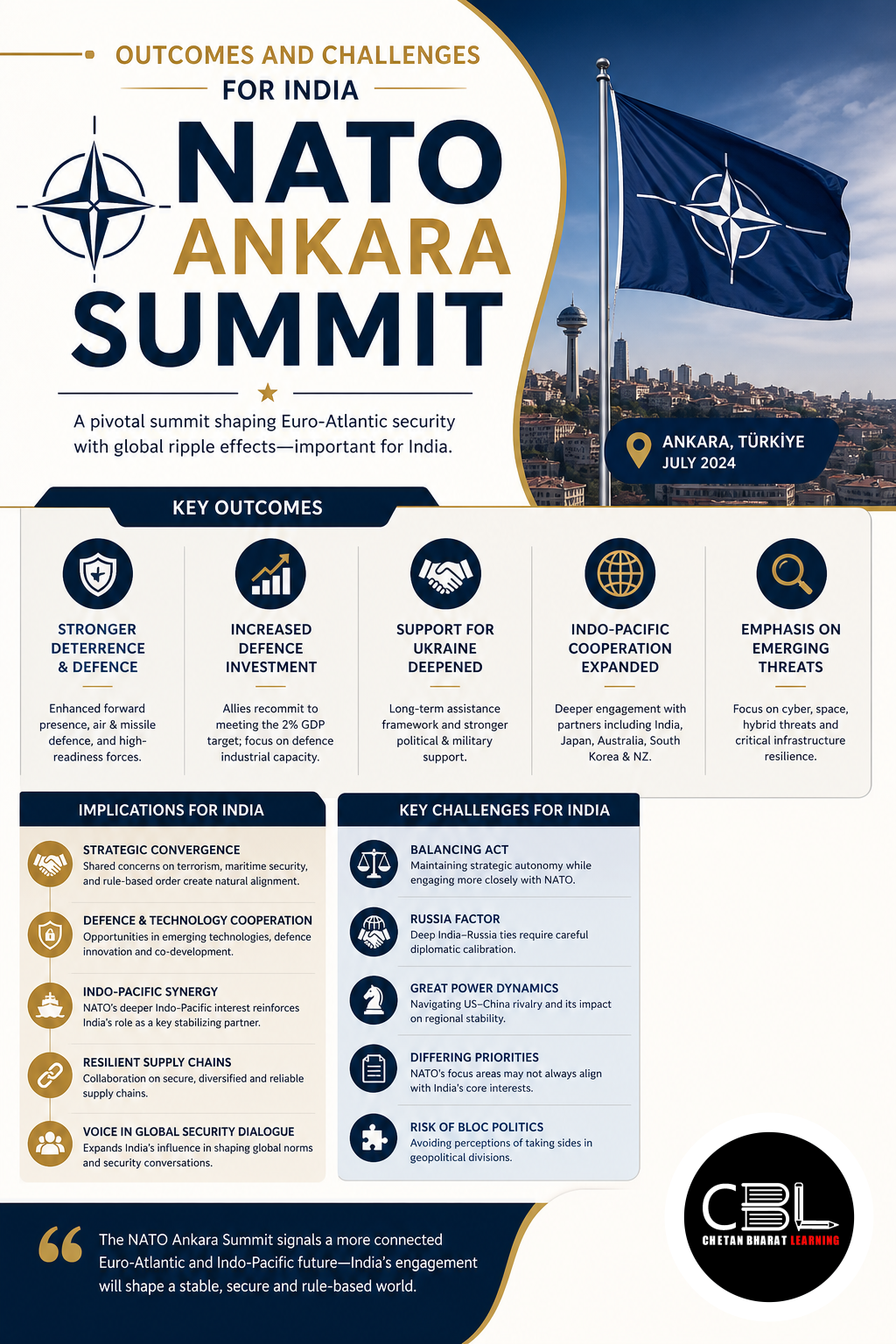
What is NATO Ankara Summit?
The summit is a meeting of leaders of the North Atlantic Treaty Organization, a political and military alliance comprising 32 member countries from Europe and North America. NATO was established through the North Atlantic Treaty, signed in 1949, with the core purpose of collective defence, political consultation and security cooperation among its members.
Article 5 of the Washington Treaty establishes that an armed attack against one or more allies is considered an attack against all, with each ally responding as deemed necessary. NATO decisions are taken by consensus. India is not a member and follows an independent foreign and security policy based on its strategic autonomy.
Why is NATO Ankara Summit in News?
The Ankara meeting focused on long-term commitments regarding defence expenditure, industrial capacity and continuing security challenges in Europe. Members reiterated the importance of collective defence and assistance to Ukraine’s sovereignty and territorial integrity. Discussions highlighted the need to translate higher defence expenditure into deployable capabilities, ammunition, technology and sustainable production capacity.
A key theme was expanding the transatlantic defence industrial base. Increased procurement demands require greater production of ammunition, air-defence systems, missiles and other equipment while maintaining technological innovation. As many manufacturers supply both NATO and non-member countries, this shift has global implications.
Key Features of NATO Ankara Summit
- Collective defence: Reaffirmation of Article 5 and transatlantic security relationship.
- Higher defence expenditure: Push for substantially greater national investment in defence capabilities.
- Ukraine assistance: Continued military, financial and strategic support for Ukraine.
- Industrial expansion: Increase production capacity across factories, laboratories and supply chains.
- Operational readiness: Linking expenditure to delivery of ammunition, equipment and deployable capability.
- Technology focus: Emphasis on drones, artificial intelligence, cyber, electronic warfare and advanced defence systems.
Challenges Related to NATO Ankara Summit for India
Competition for limited manufacturing capacity may lead Western manufacturers to prioritise NATO orders, causing longer delivery schedules for non-member countries like India. Supply constraints affect programmes dependent on a small number of overseas original equipment manufacturers.
Inventories of precision-guided weapons, air-defence interceptors and artillery ammunition can be depleted faster than production lines can replenish. Increased European demand from US suppliers intensifies competition for shared production capacity. India must assess vulnerabilities in engines, electronics, sensors, semiconductors and replacement parts.
Programmes incorporating foreign subsystems risk delays if critical imported components are delayed, affecting overall production schedules. As warfare increasingly relies on advanced technologies, such dependencies become more consequential.
Way Forward for India’s Defence Preparedness
India should pursue deeper indigenisation in propulsion, aero-engines, sensors, electronic warfare, semiconductors, autonomous systems and precision munitions. A robust domestic ecosystem with research institutions, public-sector manufacturers, private industry and start-ups is essential.
Production scale matters: domestic systems offer limited protection if critical components cannot be rapidly manufactured during emergencies. India can build surge capacity for ammunition, diversify supply relationships and maintain reserves of strategic components. Foreign procurement should emphasise local production, technology partnerships and resilient maintenance arrangements.
The broader objective is strategic autonomy backed by industrial capability. India can balance multiple defence partnerships while reducing single-source vulnerabilities and strengthening indigenous technological depth.
Prelims Practice Corner
- With reference to NATO, consider the following statements:
- It was established through the Washington Treaty.
- Article 5 concerns collective defence.
- India is a member of NATO.
Which are correct? (a) 1 only (b) 1 and 2 only (c) 2 and 3 only (d) 1, 2 and 3
Answer: (b) 1 and 2 only. - NATO currently consists of countries primarily from:
- (a) Europe and North America
- (b) South America and Africa
- (c) South and Southeast Asia
- (d) Africa and West Asia
Answer: (a) Europe and North America.
- Article 5 of the Washington Treaty is most closely associated with:
- (a) Common currency
- (b) Collective defence
- (c) Free movement of labour
- (d) Nuclear disarmament
Answer: (b) Collective defence.
- Which of the following can increase India’s vulnerability to disruptions in international defence supply chains?
- 1. Dependence on imported jet engines
- 2. Dependence on foreign electronic subsystems
- 3. Limited domestic ammunition production capacity
Select the correct answer: (a) 1 only (b) 1 and 2 only (c) 2 and 3 only (d) 1, 2 and 3
Answer: (d) 1, 2 and 3. - Strategic autonomy in defence is best strengthened by:
- (a) Dependence on a single foreign supplier
- (b) Indigenous technological capability combined with diversified partnerships
- (c) Eliminating domestic defence production
- (d) Restricting research to civilian technologies
Answer: (b) Indigenous capability and diversified partnerships.
Mains Practice Questions
- Expansion of NATO’s defence industrial capacity can have consequences extending far beyond the transatlantic alliance. Examine its implications for India’s defence preparedness. (10 marks)
Outline: Changing European security environment → rising procurement → global production constraints → ammunition and component shortages → implications for Indian programmes → need for indigenisation, diversification and strategic reserves.
- Defence indigenisation is not merely an industrial policy objective but an essential component of India’s strategic autonomy. Discuss. (15 marks)
Outline: Define strategic autonomy → foreign supply-chain vulnerabilities → propulsion and critical technologies → domestic DIB → private-public ecosystem → technology partnerships → surge capacity and inventories → balanced international partnerships.
FAQs on NATO Ankara Summit
What is Article 5 of NATO?
Article 5 embodies NATO’s collective-defence principle. It treats an armed attack against one or more covered allies as an attack against all, with each member assisting in accordance with the treaty.
Why do NATO’s defence-industrial plans matter to India?
Western manufacturers also supply equipment and components to countries outside the alliance. Higher NATO demand can therefore influence production priorities, delivery schedules, inventories and global defence supply chains.
How can India reduce defence supply-chain risks?
India can deepen indigenous R&D and manufacturing, build domestic capacity in critical technologies, diversify external suppliers, expand local production and maintain adequate reserves of strategically important components and materials.
Related Current Affairs
Preparing for UPSC, PCS or HCS?
Talk to a mentor at Chetan Bharat Learning, Chandigarh. Free guidance on choosing the right exam and building a study plan.
Chat on WhatsAppCall 97793 53345UPSC / IAS / PCS coaching in Chandigarh · Trusted by aspirants across Punjab & Haryana
Leave a Reply
You must be logged in to post a comment.