

UPSC Mapping
- Prelims: Environmental Ecology and Pollution
- Mains: GS Paper III: Environment and Disaster Management
What is Black Carbon?
Black Carbon is a dark, light-absorbing material created during the incomplete combustion of carbon-based fuels. Scientists classify it as an aerosol particle and a component of fine particulate matter, commonly called PM2.5. It is neither a greenhouse gas nor the same substance as atmospheric carbon dioxide.
Diesel engines, household cookstoves, brick kilns, coal combustion and open fires release these particles. Crop-residue burning, forest fires and the burning of wood or waste add further emissions. The particles remain airborne for days or weeks before rainfall or gravity removes them. During that period, their strong solar absorption heats the surrounding atmosphere and affects cloud formation.
Why is Black Carbon in News?
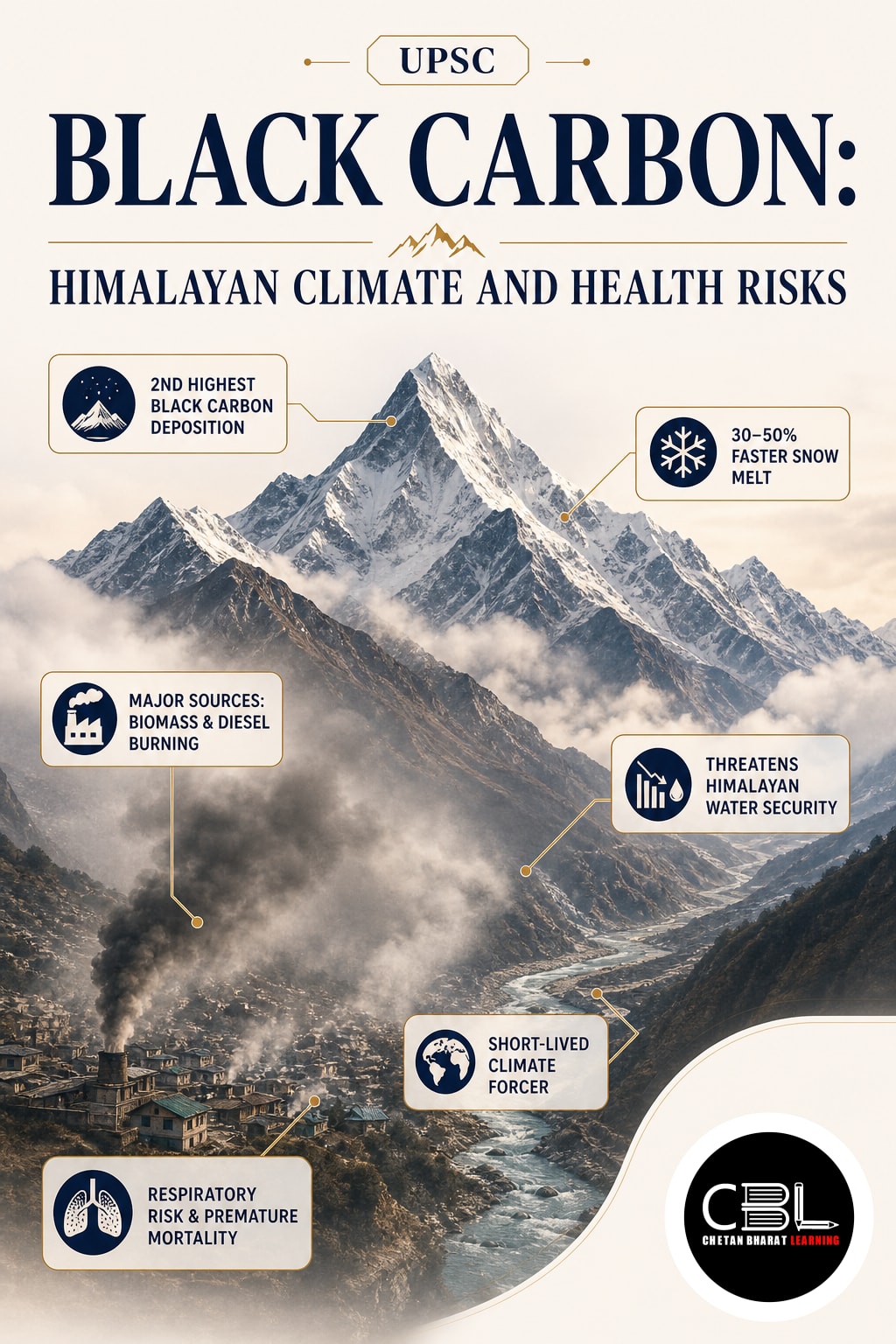
The 2026 report titled A Resilient Himalaya highlighted soot pollution as an important contributor to Himalayan glacier retreat. SYSTEMIQ prepared the research with the Integrated Mountain Initiative and technical contributors from the Himalayan region. Its primary report page connects ecological degradation with regional water, livelihood and economic risks.
Airborne particles can travel from densely populated plains towards high-altitude snow and ice. Once deposited, they darken the surface and reduce its albedo, which measures reflected solar energy. Darker snow absorbs more heat and melts faster, compounding the warming caused by greenhouse gases. Accelerated retreat can initially increase river flows before making seasonal water supplies less dependable.
Key Features
The pollutant combines distinctive physical properties with closely connected climate and health effects.
- Strong solar absorber: Black Carbon absorbs incoming radiation, warms the atmosphere and can alter regional temperature patterns.
- Short atmospheric lifetime: Individual particles generally remain airborne for only several days or weeks before removal.
- Cryosphere impact: Deposited soot lowers snow reflectivity and intensifies melting across glaciers and seasonal snowfields.
- Combustion indicator: Concentrations often reveal pollution from diesel, biomass, coal and other inefficient burning processes.
- Health connection: As part of PM2.5, it can penetrate deeply into the lungs and accompany harmful combustion pollutants.
Its climate effect also depends on the source and the pollutants emitted alongside it. Some combustion sources release organic particles that reflect sunlight and partly offset atmospheric warming. Policymakers must therefore evaluate the net emission mixture instead of treating every source as identical. Measures targeting diesel soot and inefficient cookstoves often deliver strong climate and health benefits together.
Challenges
India faces technological, administrative and social constraints while controlling emissions across diverse sectors.
- Dispersed emission sources: Millions of vehicles, cookstoves, farms and small enterprises make inspection and enforcement difficult.
- Limited mountain monitoring: Sparse high-altitude stations restrict reliable measurement of transport, deposition and seasonal variations.
- Source-apportionment gaps: Authorities cannot design targeted action without separating contributions from transport, homes, industries and fires.
- Affordability barriers: Cleaner fuels and modern equipment may remain costly for vulnerable households and informal businesses.
- Transboundary movement: Winds carry particles across jurisdictions, requiring cooperation among Himalayan and Indo-Gangetic Plain governments.
Several regulatory systems address PM2.5, vehicle exhaust, industrial pollution and open burning without maintaining a separate soot standard. This fragmented framework can weaken source-specific accountability and obscure the pollutant’s cryosphere impact. India must connect its air-quality programmes with climate adaptation and mountain research.
Way Forward
Cutting Black Carbon can produce relatively rapid benefits because atmospheric concentrations respond soon after emission reductions. Governments should expand clean cooking energy, enforce vehicle emission standards and require efficient filters for diesel fleets. They should modernise brick kilns, prevent open waste burning and help farmers adopt practical residue-management systems. The World Health Organization guidance explains how controlling short-lived pollutants can jointly support health and climate goals.
India should strengthen high-altitude monitoring, emission inventories and regional source-apportionment studies across the Himalayan arc. Central and state agencies can share comparable data through an integrated airshed approach. Financial support must help households and small firms replace polluting technologies without damaging livelihoods. Cross-border scientific cooperation can improve forecasting, identify transport corridors and support coordinated mitigation. These actions must complement sustained carbon-dioxide reductions because short-lived pollutant controls cannot replace long-term decarbonisation.
Prelims Practice Corner
Q1. The pollutant discussed above is primarily formed through which process?
- (a) Complete combustion
- (b) Incomplete combustion
- (c) Radioactive decay
- (d) Ocean evaporation
Answer: (b) Inefficient burning of fossil fuels, biofuels and biomass produces the particles.
Q2. Which statement correctly distinguishes this pollutant from carbon dioxide?
- (a) It is an aerosol particle
- (b) It remains for centuries
- (c) It cannot absorb sunlight
- (d) It forms only naturally
Answer: (a) It is a light-absorbing particulate pollutant rather than a greenhouse gas.
Q3. How does deposited soot accelerate the melting of snow and ice?
- (a) It raises albedo
- (b) It blocks gravity
- (c) It lowers albedo
- (d) It increases salinity
Answer: (c) Darkened surfaces reflect less sunlight and absorb more solar energy.
Q4. Which source is most directly associated with combustion-related soot emissions?
- (a) Diesel engines
- (b) Tidal turbines
- (c) Hydroelectric dams
- (d) Geothermal springs
Answer: (a) Diesel combustion releases substantial particulate matter when controls remain inadequate.
Q5. Consider the following statements: 1. The pollutant forms part of PM2.5. 2. It remains in the atmosphere for several centuries. Which is correct?
- (a) 1 only
- (b) 2 only
- (c) Both 1 and 2
- (d) Neither 1 nor 2
Answer: (a) It forms part of PM2.5 but generally remains airborne for days or weeks.
Mains Practice Questions
Q1. Examine how short-lived climate pollutants affect Himalayan glaciers and India’s water security. (250 words, 15 marks)
Answer Structure:
- Intro: Define the pollutant and connect its light-absorbing nature with Himalayan warming.
- Body: Explain emission sources, atmospheric transport, albedo reduction, glacier retreat and downstream water risks.
- Conclusion: Advocate coordinated airshed management alongside deep carbon-dioxide reductions and climate adaptation.
Q2. Air-pollution control can generate simultaneous climate, health and development benefits. Discuss. (150 words, 10 marks)
Answer Structure:
- Intro: Present combustion pollution as a shared environmental and public-health challenge.
- Body: Cover clean cooking, transport, brick kilns, agricultural burning, monitoring and just-transition concerns.
- Conclusion: Emphasise targeted implementation, regional cooperation and measurable benefits for vulnerable communities.
FAQs on Black Carbon
How does Black Carbon affect Himalayan glaciers?
Deposited particles darken snow and ice, reducing their ability to reflect sunlight. The surface absorbs additional heat and melts faster.
Is soot pollution a greenhouse gas?
No, it consists of atmospheric particles produced by incomplete combustion. It still warms the climate by absorbing sunlight and changing snow reflectivity.
Which measures can reduce these emissions in India?
Priority measures include clean cooking, effective diesel controls, modern brick kilns and alternatives to open burning. Better monitoring and regional coordination can improve enforcement and target major sources.
Related Current Affairs
Preparing for UPSC, PCS or HCS?
Talk to a mentor at Chetan Bharat Learning, Chandigarh. Free guidance on choosing the right exam and building a study plan.
Chat on WhatsAppCall 97793 53345UPSC / IAS / PCS coaching in Chandigarh · Trusted by aspirants across Punjab & Haryana
Leave a Reply
You must be logged in to post a comment.