
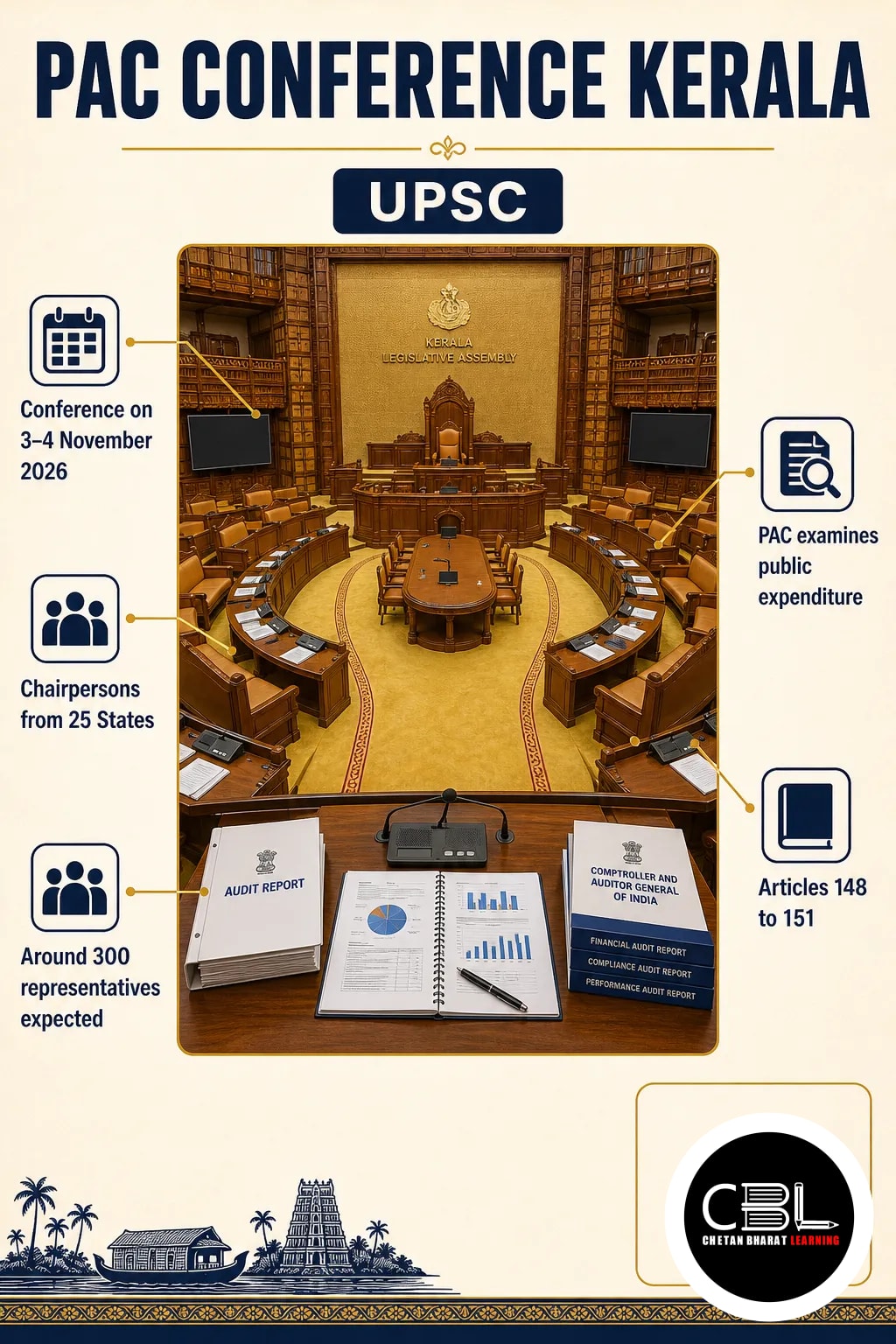

PAC conference Kerala will bring legislative committee chairpersons from 25 States to the Keralam Assembly on 3–4 November 2026. The meeting places legislative scrutiny of public spending at the centre of the discussion.
Quick answer: The PAC conference Kerala will host on 3–4 November 2026 brings together Public Accounts Committee chairpersons from 25 States. Lok Sabha Speaker Om Birla will inaugurate it. Around 300 representatives, including Members of Parliament and Members of Legislative Assemblies, are expected to attend. The meeting highlights legislative oversight of government expenditure.
Why is the conference in the news?
The Keralam Assembly will host the two-day conference for the first time, according to Assembly Speaker Thiruvanchoor Radhakrishnan. Lok Sabha Speaker Om Birla will inaugurate it and inspect a Guard of Honour beforehand.
The opening and closing ceremonies will take place at the Sankaranarayanan Thampi Members Lounge. Meanwhile, the Assembly Hall will host plenary sessions. The Speaker said he had moved a resolution to waive the rule against other events in the Hall; all members responded favourably.
Chief Minister V.D. Satheesan, Parliament’s PAC chairperson K.C. Venugopal and Kerala PAC chairperson K.N. Balagopal are among those scheduled to speak. As of 2 November, the conference remains an upcoming event; its outcomes are not yet available.
What does a Public Accounts Committee do?
A Public Accounts Committee examines public expenditure after the government has spent the money. It uses audit findings to assess whether spending followed legislative authorisation and financial rules.
The committee examines reports of the Comptroller and Auditor General of India (CAG), along with appropriation and finance accounts. It can also scrutinise whether expenditure was prudent, not merely whether it complied with rules.
The PAC does not conduct the CAG’s audit or itself approve the budget. Instead, it examines selected matters, seeks explanations from officials and reports its findings to the legislature. Its recommendations are not court orders; therefore, follow-up matters for effective oversight.
Parliamentary composition
Parliament’s PAC has 22 members: 15 from the Lok Sabha and seven from the Rajya Sabha. Members are elected annually by their respective Houses through proportional representation by means of the single transferable vote.
A minister cannot be a PAC member. The Lok Sabha Speaker appoints its chairperson from among the committee’s members; by convention, the chairperson comes from the Opposition. State committees operate under their respective legislative rules, so their composition need not be identical.
Which constitutional provisions support financial oversight?
The Constitution establishes the CAG and provides for audit reports to reach the legislature; it does not itself create the PAC.
| Provision | Relevance |
|---|---|
| Article 148 | Provides for the CAG and safeguards its independence. |
| Article 149 | Provides for the CAG’s duties and powers as prescribed by Parliament. |
| Article 150 | Provides for the form of Union and State accounts, prescribed by the President on the CAG’s advice. |
| Article 151 | Union audit reports go to the President and State reports to the Governor for placement before the respective legislatures. |
Consequently, the distinction between the auditor and the legislative committee is important. The CAG produces audit reports; the PAC examines selected findings and makes recommendations.
Why does the PAC conference Kerala hosts matter?
The conference provides a forum for State committee chairpersons to exchange perspectives on legislative financial scrutiny. Its value lies in the possibility of sharing methods, rather than in any announced binding outcome.
- Legislative accountability: Committee examination connects audit findings with questions that representatives can ask the executive.
- Federal learning: State committees can compare approaches while remaining accountable to their own legislatures.
- Financial discipline: Scrutiny can identify procedural weaknesses and encourage departments to correct them.
- Public services: Following the expenditure trail can illuminate implementation issues, including those discussed in the Kerala Jal Jeevan Mission funding analysis.
For example, procurement scrutiny can ask whether spending met authorisation and financial rules. The analysis of Government e-Marketplace procurement reforms provides related context on public purchasing.
What limits PAC effectiveness?
Time, information and follow-up can limit the impact of committee scrutiny. These are general oversight challenges, not findings announced by this conference.
- Delayed examination: When audit findings reach committees long after expenditure, corrective action can become harder.
- Limited capacity: Complex accounts and procurement systems require sustained technical support and careful selection of cases.
- Executive follow-up: Recommendations alone do not guarantee departmental compliance; therefore, action taken must be tracked.
- Political incentives: Partisan disagreement can divert attention from evidence and cross-party scrutiny.
How can legislative scrutiny improve?
Legislatures can strengthen scrutiny by connecting timely examination with transparent follow-up. The following measures are analytical suggestions, not conference decisions.
- Prioritise cases: Select audit findings by financial significance and potential impact on service delivery.
- Track action: Set clear timelines for departmental responses and review outstanding recommendations.
- Build expertise: Provide committee members and secretariats with training in accounts, procurement and audit.
- Share practices: Compare useful procedures across States, while respecting each legislature’s rules and autonomy.
Overall, independent audit and effective committee follow-up serve different but complementary purposes. Together, they can make the executive answerable for how authorised funds are used.
Source: The Hindu, 2 November 2026
- GeM Reforms: MSME Procurement and Finance for UPSC (28 Oct 2026)
Punjab PCS and Haryana HCS can test the roles of State legislatures, the CAG and financial committees. In addition, candidates should distinguish audit findings from legislative recommendations and executive follow-up.
Prelims Practice Corner
Mains Practice Questions
Frequently Asked Questions
When and where is the PAC conference being held?
The Keralam Assembly will host it on 3–4 November 2026. Around 300 public representatives are expected, including participants from 25 States.
Is the Public Accounts Committee a constitutional body?
No, the Constitution does not itself establish the PAC. However, it establishes the CAG and provides for audit reports to reach legislatures.
Who chairs Parliament’s Public Accounts Committee?
The Lok Sabha Speaker appoints the chairperson from the committee’s members. By convention, the appointee comes from the Opposition.
Related Current Affairs
Preparing for UPSC, PCS or HCS?
Talk to a mentor at Chetan Bharat Learning, Chandigarh. Free guidance on choosing the right exam and building a study plan.
Chat on WhatsAppCall 97793 53345UPSC / IAS / PCS coaching in Chandigarh · Trusted by aspirants across Punjab & Haryana

 Ananya RanaIAS · AIR 60
 Aditya SharmaIAS · AIR 70
 Ria Kaur SethiIPS · AIR 89
 Aman AloonIRS · AIR 295
 Sumer Singh VirkIRS · AIR 335
 Shivani PanchalIAS

Leave a Reply
You must be logged in to post a comment.