

UPSC Mapping
| Exam | Topics |
|---|---|
| Prelims | International Organisations, Arctic Region, India’s Arctic Policy |
| Mains | GS Paper II – International Relations and Global Governance |
What is Arctic Council?
Arctic Council is an intergovernmental forum established through the Ottawa Declaration of 1996 to promote cooperation among Arctic countries on issues relating to sustainable development, environmental protection and scientific research. It is not a treaty-based international organisation but functions through consensus among its members.
The Council serves as the principal forum for dialogue on Arctic governance while maintaining the region as an area of peaceful cooperation. Military security issues are outside its mandate.
Why is Arctic Council in News?
The Parliamentary Standing Committee on External Affairs has recommended that India appoint a Polar Ambassador and actively pursue full-fledged membership of the Arctic Council. The committee highlighted the growing strategic importance of the Arctic in climate science, maritime trade and global geopolitics.
India’s engagement with Arctic governance has gained significance due to climate change, energy security and scientific research. Official information is available through the Arctic Council.
Members of the Arctic Council
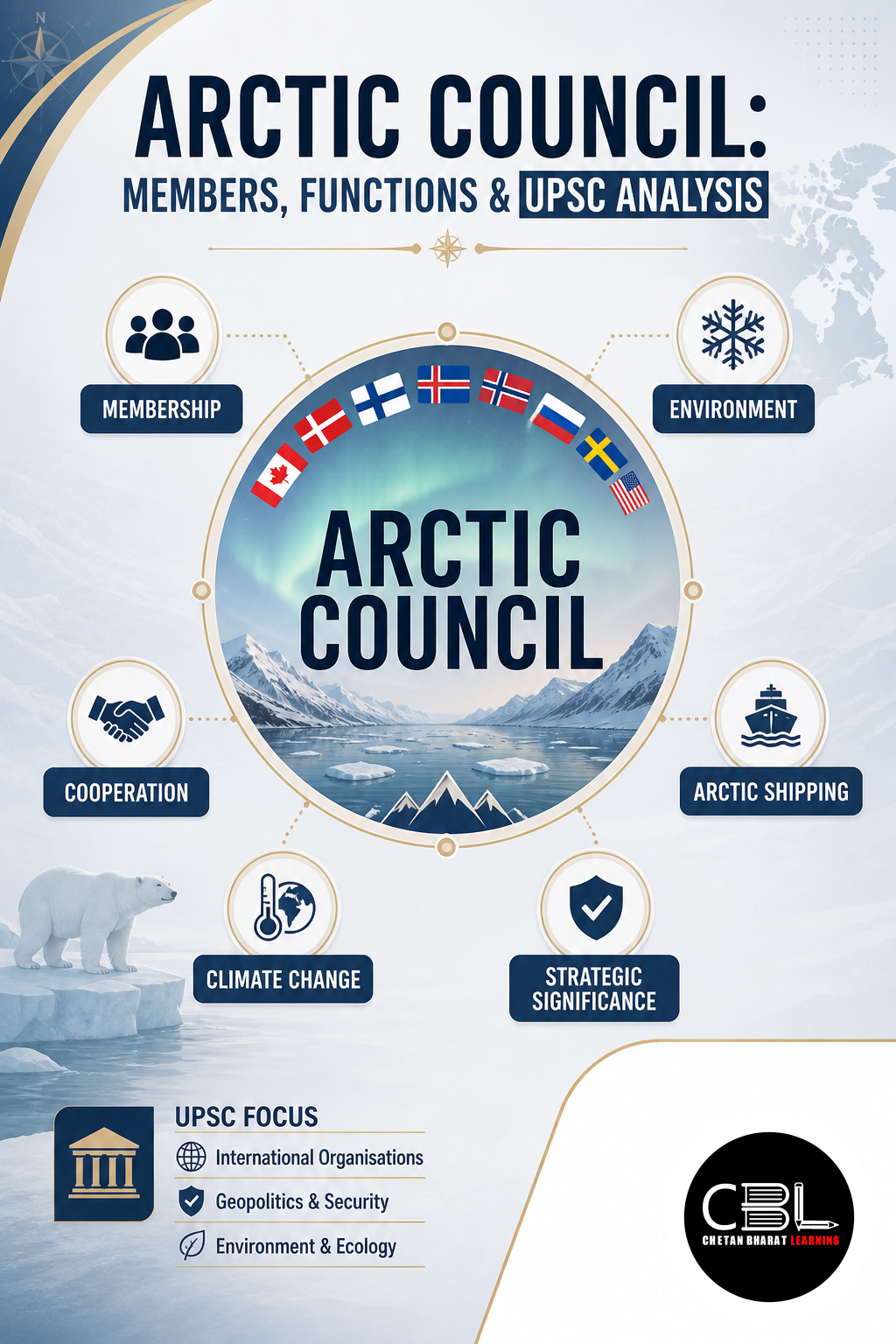
The Arctic Council consists of the eight Arctic states that possess territory within the Arctic Circle.
- Canada
- Denmark (including Greenland and the Faroe Islands)
- Finland
- Iceland
- Norway
- Sweden
- Russian Federation
- United States
In addition to member states, the Council recognises six Permanent Participant organisations representing Indigenous peoples of the Arctic, ensuring their participation in Arctic governance.
Observer Status and India’s Role
Observer status is open to non-Arctic countries, intergovernmental organisations, inter-parliamentary organisations and accredited non-governmental organisations. India became an Observer State in 2013 and remains one of the 13 observer countries.
Observer states can participate in Council meetings and contribute expertise, but they do not possess decision-making powers. They also cannot independently undertake Arctic research under the Council’s framework or make financial contributions to its core activities.
India’s Arctic engagement focuses on scientific research, climate studies, sustainable development and understanding the Arctic’s influence on the Indian monsoon.
Functions of the Arctic Council
The Council promotes cooperation on issues affecting the Arctic region.
- Sustainable development: Supports balanced economic growth while protecting fragile Arctic ecosystems.
- Environmental protection: Addresses climate change, biodiversity conservation and pollution.
- Scientific cooperation: Encourages collaborative research among Arctic and observer states.
- Indigenous participation: Ensures representation of Arctic Indigenous communities through Permanent Participants.
- Consensus-based governance: Decisions are adopted through consensus among member states.
Significance of the Arctic Council for India
The Arctic has direct implications for India’s climate, especially through its influence on monsoon patterns and global weather systems. Melting Arctic ice also affects sea-level rise and global climate stability, making the region strategically important for India.
India’s scientific presence includes the Himadri Research Station in Svalbard and its Arctic Policy (2022), which focuses on science, environmental protection, economic cooperation, transportation and governance. Aspirants should revise related developments through the international relations section.
Challenges
The Arctic Council faces several emerging geopolitical and environmental challenges.
- Climate change: Rapid warming threatens Arctic ecosystems and Indigenous livelihoods.
- Geopolitical tensions: Strategic competition among major powers complicates regional cooperation.
- Resource exploitation: Increased interest in hydrocarbons and minerals raises environmental concerns.
- Shipping expansion: Melting sea ice opens new shipping routes requiring effective governance.
- Consensus mechanism: Decision-making may become difficult during periods of political disagreement.
Way Forward
India should continue strengthening Arctic scientific research, climate cooperation and diplomatic engagement while implementing its Arctic Policy. Expanding collaboration with Arctic states can improve understanding of climate impacts and promote sustainable development.
Greater international cooperation through science, environmental protection and peaceful dialogue will remain essential for the future of Arctic governance. Additional information is available through the Ministry of Earth Sciences.
Prelims Practice Corner
Q1. The Arctic Council was established through which declaration?
- Kyoto Declaration
- Ottawa Declaration
- Rio Declaration
- Paris Declaration
Answer: Ottawa Declaration, 1996.
Q2. Which of the following is NOT a member of the Arctic Council?
- Norway
- Finland
- India
- Canada
Answer: India is an Observer State.
Q3. India currently holds which status in the Arctic Council?
- Member
- Permanent Participant
- Observer
- Associate Member
Answer: Observer.
Q4. The Arctic Council mainly focuses on:
- Collective defence
- Nuclear security
- Sustainable development and environmental cooperation
- Global trade regulation
Answer: Sustainable development, environment and scientific cooperation.
Q5. The Arctic Council functions primarily on the basis of:
- Majority voting
- Consensus
- Veto power
- Weighted voting
Answer: Consensus.
Mains Practice Questions
Q1. Discuss the significance of the Arctic Council in promoting sustainable governance of the Arctic region. (10 marks)
Answer Structure:
- Intro: Introduce the Arctic Council.
- Body: Membership, objectives, functions, Indigenous participation, challenges and India’s role.
- Conclusion: Highlight cooperative Arctic governance.
Q2. Examine India’s strategic interests in the Arctic and evaluate the importance of its observer status in the Arctic Council. (15 marks)
Answer Structure:
- Intro: Explain India’s Arctic engagement.
- Body: Climate research, Arctic Policy, economic interests, observer limitations and future prospects.
- Conclusion: Emphasise science-led and sustainable cooperation.
FAQs on Arctic Council
What is the Arctic Council?
The Arctic Council is an intergovernmental forum established in 1996 to promote cooperation on sustainable development, environmental protection and scientific research in the Arctic.
Is India a member of the Arctic Council?
No. India is an Observer State and participates in Council activities without decision-making powers.
Why is the Arctic Council important for UPSC?
The topic is relevant for international relations, climate change, Arctic governance, India’s Arctic Policy and GS Paper II.
Related Current Affairs
Preparing for UPSC, PCS or HCS?
Talk to a mentor at Chetan Bharat Learning, Chandigarh. Free guidance on choosing the right exam and building a study plan.
Chat on WhatsAppCall 97793 53345UPSC / IAS / PCS coaching in Chandigarh · Trusted by aspirants across Punjab & Haryana
Leave a Reply
You must be logged in to post a comment.