

UPSC Mapping
| Prelims | NPPA, DPCO and Essential Medicines |
|---|---|
| Mains | GS Paper II – Health and Social Justice |
| Legal Basis | Essential Commodities Act, 1955 |
|---|---|
| Principal Order | DPCO, 2013 |
| Price Regulator | NPPA |
| Retailer Margin | 16% in Ceiling-Price Formula |
What are Drug Pricing Mechanisms?
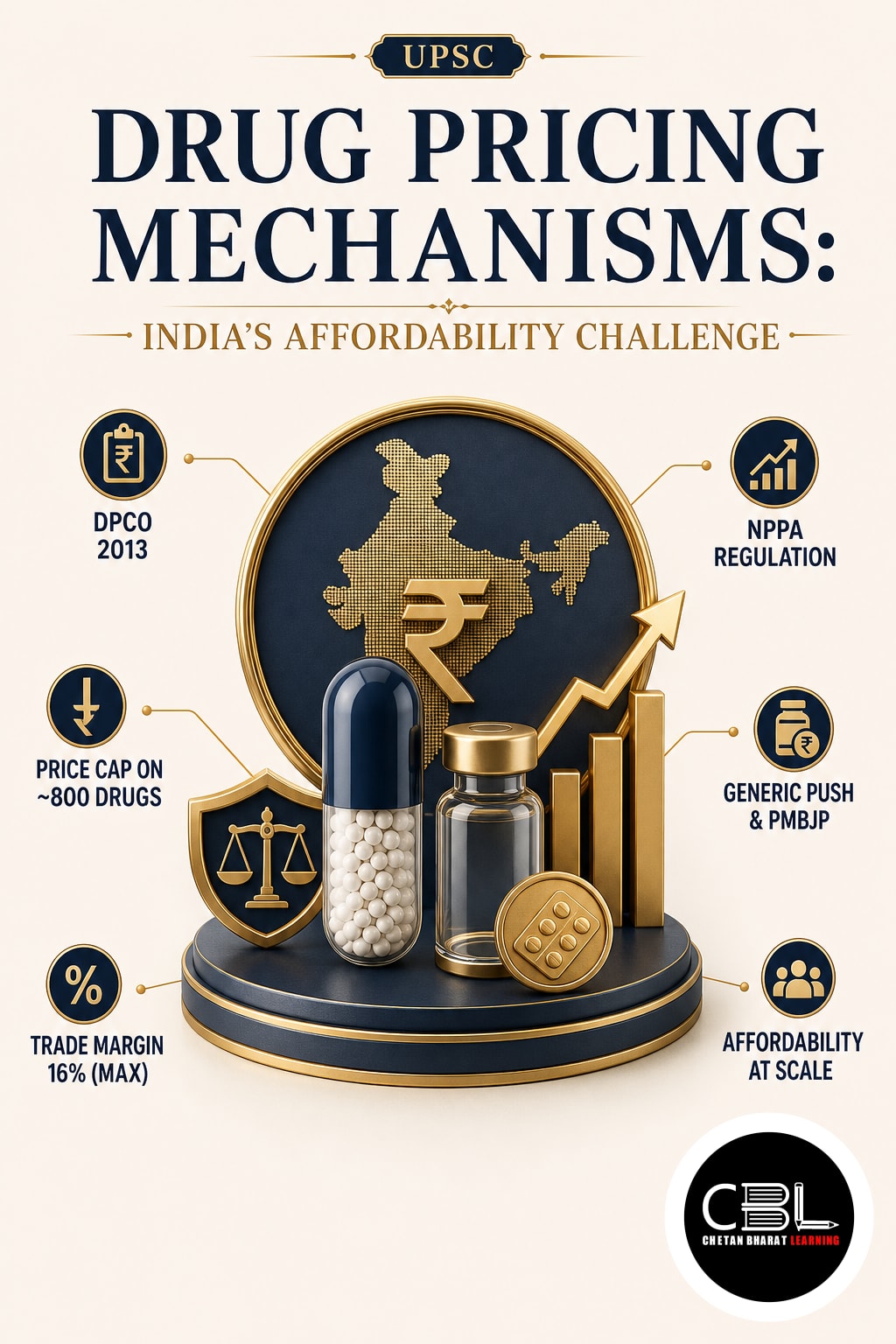
Drug Pricing Mechanisms are legal and regulatory arrangements used to monitor or limit the prices of medicines and selected medical devices. Their central objective is to improve affordable access while maintaining product availability, quality and incentives for pharmaceutical production. India applies direct controls mainly to formulations listed under the Drugs Prices Control Order.
Section 3 of the Essential Commodities Act, 1955, authorises the Union government to regulate the production, supply, distribution and prices of essential commodities. Medicines fall within this statutory framework. The government issued the DPCO 2013 under this authority and delegated implementation powers to the National Pharmaceutical Pricing Authority.
Why are Drug Pricing Mechanisms in News?
India’s Drug Pricing Mechanisms came under judicial scrutiny after the Supreme Court examined exceptionally high mark-ups on essential medicines. The Court was informed that one cancer medicine supplied to retailers for approximately ₹2,700 carried an MRP of nearly ₹27,000. The Bench questioned the ten-fold difference and the absence of effective regulatory intervention.
The proceedings also raised concerns about hospital pharmacies compelling patients to purchase medicines internally at inflated MRPs. The Court asked whether a uniform 16% retail margin should apply more widely, particularly to essential and life-saving medicines. The observations are part of ongoing judicial proceedings and do not themselves constitute a final pricing rule.
Key Features
- Scheduled formulations: Medicines included in Schedule I of DPCO 2013, based upon the National List of Essential Medicines, remain subject to direct ceiling-price control.
- Market-based formula: NPPA calculates the average price to retailers of qualifying brands with at least 1% market share and adds a 16% retailer margin.
- Ceiling price compliance: Manufacturers cannot sell a scheduled formulation above the notified ceiling price plus applicable taxes and must reduce higher MRPs accordingly.
- New-drug pricing: Manufacturers launching specified new formulations of scheduled medicines must seek prior price approval from NPPA under the applicable DPCO provisions.
- Non-scheduled monitoring: Manufacturers generally determine launch prices, but annual MRP increases cannot ordinarily exceed the DPCO limit and NPPA may intervene in extraordinary public-interest circumstances.
Challenges
- Limited direct coverage: Numerous medicines, strengths and combinations remain outside Schedule I, allowing manufacturers to establish high initial MRPs subject only to limited monitoring.
- Excessive trade margins: Large differences between prices to retailers and printed MRPs can incentivise hospitals and sellers to promote high-margin brands rather than affordable alternatives.
- Hospital pharmacy practices: Patients may have limited freedom to purchase medicines externally, weakening price comparison and allowing tied pharmacies to charge inflated amounts.
- Availability risks: Very low ceiling prices can make production commercially unattractive when active ingredients, energy, packaging or regulatory-compliance costs rise sharply.
- Innovation concerns: Indiscriminate controls may weaken incentives for research, specialised therapies and new product launches unless policy distinguishes essential access from innovation costs.
Way Forward
The government should regularly update Schedule I using disease burden, treatment guidelines, market behaviour and household expenditure. Reviews must include critical formulations rather than only active ingredients. Rapid inclusion procedures can address newly essential therapies and emerging public-health needs.
NPPA should require greater transparency regarding price to stockist, price to retailer, institutional procurement prices and MRP. A digital public database can help patients, hospitals and regulators compare prices across brands. Disclosure would also reveal unusually high margins requiring investigation.
India should consider rational trade-margin limits for essential and life-saving medicines beyond the existing ceiling-price formula. Any margin framework should distinguish manufacturing costs, wholesale functions, cold-chain requirements and legitimate pharmacy services. Authorities should prevent hospitals from forcing patients to purchase medicines exclusively from internal pharmacies.
Public procurement systems must ensure uninterrupted availability of essential medicines at government facilities. Centralised price negotiation, demand forecasting and timely supplier payments can reduce costs without causing shortages. Jan Aushadhi Kendras should maintain consistent stocks and strengthen quality communication with patients.
Doctors should prescribe generic names wherever clinically appropriate, while pharmacists must follow substitution safeguards. Independent quality testing should publish accessible results for manufacturers and batches. Such transparency can build confidence in affordable alternatives without compromising patient safety.
Price controls should include periodic supply-impact assessments and an evidence-based revision mechanism. Manufacturers must demonstrate genuine cost pressures rather than receive automatic increases. The official NPPA pricing framework explains the regulator’s market-based methodology and functions.
Effective Drug Pricing Mechanisms require transparent margins, wider essential-medicine coverage and reliable public supply. India must protect patients from exploitative mark-ups while maintaining quality production and necessary pharmaceutical innovation. Affordable medicine access remains an indispensable element of the constitutional right to life and health.
Prelims Practice Corner
Q1. The Drugs Prices Control Order, 2013, derives its authority from:
(a) Drugs and Cosmetics Act, 1940 (b) Essential Commodities Act, 1955 (c) Consumer Protection Act, 2019 (d) National Medical Commission Act, 2019
Answer: (b) The Union government issued DPCO 2013 under Section 3 of the Essential Commodities Act.
Q2. Which institution fixes ceiling prices of scheduled formulations in India?
(a) CDSCO (b) ICMR (c) NPPA (d) NITI Aayog
Answer: (c) The National Pharmaceutical Pricing Authority fixes and revises notified ceiling prices.
Q3. Scheduled formulations under DPCO 2013 are primarily based upon:
(a) National List of Essential Medicines (b) National Health Policy (c) Indian Pharmacopoeia only (d) WHO Model List exclusively
Answer: (a) Schedule I incorporates formulations based upon India’s National List of Essential Medicines.
Q4. Which factor is used for the annual revision of scheduled medicine ceiling prices?
(a) Consumer Price Index (b) Wholesale Price Index (c) Index of Industrial Production (d) GDP deflator
Answer: (b) Annual revisions follow the applicable Wholesale Price Index change.
Q5. Consider the following statements:
1. Every medicine sold in India has its initial price directly fixed by NPPA.
2. NPPA monitors non-scheduled medicines and may intervene in extraordinary circumstances.
Which statement is correct?
(a) 1 only (b) 2 only (c) Both 1 and 2 (d) Neither 1 nor 2
Answer: (b) Most non-scheduled launch prices are not fixed beforehand, although NPPA retains monitoring and exceptional powers.
Mains Practice Questions
Q1. Examine whether India’s pharmaceutical pricing framework adequately balances medicine affordability, availability and innovation. (250 words, 15 marks)
Answer Structure:
- Intro: Introduce DPCO 2013 and NPPA’s price-regulation role.
- Body: Discuss ceiling prices, limited coverage, trade margins, household expenditure, supply risks and innovation concerns.
- Conclusion: Recommend transparent, evidence-based regulation supported by reliable public procurement.
Q2. Excessive trade margins can undermine medicine affordability even when formal price controls exist. Discuss. (150 words, 10 marks)
Answer Structure:
- Intro: Explain the difference between price to retailer and maximum retail price.
- Body: Cover opaque discounts, hospital pharmacies, non-scheduled medicines, information asymmetry and regulatory gaps.
- Conclusion: Support transparent margins and wider protection for essential medicines.
FAQs on Drug Pricing Mechanisms
What is a drug ceiling price?
It is the maximum price, excluding applicable taxes, that manufacturers may charge for a scheduled formulation. Companies selling above the notified amount must reduce their MRPs.
Are all medicines directly price-controlled in India?
No. Direct ceiling prices mainly cover scheduled formulations listed under DPCO 2013. NPPA monitors non-scheduled medicines and restricts excessive annual price increases.
Why can two medicines with similar ingredients have different prices?
Price control applies to specified formulations, strengths and dosage forms. Different combinations, brands or non-scheduled versions may therefore carry substantially different prices.
Related Current Affairs
Preparing for UPSC, PCS or HCS?
Talk to a mentor at Chetan Bharat Learning, Chandigarh. Free guidance on choosing the right exam and building a study plan.
Chat on WhatsAppCall 97793 53345UPSC / IAS / PCS coaching in Chandigarh · Trusted by aspirants across Punjab & Haryana
Leave a Reply
You must be logged in to post a comment.