

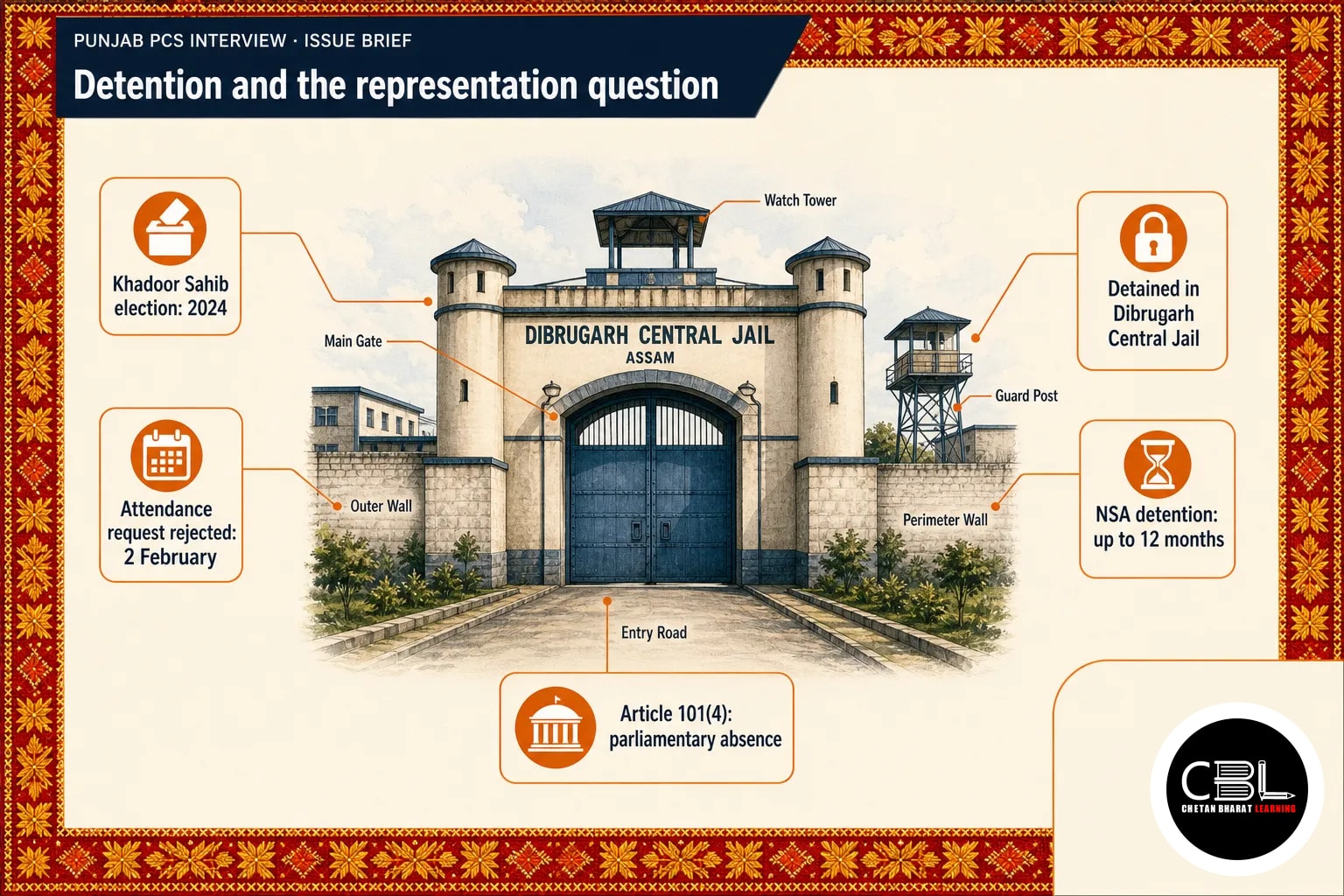
Amritpal Singh, elected to the Lok Sabha from Khadoor Sahib in 2024, is detained under the National Security Act, 1980, in Dibrugarh Central Jail, Assam. On 2 February 2026, Punjab rejected his request for temporary release to attend Parliament’s Budget Session, citing security, public order and public peace. The decision followed a High Court direction to decide his application. The case raises questions about preventive detention, liberty and voters’ representation.
Timeline: detention and representation
- 1980Legal frameworkDetention law
The National Security Act, 1980, provides for preventive detention.
- 2024Lok Sabha electionElected
Amritpal Singh was elected from Khadoor Sahib.
- 2026Before decisionCourt direction
The Punjab and Haryana High Court directed the government to decide his temporary-release application.
- 2 Feb2026Request rejected
Punjab rejected the request, citing security, public order and public peace.
What is preventive detention?
Preventive detention restrains a person to prevent specified future harm, rather than punish a proven offence. The National Security Act (NSA), 1980, provides for such detention on specified grounds.
Article 22 of the Constitution provides safeguards, including advisory board review, for preventive detention. The NSA permits detention for up to 12 months. Parliamentary attendance raises a separate question about the representation of constituents.
The two sides
Punjab government’s position
- The government rejected the temporary-release request after the High Court direction.
- It cited security, public order and public peace.
- The decision placed these concerns before the request to attend the Budget Session.
Liberty and representation concerns
- Preventive detention limits personal liberty without being punishment for a proven offence.
- Absence from Parliament affects an elected representative’s opportunity to participate.
- Voters’ representation must be considered alongside lawful security measures.
Key data
| Point | Details |
|---|---|
| Constituency | Khadoor Sahib; elected in 2024 |
| Place of detention | Dibrugarh Central Jail, Assam |
| Detention law | NSA, 1980; permits detention for up to 12 months |
| Government decision | Temporary-release request rejected on 2 February 2026 |
| Preventive detention safeguards | Article 22 includes advisory board review |
| Parliamentary absence | Article 101(4): the House may declare a seat vacant after 60 days of absence without permission, subject to the constitutional counting rule |
Way forward
- Lawful review: Ensure detention and its review comply with statutory and constitutional safeguards.
- Reasoned decisions: Assess temporary-release requests against documented security and public-order considerations.
- Representation: Consider lawful options for parliamentary participation while assessing their security implications.
- Institutional coordination: Facilitate timely communication among the authorities and parliamentary institutions concerned.
- Public communication: Explain decisions accurately without disclosing sensitive security information.
Likely interview questions
What is the issue concerning Amritpal Singh’s Parliament attendance?
Answer pointers:
- He was elected from Khadoor Sahib in 2024 and is detained under the NSA.
- Punjab rejected his temporary-release request on 2 February 2026, citing security and public order.
- Frame the issue around lawful detention and constituents’ representation.
Do you think security concerns should outweigh parliamentary attendance?
Answer pointers:
- Public order and security are legitimate considerations.
- Attendance and representation also matter in a democracy.
- Support a reasoned, lawful assessment rather than an automatic preference.
Do you think preventive detention is justified in a democracy?
Answer pointers:
- It can address specified threats before harm occurs.
- It also restricts liberty without a criminal conviction.
- Emphasise necessity, legal safeguards and timely review.
As Deputy Commissioner of Amritsar, how would you handle public concern about this issue?
Answer pointers:
- Assess local public-order risks and coordinate with police.
- Protect lawful expression and communicate verified information.
- Respond impartially, using proportionate measures within your authority.
How would you link this case to Articles 22 and 101(4) of the Constitution?
Answer pointers:
- Article 22 provides safeguards for preventive detention, including advisory board review.
- Article 101(4) addresses prolonged parliamentary absence without permission.
- Apply each provision separately and balance liberty, security and representation.
Distinguish preventive detention from punishment, and do not assume that absence automatically ends a seat. Discuss security and representation without making partisan judgments.
Prelims Practice Corner
Q1. Which law is involved in Amritpal Singh’s detention?
(a) National Security Act, 1980 (b) Indian Forest Act, 1927 (c) Right to Information Act, 2005 (d) Representation of the People Act, 1951
Show answer
Answer: (a) because he is detained under the National Security Act, 1980.
Q2. Which constitutional article addresses prolonged absence of a member from a House of Parliament?
(a) Article 19 (b) Article 22 (c) Article 101(4) (d) Article 262
Show answer
Answer: (c) because Article 101(4) permits the House to declare a seat vacant under specified conditions.
Q3. Which constituency elected Amritpal Singh to the Lok Sabha in 2024?
(a) Khadoor Sahib (b) Amritsar (c) Patiala (d) Ludhiana
Show answer
Answer: (a) because he was elected from Khadoor Sahib.
Frequently Asked Questions
Why was Amritpal Singh’s Parliament attendance request rejected?
Punjab rejected his temporary-release request citing security, public order and public peace. The decision was made on 2 February 2026.
Where is Amritpal Singh detained?
He is detained in Dibrugarh Central Jail, Assam. His detention is under the National Security Act, 1980.
Does 60 days of parliamentary absence automatically end an MP’s seat?
No. Article 101(4) permits the House to declare a seat vacant after 60 days of absence without permission, subject to its counting rule.
Sources: GKToday
Related Current Affairs
More Punjab interview issues
Preparing for UPSC, PCS or HCS?
Talk to a mentor at Chetan Bharat Learning, Chandigarh. Free guidance on choosing the right exam and building a study plan.
Chat on WhatsAppCall 97793 53345UPSC / IAS / PCS coaching in Chandigarh · Trusted by aspirants across Punjab & Haryana


Leave a Reply
You must be logged in to post a comment.