
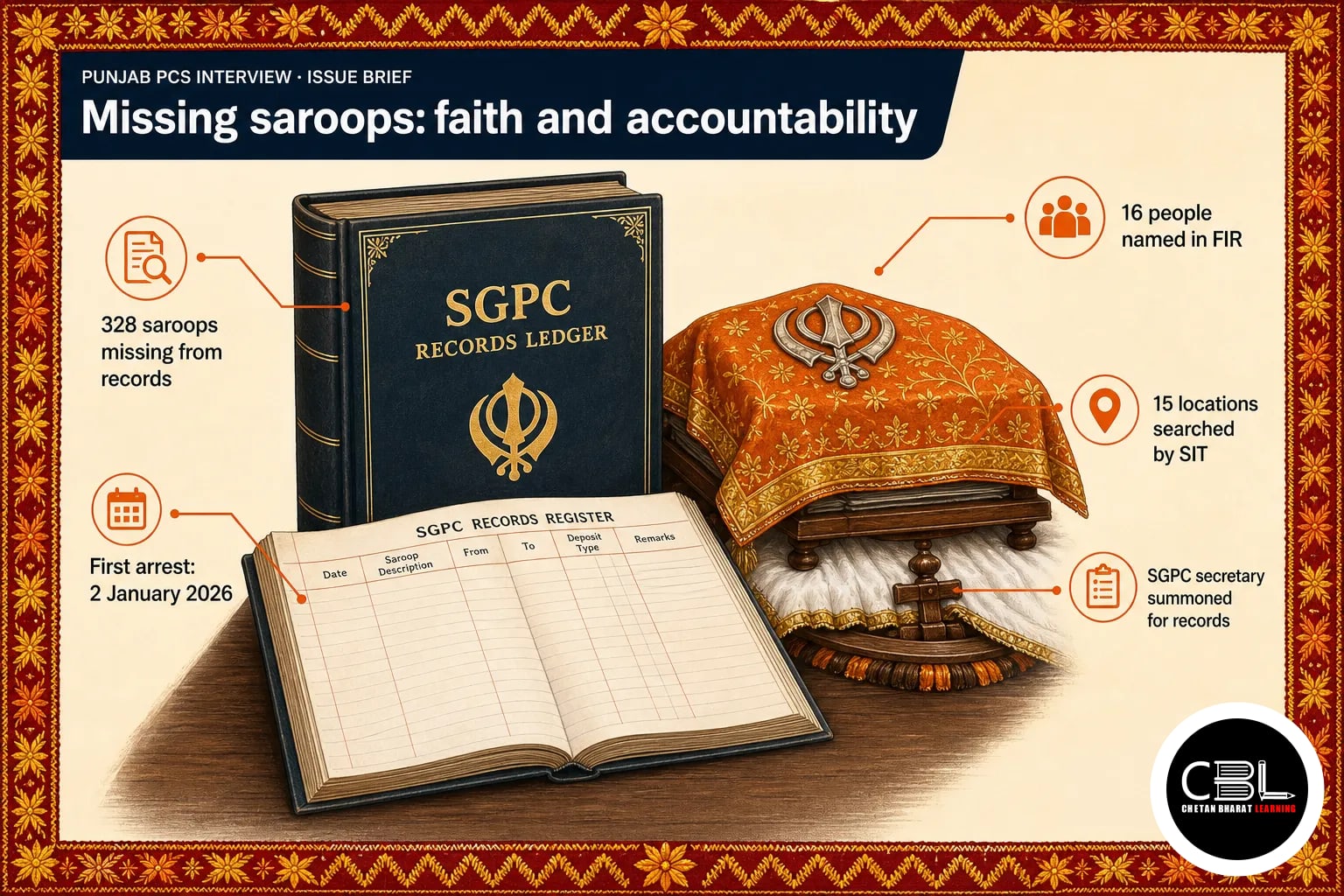
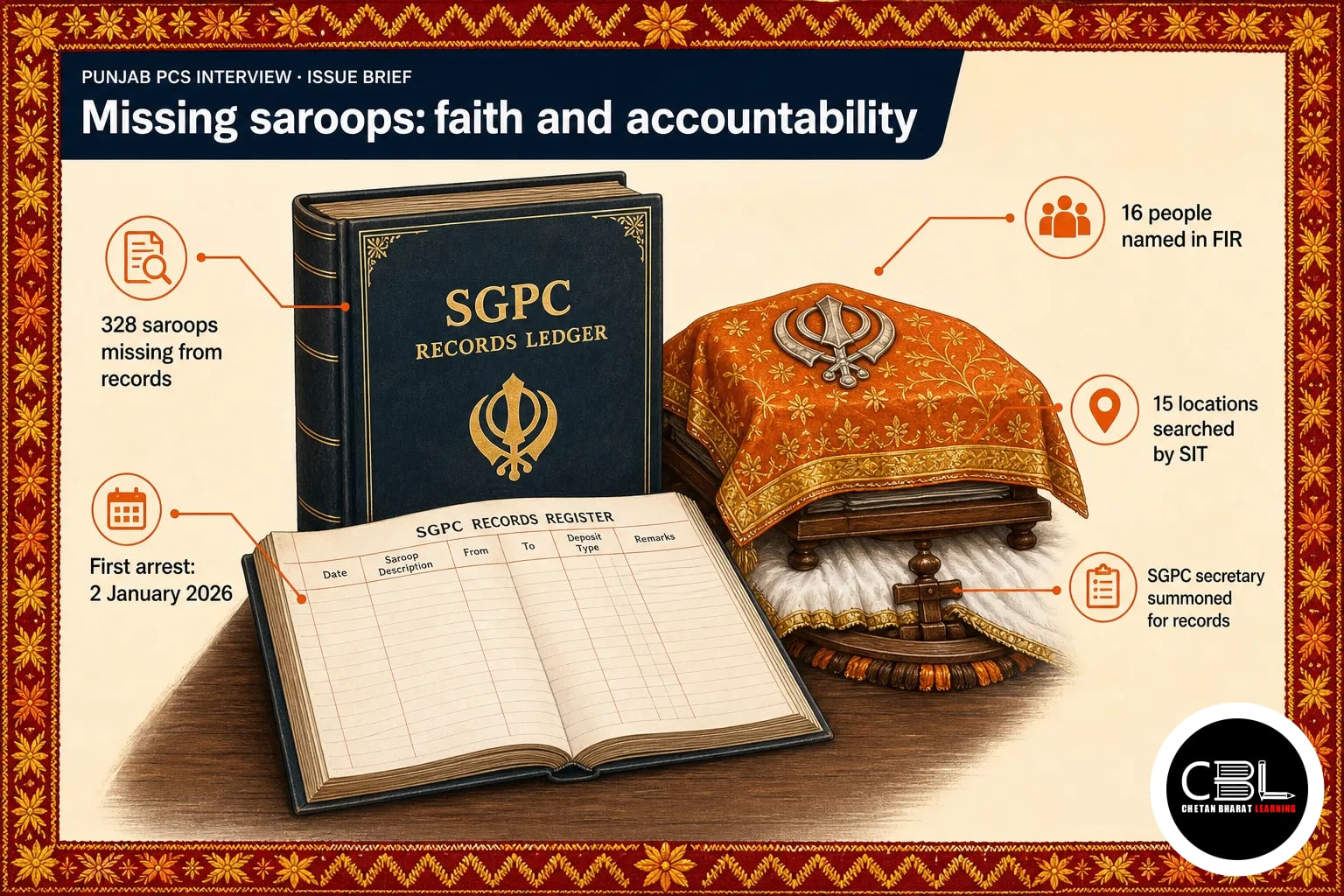
The case concerns 328 missing saroops, or volumes, of Sri Guru Granth Sahib from the records of the Shiromani Gurdwara Parbandhak Committee (SGPC). On 2 January 2026, police made their first arrest in Chandigarh. The first information report (FIR) names 16 people. A Special Investigation Team (SIT) subsequently searched 15 locations and sought SGPC records. The case raises questions about religious autonomy, record management and a fair investigation.
Timeline: from management to investigation
- 1925legal frameworkFramework
The Sikh Gurdwaras Act, 1925, provides the framework for SGPC management of gurdwaras.
- 2 Jan2026First arrest
Police arrested former SGPC chartered accountant Satinder Singh Kohli in Chandigarh.
- 3 Jan2026Searches
The SIT searched 15 locations in Punjab and Chandigarh.
- 5 Jan2026Records sought
The SIT summoned SGPC secretary Partap Singh to produce records.
What is the SGPC case about?
The case concerns 328 saroops of Sri Guru Granth Sahib missing from SGPC records. A saroop is a volume of the Sikh scripture, treated with reverence by Sikhs.
The SGPC manages gurdwaras under the Sikh Gurdwaras Act, 1925. The case connects institutional record-keeping with sacrilege concerns and the anti-sacrilege Bill of 2025.
The two sides
Religious autonomy and community concerns
- Religious institutions have an interest in managing their affairs and preserving religious practices.
- The handling of saroops requires sensitivity to Sikh beliefs and community sentiment.
- Investigation should avoid treating allegations as proof of wrongdoing.
Accountability and public investigation
- Missing records concerning sacred volumes warrant a thorough examination.
- Police can seek relevant records and investigate under the law.
- Transparent procedures can support public confidence while protecting due process.
Key data
| Point | Details |
|---|---|
| Missing saroops | 328 volumes from SGPC records |
| FIR | 16 people named |
| First arrest | Satinder Singh Kohli, arrested in Chandigarh on 2 January 2026 and remanded to six days of police custody |
| Searches | 15 locations in Punjab and Chandigarh on 3 January 2026 |
| Records | SGPC secretary Partap Singh summoned on 5 January 2026 |
| Legal framework | Sikh Gurdwaras Act, 1925; Article 26 of the Constitution concerns religious denominations’ freedom to manage religious affairs, subject to public order, morality and health |
Way forward
- Evidence first: Examine records and other evidence through a fair, independent investigation.
- Respectful engagement: Consult religious representatives while following lawful investigative procedures.
- Better records: Strengthen inventory controls, documentation and regular audits of saroops.
- Measured communication: Share verified procedural updates without prejudging guilt or inflaming tensions.
- Public order: Coordinate locally to address concerns peacefully and prevent rumours.
Likely interview questions
What is the missing saroops case?
Answer pointers:
- It concerns 328 saroops missing from SGPC records.
- Police made a first arrest and the SIT sought records in January 2026.
- Describe the investigation without presuming guilt.
Do you think police investigation interferes with religious autonomy?
Answer pointers:
- Religious autonomy protects the management of religious affairs.
- Lawful investigation and accountability also serve the public interest.
- Use proportionate procedures and respectful engagement.
Do you think stronger inventory controls are enough to restore confidence?
Answer pointers:
- Audits and documentation can reduce record-keeping failures.
- Controls alone cannot replace investigation or address community concerns.
- Combine better systems with fair inquiry and communication.
As the Deputy Commissioner of Amritsar, how would you respond to public concern about this case?
Answer pointers:
- Listen to community representatives and coordinate with police.
- Counter rumours using verified information, without prejudging the case.
- Protect peaceful expression and maintain public order sensitively.
How would you link this case to Article 26 of the Constitution?
Answer pointers:
- Article 26 protects religious denominations’ freedom to manage religious affairs.
- That freedom is subject to public order, morality and health.
- Balance religious autonomy with lawful, evidence-based investigation.
Use respectful language and distinguish allegations from findings. Discuss both religious autonomy and accountability without assigning guilt.
Prelims Practice Corner
Q1. How many saroops are missing from SGPC records in this case?
(a) 15 (b) 16 (c) 328 (d) 1925
Show answer
Answer: (c) because the case concerns 328 missing saroops.
Q2. Which Act provides the framework for SGPC management of gurdwaras?
(a) Sikh Gurdwaras Act, 1925 (b) Government of India Act, 1935 (c) Indian Councils Act, 1909 (d) Regulating Act, 1773
Show answer
Answer: (a) because the Sikh Gurdwaras Act, 1925, governs this framework.
Q3. Which constitutional article concerns religious denominations’ freedom to manage religious affairs?
(a) Article 14 (b) Article 21 (c) Article 26 (d) Article 32
Show answer
Answer: (c) because Article 26 protects that freedom subject to specified conditions.
Frequently Asked Questions
What does saroop mean in the SGPC case?
A saroop is a volume of Sri Guru Granth Sahib. Sikhs treat the scripture with reverence.
Who was first arrested in the missing saroops case?
Former SGPC chartered accountant Satinder Singh Kohli was the first person arrested. Police arrested him in Chandigarh on 2 January 2026.
What did the SIT do in January 2026?
It searched 15 locations and summoned the SGPC secretary to produce records. The searches took place in Punjab and Chandigarh on 3 January.
Sources: GKToday
Related Current Affairs
More Punjab interview issues
Preparing for UPSC, PCS or HCS?
Talk to a mentor at Chetan Bharat Learning, Chandigarh. Free guidance on choosing the right exam and building a study plan.
Chat on WhatsAppCall 97793 53345UPSC / IAS / PCS coaching in Chandigarh · Trusted by aspirants across Punjab & Haryana


Leave a Reply
You must be logged in to post a comment.