
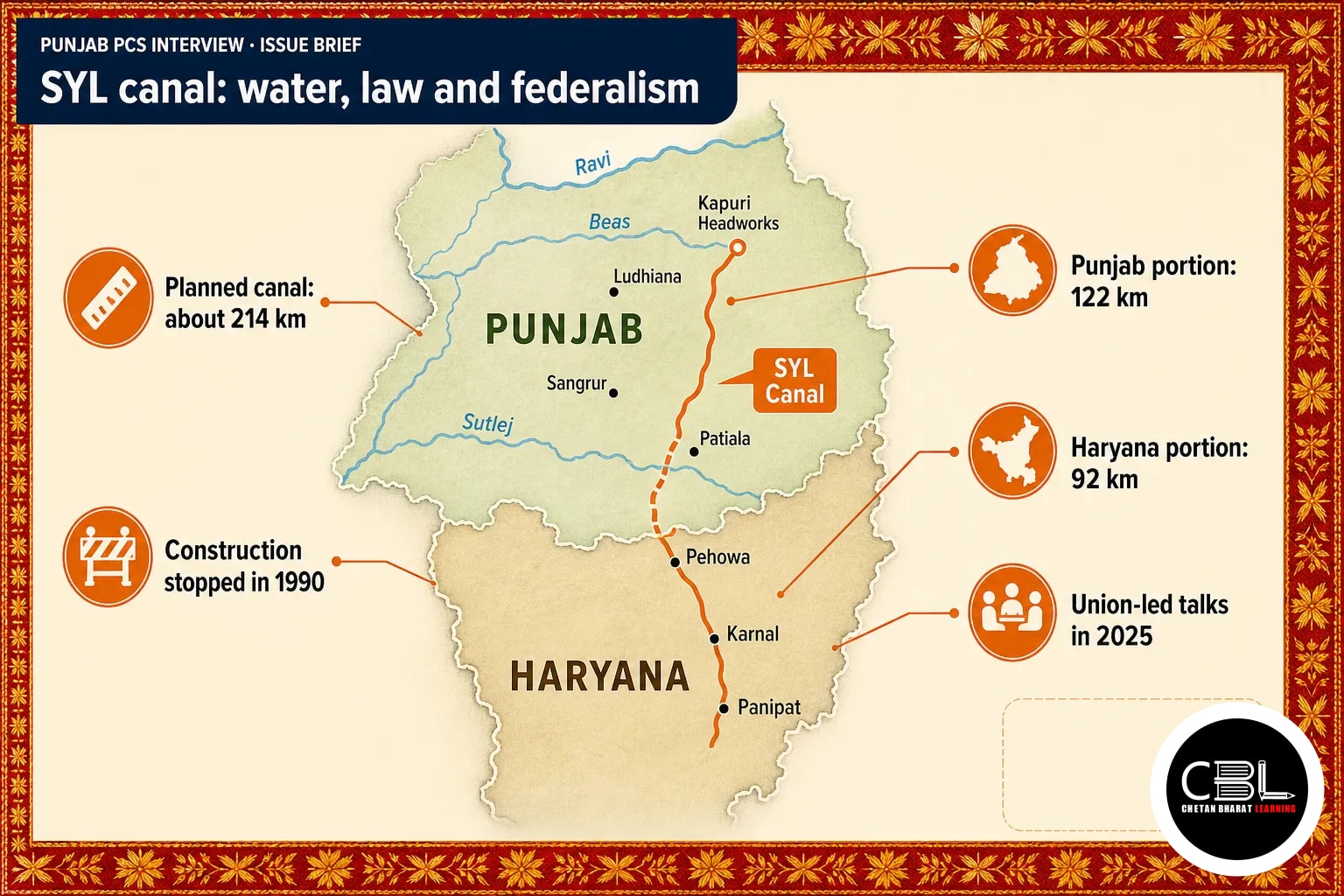

The Sutlej-Yamuna Link (SYL) canal was planned to carry Haryana’s share of Ravi-Beas water after Haryana’s creation in 1966. The proposed canal is about 214 km long. Punjab says it has no surplus water; Haryana seeks implementation of the Supreme Court decree to complete Punjab’s portion. In 2025, the Court sought cooperation with the Centre, and Union-led meetings discussed possible solutions, including diversion of Chenab water. The dispute remains a question of water availability, law and inter-state cooperation.
Timeline: from state division to mediation
- 1966ReorganisationDivision
Haryana was carved out of Punjab; the canal was planned to carry Haryana’s Ravi-Beas share.
- 1981–82Agreement and startFoundation
Punjab, Haryana and Rajasthan agreed in 1981; the foundation stone was laid at Kapoori in 1982.
- 1990ViolenceHalt
Construction stopped after militant violence.
- 2002–04Court and lawDecrees
The Supreme Court directed completion of Punjab’s portion; Punjab passed the Termination of Agreements Act in 2004.
- 2016Presidential referenceOpinion
The Supreme Court held the 2004 Act unconstitutional in its opinion on a Presidential reference.
- 2025May–AugustMediation
The Court sought cooperation in May; Union-led talks followed on 9 July and 5 August.
What is the SYL canal dispute?
The SYL canal was planned to carry Haryana’s share of Ravi-Beas water. Of its approximately 214 km, 122 km lies in Punjab and 92 km in Haryana.
The 1981 agreement involved Punjab, Haryana and Rajasthan. The Rajiv-Longowal Accord followed in 1985. Construction stopped in 1990 after militant violence.
The two sides
Punjab’s position
- Punjab says it has no surplus water to share.
- It points to over-exploited groundwater.
- Water availability is central to its position in talks.
Haryana’s position
- Haryana seeks implementation of the Supreme Court decree.
- The decree directed Punjab to complete its portion of the canal.
- The planned canal was intended to carry Haryana’s share of Ravi-Beas water.
Key data
| Point | Details |
|---|---|
| Planned length | About 214 km: 122 km in Punjab and 92 km in Haryana |
| 1981 agreement | Punjab, Haryana and Rajasthan |
| Court decrees | In 2002 and 2004, the Supreme Court directed Punjab to complete its portion. |
| Punjab’s 2004 Act | The Supreme Court held it unconstitutional in its 2016 opinion on a Presidential reference. |
| 2025 talks | Union-led meetings took place on 9 July and 5 August; Chenab diversion was discussed. |
| Constitutional hooks | Article 143 concerns Presidential references; Article 262 concerns adjudication of inter-state river water disputes. |
Way forward
- Cooperative dialogue: Continue Union-facilitated talks with both states while respecting judicial directions.
- Shared evidence: Use transparent, jointly examined data on surface water and groundwater.
- Assess alternatives: Examine the legal, environmental and technical implications of any proposed diversion.
- Manage demand: Support water-efficient farming and groundwater conservation in both states.
- Engage communities: Explain proposals and listen to affected farmers and residents before implementation.
Likely interview questions
What is the SYL canal, and why was it planned?
Answer pointers:
- It was planned to carry Haryana’s share of Ravi-Beas water after Haryana’s creation.
- The planned length is about 214 km, including 122 km in Punjab.
- Close by distinguishing the canal project from the wider question of water availability.
Do you think the Supreme Court decree alone can resolve the dispute?
Answer pointers:
- The decree is a binding legal consideration and Haryana seeks its implementation.
- Punjab raises concerns about surplus water and groundwater.
- Close with respect for court directions and cooperative dialogue on practical implementation.
Do you think diverting Chenab water is a suitable solution?
Answer pointers:
- The possibility was discussed in the 2025 meetings, with the Indus Waters Treaty in abeyance.
- Its legal, technical and environmental implications need careful examination.
- Close by supporting an evidence-based assessment involving the affected states.
As SDM in Rupnagar, how would you handle local concerns about a proposed water-sharing measure?
Answer pointers:
- Hear residents and farmers, and explain the measure using verified information.
- Maintain public order and report concerns to the competent authorities.
- Close with transparent engagement and action within the administration’s lawful mandate.
How does the SYL dispute link groundwater depletion with cooperative federalism?
Answer pointers:
- Punjab cites over-exploited groundwater and lack of surplus water.
- Haryana stresses implementation of the court decree; both concerns require attention.
- Close with shared data, water conservation and dialogue between governments.
Separate the court’s directions from the states’ positions on water. Avoid treating a proposed alternative as an agreed or tested solution.
Prelims Practice Corner
Q1. Approximately how much of the planned SYL canal lies in Punjab?
(a) 92 km (b) 122 km (c) 214 km (d) 66 km
Show answer
Answer: (b) because approximately 122 km of the planned canal lies in Punjab.
Q2. Which states were parties to the 1981 agreement?
(a) Punjab, Haryana and Rajasthan (b) Punjab, Haryana and Gujarat (c) Punjab, Rajasthan and Maharashtra (d) Haryana, Rajasthan and Gujarat
Show answer
Answer: (a) because the 1981 agreement involved Punjab, Haryana and Rajasthan.
Q3. Which constitutional article concerns a Presidential reference to the Supreme Court?
(a) Article 32 (b) Article 143 (c) Article 262 (d) Article 356
Show answer
Answer: (b) because Article 143 provides for the President to consult the Supreme Court.
Frequently Asked Questions
Why was the SYL canal planned?
It was planned to carry Haryana’s share of Ravi-Beas water. Haryana was carved out of Punjab in 1966.
What did the Supreme Court say about Punjab’s 2004 Act?
It held the Act unconstitutional in its 2016 opinion on a Presidential reference. The Act was the Punjab Termination of Agreements Act, 2004.
What happened in the SYL talks in 2025?
Union-led meetings were held on 9 July and 5 August. Diversion of Chenab water was discussed as a possible solution.
Sources: Tribune: Chenab proposal, Tribune: resolution talks, Business Standard: chronology
Related Current Affairs
More Punjab interview issues
Preparing for UPSC, PCS or HCS?
Talk to a mentor at Chetan Bharat Learning, Chandigarh. Free guidance on choosing the right exam and building a study plan.
Chat on WhatsAppCall 97793 53345UPSC / IAS / PCS coaching in Chandigarh · Trusted by aspirants across Punjab & Haryana


Leave a Reply
You must be logged in to post a comment.