

UPSC Mapping
| Prelims | Mains |
|---|---|
| CBG, Bioenergy and Government Schemes | GS Paper III – Environment, Energy and Agriculture |
| Total Outlay | Implementation | Nodal Ministry | Core Goal |
|---|---|---|---|
| ₹23,731 Crore | FY 2026–27 to FY 2035–36 | Ministry of Petroleum and Natural Gas | Nearly Ten-Fold CBG Growth |
Article
What is GOBARdhan Scheme?
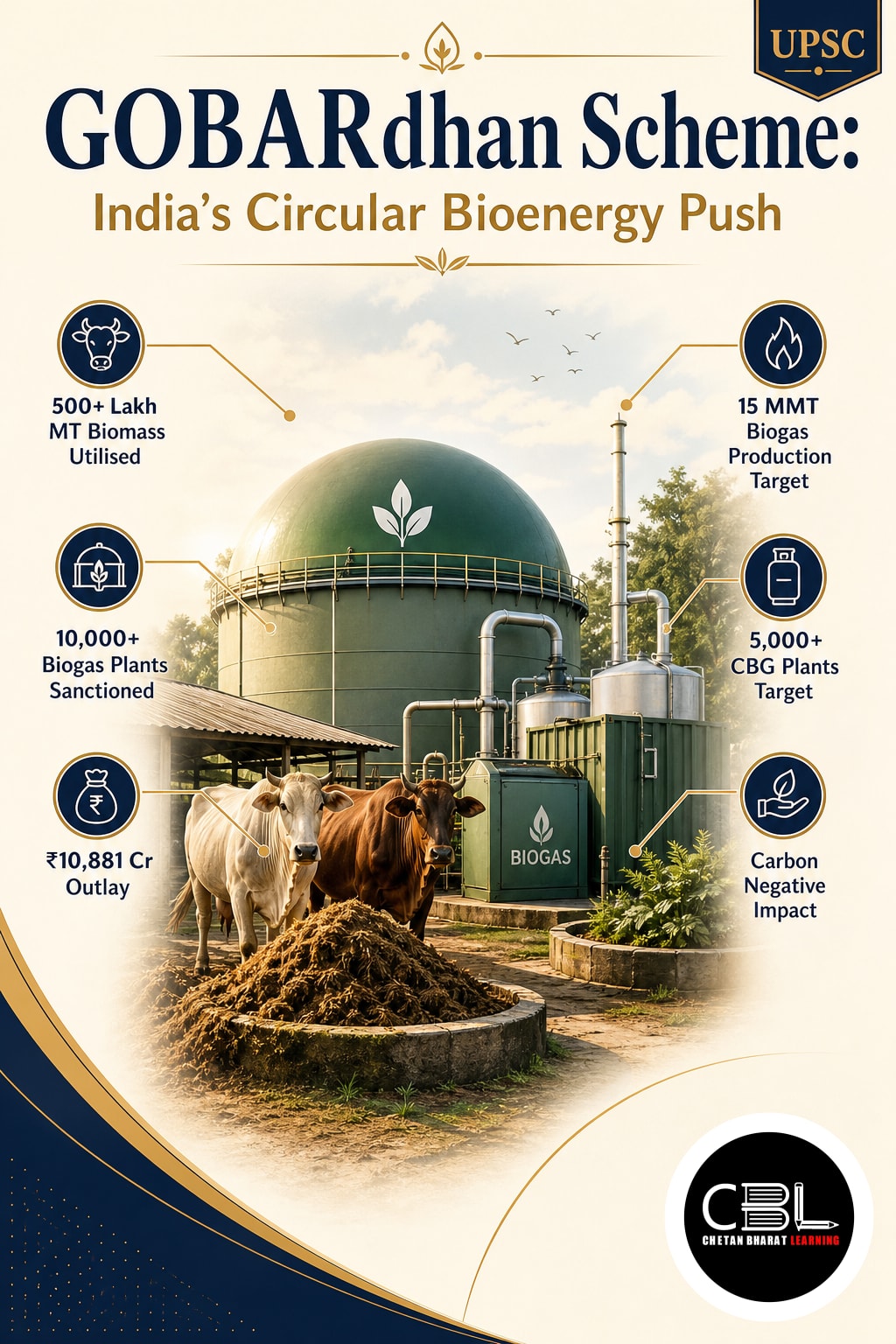
The GOBARdhan Scheme is India’s national framework for converting cattle dung, crop residue, municipal organic waste and other biodegradable materials into compressed biogas. GOBARdhan stands for Galvanizing Organic Bio-Agro Resources Dhan. The initiative also produces bio-slurry that can be processed into nutrient-rich organic fertiliser.
The programme originally began in 2018 under Swachh Bharat Mission-Grameen as a rural waste-management initiative. The expanded framework consolidates CBG-related support under the Ministry of Petroleum and Natural Gas. It creates an integrated platform covering feedstock, production, finance, transportation, gas procurement and manure marketing.
Why is GOBARdhan Scheme in News?
The Union Cabinet approved the expanded GOBARdhan Scheme in August 2026 with an outlay of ₹23,731 crore. It will operate from FY 2026–27 to FY 2035–36 and aims to increase domestic CBG production nearly ten-fold. The framework seeks to develop a commercially viable circular bioeconomy across India.
The government expects the programme to save over ₹40,000 crore in foreign exchange and add more than ₹75,000 crore to GDP over ten years. It also projects over 1.5 lakh jobs, displacement of 10 million metric tonnes of fossil fuel and production of 250 million metric tonnes of organic fertiliser. The official PIB scheme explainer details these expected outcomes.
Key Features
Six integrated components address the major commercial bottlenecks affecting India’s compressed biogas industry.
- Assured CBG offtake: City Gas Distribution entities will procure CBG according to an obligation of 3% in 2026–27, 4% in 2027–28 and 5% from 2028–29.
- Stable administered pricing: The framework provides a government-backed price of ₹2,110 per MMBtu, equivalent to approximately ₹105 per kilogram, with a minimum ten-year horizon.
- Capital assistance: Eligible greenfield plants can receive up to ₹2 crore per tonne-per-day of installed CBG capacity, while qualifying brownfield expansion projects can also receive support.
- Pipeline and credit support: The programme funds connections with trunk and city-gas networks while offering eligible MSME projects credit-guarantee coverage of up to 85% on loans.
- Ecosystem Challenge Fund: District-level assistance will support feedstock mapping, aggregation infrastructure, technology adoption, manure value addition, planning and stakeholder capacity building.
Challenges
The programme’s success depends upon reliable feedstock supply, viable plants, coordinated implementation and strong demand for organic manure.
- Seasonal feedstock availability: Agricultural residue supply varies across seasons, while dispersed collection areas can raise transportation, drying, storage and handling costs.
- Project viability: High capital costs, uncertain plant performance and delayed payments can discourage lenders and smaller entrepreneurs despite financial assistance.
- Technology constraints: Different feedstocks require suitable pre-treatment and digestion systems, while poor operations can reduce gas yield and cause equipment failure.
- Manure marketing: Bio-slurry can accumulate when plants lack quality certification, farmer awareness, processing facilities and dependable distribution arrangements.
- Institutional coordination: Effective implementation requires cooperation among petroleum, agriculture, fertiliser, rural-development, municipal, environmental and State-level authorities.
Way Forward
District administrations should map cattle dung, crop residue, food waste and municipal organic waste before approving projects. Resource assessments must consider seasonality, competing uses and economical transport distances. Accurate mapping will prevent excessive capacity in areas lacking reliable feedstock.
Long-term agreements among farmers, aggregators and plant operators can stabilise supply. Farmer producer organisations, dairy cooperatives and self-help groups should receive opportunities to participate as feedstock partners or project stakeholders. Transparent digital payments can ensure timely and traceable compensation.
Authorities should establish performance standards for methane yield, gas quality, emissions and plant availability. Independent audits can link continued support with operational results rather than installed capacity alone. Training centres should prepare operators for feedstock management, biological processes and safety procedures.
Pipeline planning must prioritise clusters with adequate production potential and proximity to city-gas networks. Standalone projects in remote areas may require virtual-pipeline solutions and local transport-fuel markets. The unified registration portal can support project tracking and access to government benefits.
India should develop a dependable market for fermented organic manure through quality standards, packaging and field demonstrations. Linking the product with natural-farming and soil-health programmes can improve demand. Research should evaluate crop-specific benefits and safe application practices across agro-climatic regions.
The GOBARdhan Scheme can advance energy security, scientific waste management and rural diversification when projects remain commercially and environmentally sound. Its long-term success should be measured through sustained gas production, farmer income, fossil-fuel displacement and verified emission reductions rather than registrations alone.
Prelims Practice Corner
- Q1. What does GOBARdhan stand for?
(a) Generating Organic Biomass and Rural Development (b) Galvanizing Organic Bio-Agro Resources Dhan (c) Green Organic Biofuel and Rural Dhan (d) Government Organic Biomass and Renewable Development
Answer: (b) Galvanizing Organic Bio-Agro Resources Dhan. - Q2. Which ministry administers the expanded national framework?
(a) Ministry of Agriculture (b) Ministry of Rural Development (c) Ministry of Petroleum and Natural Gas (d) Ministry of Power
Answer: (c) Ministry of Petroleum and Natural Gas. - Q3. What is the notified CBG obligation from FY 2028–29 onwards?
(a) 2% (b) 3% (c) 4% (d) 5%
Answer: (d) 5%. - Q4. Which of the following can serve as feedstock for compressed biogas production?
1. Cattle dung 2. Crop residue 3. Municipal organic waste 4. Food waste
(a) 1 and 2 only (b) 2 and 3 only (c) 1, 2 and 4 only (d) 1, 2, 3 and 4
Answer: (d) 1, 2, 3 and 4. - Q5. SATAT is associated primarily with:
(a) Solar rooftop installations (b) Affordable transport through compressed biogas (c) Urban electric buses (d) Green hydrogen exports
Answer: (b) Affordable transport through compressed biogas.
Mains Practice Questions
-
Examine how compressed biogas can advance India’s energy security, rural economy and waste-management objectives. (250 words, 15 marks)
- Intro: Define compressed biogas and its production from organic resources.
- Body: Cover import substitution, farmer income, employment, manure, emissions, waste management and project-level constraints.
- Conclusion: Recommend an integrated and locally adapted circular-bioeconomy model.
-
Discuss the principal components and implementation challenges of India’s expanded bioenergy framework. (150 words, 10 marks)
- Intro: Mention the ten-year national framework and its production objective.
- Body: Explain offtake, pricing, capital support, pipelines, credit guarantees, feedstock and technology challenges.
- Conclusion: Emphasise performance monitoring, farmer participation and environmental safeguards.
FAQs on GOBARdhan Scheme
- What is compressed biogas?
- Compressed biogas is purified and compressed biogas with properties comparable to conventional natural gas. Producers can supply it as transport fuel or through compatible gas networks.
- How can farmers benefit from the programme?
- Farmers earn income by supplying cattle dung and agricultural residue to plants and can access organic fertiliser produced from processed bio-slurry.
- Why is assured offtake important for CBG plants?
- Assured procurement gives producers a predictable market and revenue certainty, strengthening project bankability and encouraging private investment.
Related Current Affairs
Preparing for UPSC, PCS or HCS?
Talk to a mentor at Chetan Bharat Learning, Chandigarh. Free guidance on choosing the right exam and building a study plan.
Chat on WhatsAppCall 97793 53345UPSC / IAS / PCS coaching in Chandigarh · Trusted by aspirants across Punjab & Haryana
Leave a Reply
You must be logged in to post a comment.