
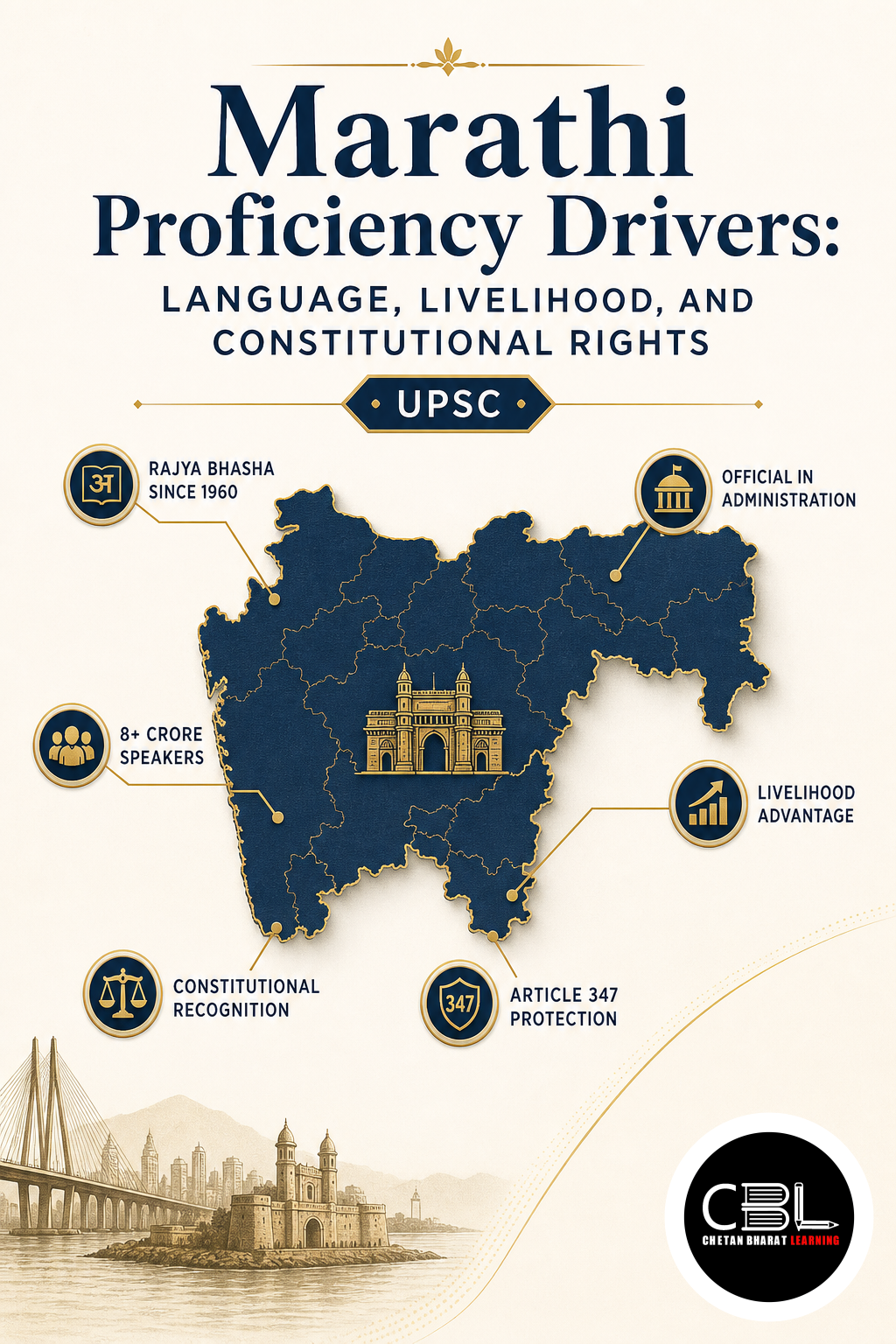
UPSC Mapping
| Prelims | Polity & Federalism |
|---|---|
| Mains | GS Paper 2 (Polity & Federalism) |
| Training Period | 105 days |
|---|---|
| Key Articles | 14, 19(1)(d), 19(1)(e), 19(1)(g) |
What is Marathi Proficiency Drivers?
Marathi Proficiency Drivers refers to the Maharashtra government’s requirement that auto-rickshaw and taxi drivers demonstrate basic proficiency in Marathi to communicate with passengers. The requirement is backed by a 105-day training programme and assessment. Failure to demonstrate proficiency may affect the driver’s licence or permit.
The requirement revives the debate over whether a State can impose linguistic qualifications on a profession, affecting the livelihood of drivers, many of whom migrate from other States. A similar requirement was examined by the Bombay High Court in 2017, which questioned its validity under the relevant legal framework.
Why is Marathi Proficiency Drivers in News?
Marathi Proficiency Drivers is in the news because it has raised constitutional questions about the balance between promoting a regional language and protecting the right to earn a livelihood under Article 19(1)(g). The requirement also engages Article 14 (equality), Article 19(1)(d) (movement), and Article 19(1)(e) (residence and settlement).
The government has argued that the requirement improves public communication, enhances passenger safety and service, and promotes the regional language. Critics argue it disproportionately impacts migrants and could be a barrier to livelihood. The proportionality test—whether the requirement is a reasonable restriction—is central to the debate.
Key Features of Marathi Proficiency Drivers
- Language Requirement: Basic Marathi proficiency for auto/taxi drivers.
- Training Programme: 105-day course and assessment.
- Licence Impact: Failure may affect licence/permit.
- Constitutional Rights: Engages Articles 14, 19(1)(d), (e), (g), and 19(6).
- Proportionality Test: Whether the restriction is reasonable and proportionate to the objective.
Challenges in Marathi Proficiency Drivers
- Livelihood Barrier: It may disproportionately impact migrants who do not speak Marathi.
- Article 19(1)(g): The right to practice any profession may be unreasonably restricted.
- Proportionality: The requirement must be a reasonable restriction, not an arbitrary one.
- Legal Authority: The government must have clear statutory authority to impose such conditions.
- Penalties: Penalties must be proportionate and non-arbitrary.
Way Forward for Marathi Proficiency Drivers
To balance Marathi Proficiency Drivers with constitutional rights, the government should ensure that the requirement is clearly linked to a legitimate objective—such as passenger safety and service quality—and is proportionate. Providing adequate training and a reasonable transition period can mitigate the impact on drivers.
The proficiency standard must be reasonable and not overly burdensome. Clear statutory authority and transparent criteria are essential. The Bombay High Court’s 2017 judgment on a similar issue provides important guidance. For international best practices, refer to the UNHRC standards.
Prelims Practice Corner
Q1. Which Article guarantees the right to practice any profession?
(a) Article 14 (b) Article 19(1)(g) (c) Article 21 (d) Article 22
Answer: (b) Article 19(1)(g) guarantees the right to practice any profession.
Q2. What is the proportionality test?
(a) A test of absolute rights (b) A test to determine if a restriction is reasonable and proportionate (c) A test of parliamentary sovereignty (d) A test of federalism
Answer: (b) Proportionality assesses whether a restriction is reasonable and not excessive.
Q3. Which court examined a similar Marathi proficiency requirement in 2017?
(a) Supreme Court (b) Bombay High Court (c) Delhi High Court (d) Madras High Court
Answer: (b) The Bombay High Court examined a similar issue in 2017.
Q4. Which constitutional right is engaged by the requirement?
(a) Right to equality (b) Right to movement (c) Right to residence (d) All of the above
Answer: (d) Articles 14, 19(1)(d), (e), (g) are engaged.
Q5. What is the stated objective of the Marathi proficiency requirement?
(a) To promote Hindi (b) To improve communication and passenger service (c) To restrict migration (d) To increase revenue
Answer: (b) The objective is improved communication and passenger safety.
Mains Practice Questions
Q1. Discuss the constitutional and policy dimensions of imposing language proficiency requirements for professional drivers in India. (250 words, 15 marks)
- Intro: Introduce the Marathi proficiency requirement and the debate.
- Body: Discuss the constitutional rights involved (Articles 14, 19), the proportionality test, and the federalism dimension. Analyse the arguments for and against the requirement. Suggest a balanced approach.
- Conclusion: Emphasise the need to balance language promotion with livelihood rights.
Q2. What is the principle of proportionality in the context of fundamental rights? (150 words, 10 marks)
- Intro: Define proportionality as a constitutional test.
- Body: Explain that any restriction on fundamental rights must be reasonable, not arbitrary, and proportionate to the objective. In the Marathi proficiency case, the restriction must be justified by a legitimate aim and not excessively burdensome.
- Conclusion: Conclude that proportionality is a key tool for judicial review.
FAQs on Marathi Proficiency Drivers
What is the Marathi proficiency requirement for drivers?
Auto and taxi drivers in Maharashtra must demonstrate basic Marathi proficiency through a 105-day training and assessment.
Why is it controversial?
It raises questions about the right to livelihood, the rights of migrants, and the proportionality of the restriction.
What is the constitutional basis for the challenge?
Articles 14 (equality), 19(1)(g) (profession), 19(1)(d) (movement), and 19(1)(e) (residence) are invoked.
Related Current Affairs
Preparing for UPSC, PCS or HCS?
Talk to a mentor at Chetan Bharat Learning, Chandigarh. Free guidance on choosing the right exam and building a study plan.
Chat on WhatsAppCall 97793 53345UPSC / IAS / PCS coaching in Chandigarh · Trusted by aspirants across Punjab & Haryana
Leave a Reply
You must be logged in to post a comment.