

UPSC Mapping
- Prelims: GI Act, WIPO and Traditional Cultural Expressions
- Mains: GS Papers I and III — Culture and Intellectual Property
Quick Facts
| Indian law | GI Act, 1999 |
|---|---|
| GI authority | GI Registry, Chennai |
| International forum | WIPO IGC |
| Core issue | Collective custodianship |
| Proposed approach | Sui generis protection |
What are Indian Crafts?
Indian Crafts are living cultural expressions shaped by artisans, families and regions over long periods. They include embroidery, weaving, leatherwork, metalwork, pottery, painting and many other knowledge-intensive practices. A community often preserves the technique collectively, while individual artisans continually adapt its colours, materials and forms.
This collective evolution makes traditional artistry different from a modern work with one clearly identifiable author. Copyright may protect a particular original drawing, design law may protect a registered product appearance, and a trademark may identify a commercial source. A Geographical Indication can protect a qualifying name and geographical reputation, but none automatically gives a community control over every inherited motif or technique.
Why are Indian Crafts in News?
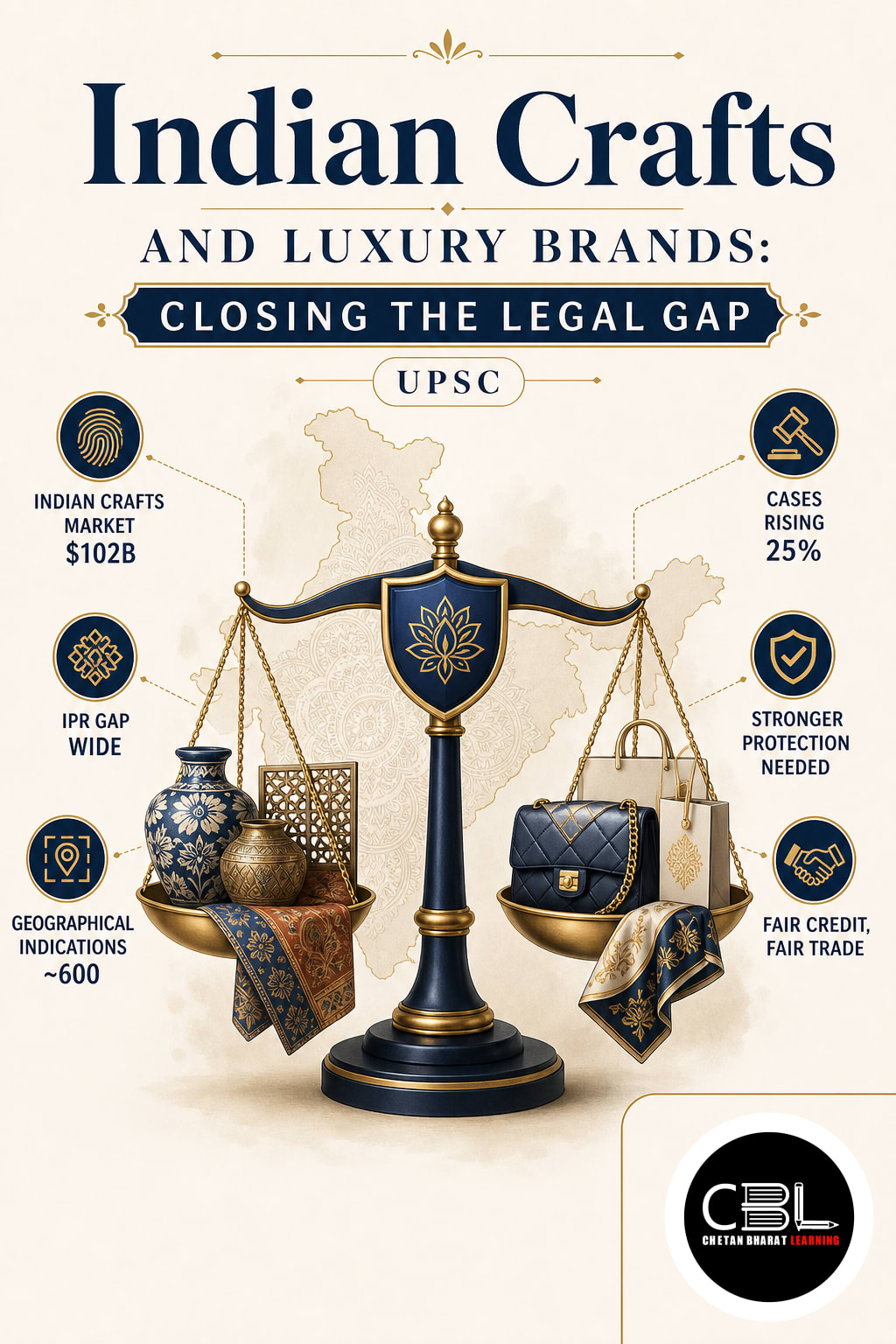
Indian Crafts have returned to public debate after luxury products were compared with Kolhapuri footwear, regional embroidery and traditional mirror work. Critics questioned whether brands had adequately acknowledged cultural origins and artisan contributions. The controversy concerns more than visual similarity because recognition, bargaining power and economic value often move away from the custodial community.
The debate coincides with negotiations at the WIPO Intergovernmental Committee on international instruments concerning traditional knowledge and traditional cultural expressions. WIPO’s 2026–2027 mandate continues text-based negotiations, but global rules remain unfinished. Recent controversies therefore expose the distance between ethical attribution and enforceable cross-border rights.
Key Features
The legal problem involves overlapping rights rather than one missing registration. Effective protection must distinguish a living tradition from a fixed commercial product while preserving the community’s continuing relationship with it and leaving space for artisans themselves to innovate, collaborate and reach new markets sustainably worldwide.
- Collective custodianship: Traditional knowledge may have no traceable first author because many generations refine it, yet historical practice, oral testimony, regional continuity and community knowledge can establish which group has preserved and transmitted the expression; representative institutions must still demonstrate accountability so outside bodies do not speak for artisans without consent.
- Layered intellectual property: Copyright, designs, trademarks, passing-off actions and geographical indications can each protect a specific element, but their separate eligibility rules rarely cover the entire cultural relationship between a technique, a place and its practitioners, requiring communities to build coordinated portfolios instead of assuming one registration will solve every form of commercial appropriation.
- Limited GI coverage: A GI identifies goods whose quality, reputation or other characteristic is essentially attributable to geographical origin, while the underlying stitch, visual grammar or production knowledge may remain available for imitation when the protected indication itself is not misused; practical value also depends on producer registration, quality standards, consumer recognition and consistent market enforcement.
- Provenance and attribution: Reliable records can connect motifs, methods, names and regions with custodial communities, helping buyers and courts identify prior cultural use without falsely claiming exclusive ownership over every resemblance or normal artistic evolution, provided communities control sensitive information and registries distinguish public evidence from sacred, secret or restricted knowledge.
- International rule-making: WIPO continues negotiations on traditional knowledge and cultural expressions, while its 2024 treaty created patent-disclosure duties for genetic resources and associated traditional knowledge rather than a complete global regime for craft designs, so policymakers must avoid presenting that treaty as a direct solution to every cultural-expression dispute.
Challenges
Protection requires legal capacity as well as formal rights. The broader relationship between heritage, livelihoods and cultural policy also features in CBL’s art and culture analysis.
- Unclear legal ownership: Conventional copyright expects identifiable authorship and originality, whereas an inherited technique may belong culturally to a fluid community whose membership, representatives and decision-making processes require careful and legitimate definition; poorly designed representation can reproduce local inequalities by excluding women, mobile artisans or smaller producer groups.
- Territorial enforcement: Indian registration does not automatically secure relief in every foreign market, and cross-border investigation, legal advice, evidence collection and litigation may cost far more than an artisan association can reasonably finance, while differences between national laws make outcomes uncertain even when cultural provenance appears historically well documented.
- Weak institutional capacity: Producers may lack authorised-user registration, market information, documentation and collective negotiating structures, so a statutory remedy can remain inaccessible even when a geographical indication or another recognised right exists; language barriers, informal production networks and limited digital access can deepen this gap between entitlement and enforcement.
- Technique-expression divide: Law can protect a particular artistic expression more easily than a general method, and manufacturers may alter materials, mechanise production or describe a borrowed form as inspiration to avoid a direct infringement claim, making ethical sourcing standards and transparent supply-chain disclosure important complements to narrow legal remedies.
- Risk of over-protection: Extremely broad exclusive rights could freeze cultural exchange, restrict artisans from adapting shared traditions and turn a dynamic practice into a museum category, making precise exceptions and community-defined boundaries essential, alongside safeguards for customary use, learning between artisan groups, repair, research and non-exploitative creative experimentation.
Way Forward
A balanced framework for Indian Crafts should recognise community custodianship without granting a monopoly over broad cultural ideas. A specially designed law can specify legitimate representatives, mandatory attribution, circumstances requiring consent, and fair benefit-sharing for major commercial uses. It should preserve research, teaching, customary exchange and genuine artistic transformation through clearly framed exceptions.
India should also strengthen producer organisations, authorised-user registration and legal assistance under the official GI framework. Community-controlled digital registries can document public provenance while shielding sacred or restricted knowledge from disclosure. Luxury companies should conduct cultural due diligence, name the source community, contract transparently and share value when commercial use depends substantially on inherited expertise.
Prelims Practice Corner
Q1. The Geographical Indications of Goods (Registration and Protection) Act was enacted in which year?
(a) 1986 (b) 1991 (c) 1999 (d) 2005
Answer: (c) Parliament enacted the Geographical Indications of Goods (Registration and Protection) Act in 1999.
Q2. Which institution conducts international negotiations on traditional knowledge and traditional cultural expressions?
(a) IMF (b) WIPO IGC (c) IAEA (d) ICAO
Answer: (b) WIPO’s Intergovernmental Committee conducts text-based negotiations on these intellectual-property issues.
Q3. Consider the following statements about a Geographical Indication: 1. It links qualifying goods with a geographical origin. 2. It automatically protects every traditional motif from all forms of imitation. Which statements are correct?
(a) 1 only (b) 2 only (c) Both 1 and 2 (d) Neither 1 nor 2
Answer: (a) A GI protects a geographical indication for qualifying goods, not every associated motif or technique automatically.
Q4. Under India’s GI framework, who may initiate an infringement action?
(a) Only the Union Government (b) Only individual consumers (c) Registered proprietors and authorised users (d) Only foreign trademark owners
Answer: (c) Registered proprietors and registered authorised users may pursue infringement remedies.
Q5. The 2024 WIPO treaty primarily establishes a patent-disclosure requirement concerning:
(a) Fashion trademarks (b) Genetic resources and associated traditional knowledge (c) Film certification (d) Internet domain names
Answer: (b) The treaty addresses patent applications based on genetic resources or associated traditional knowledge.
Mains Practice Questions
Q1. Why do conventional intellectual-property laws provide incomplete protection to India’s traditional craft communities? (10 marks)
Answer Structure:
- Intro: Define traditional craft as a collectively transmitted and continuously evolving cultural expression.
- Body: Examine authorship, originality, GI limits, territorial enforcement, community representation and institutional-capacity gaps.
- Conclusion: Support layered protection centred on attribution, custodianship and accessible remedies.
Q2. Propose a balanced legal and institutional framework to prevent commercial misappropriation without freezing India’s living craft traditions. (15 marks)
Answer Structure:
- Intro: Present the tension between cultural exchange and extraction without acknowledgement.
- Body: Cover sui generis rights, legitimate representation, consent, attribution, benefit-sharing, sensitive documentation, producer bodies, legal aid and exceptions.
- Conclusion: Link cultural justice with artisan livelihoods and responsible global collaboration.
FAQs on Indian Crafts
Why do Indian Crafts need community-based protection?
Many traditions evolved collectively and have no identifiable first author. Community-based protection recognises the people who continuously preserve, practise and transmit that heritage.
Why is a GI tag not always sufficient?
A GI protects a qualifying geographical indication and its product reputation. It does not automatically prohibit every use of a related motif, stitch or production technique.
Can stronger protection restrict cultural creativity?
Yes, overly broad rights could block legitimate adaptation and exchange. A balanced framework should target false authorship and exploitative commercial use while preserving normal cultural evolution.
Related Current Affairs
Preparing for UPSC, PCS or HCS?
Talk to a mentor at Chetan Bharat Learning, Chandigarh. Free guidance on choosing the right exam and building a study plan.
Chat on WhatsAppCall 97793 53345UPSC / IAS / PCS coaching in Chandigarh · Trusted by aspirants across Punjab & Haryana
Leave a Reply
You must be logged in to post a comment.