

UPSC Mapping
Prelims
Articles 93–96, Effective Majority and Notice Period
Mains
GS Paper II: Parliament, Presiding Officers and Accountability
Quick Facts
| Removal Provision | Article 94(c) |
|---|---|
| Minimum Notice | 14 Days |
| Required Support | Majority of All Then Members |
| Debate Safeguard | Article 96 |
Article
What is Speaker Removal?
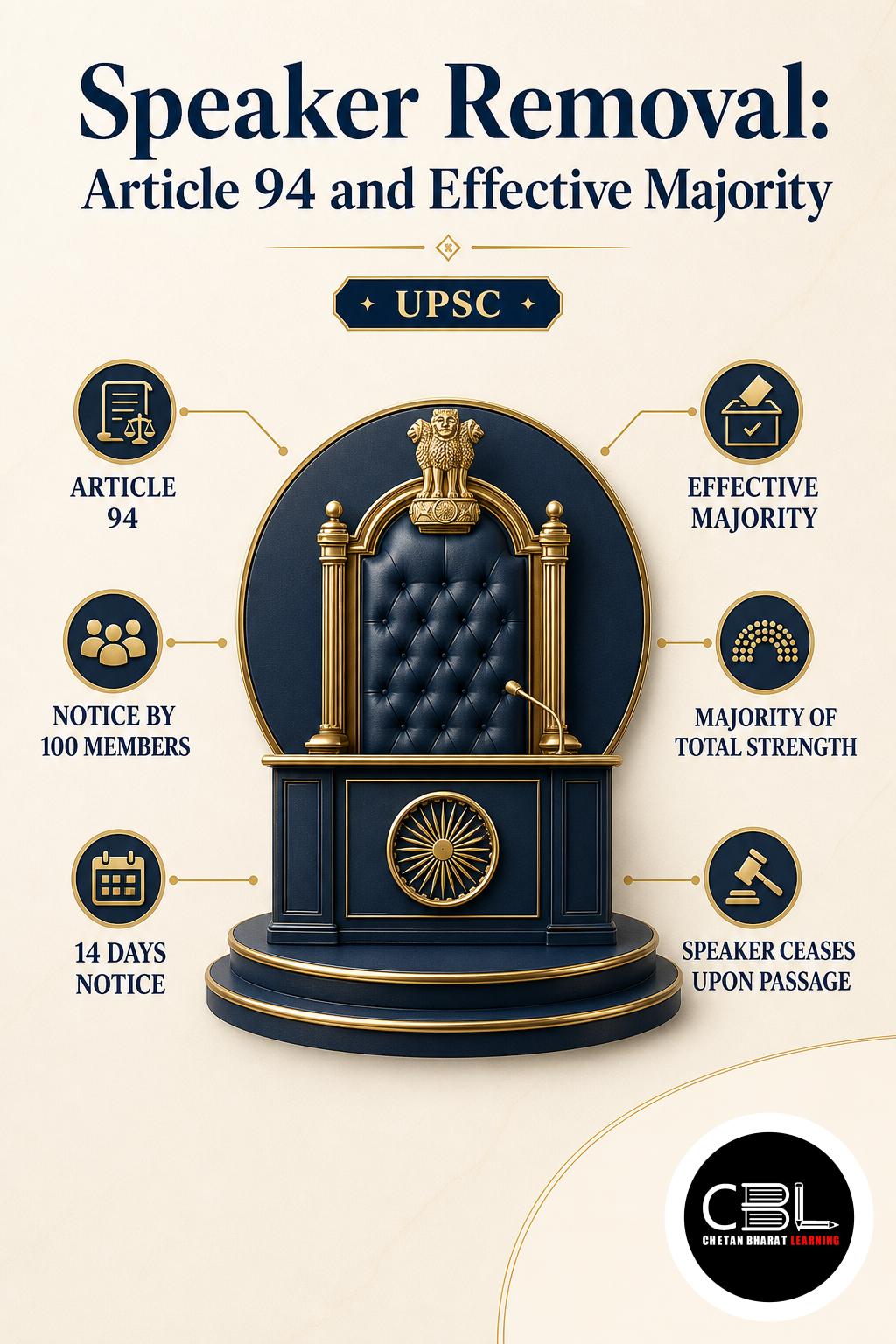
Speaker Removal is the constitutional procedure through which the Lok Sabha may remove its presiding officer before the end of the officer’s tenure. Article 94(c) requires a resolution passed by a majority of all the then members of the House, commonly described as an effective majority because vacancies are excluded from the total strength. This threshold is higher than a simple majority of members present and voting, ensuring that removal reflects broad institutional support rather than the result of temporary low attendance.
Article 94 also addresses resignation, cessation of membership and continuity after dissolution. The Speaker resigns to the Deputy Speaker, while the Deputy Speaker resigns to the Speaker; either office becomes vacant if its holder ceases to remain a Lok Sabha member. The Speaker continues after dissolution until immediately before the first meeting of the newly constituted House, protecting constitutional continuity and administrative authority during the transition between two Lok Sabhas.
Why is Speaker Removal in News?
Speaker Removal returned to public discussion after Opposition members submitted a notice against Om Birla during the 2026 Budget Session. They alleged that the presiding officer had restricted Opposition participation and acted in a partisan manner, while the government defended the Speaker’s conduct and institutional neutrality. After parliamentary consideration, the Lok Sabha rejected the resolution by voice vote, leaving the Speaker in office and turning the episode into a significant case study on legislative procedure.
The episode mattered because such resolutions are rare and directly test the relationship between majority power, Opposition rights and the authority of the Chair. Article 96 prevented the Speaker from presiding while the resolution was under consideration, although it preserved his right to speak and participate in proceedings. The official parliamentary news report records the rejection, while the broader debate underlined the need for fair procedure, decorum and reasoned institutional criticism.
Key Features
The process combines advance notice, special voting rules and procedural fairness.
- Constitutional authority: Article 94(c) expressly empowers the Lok Sabha to remove the Speaker or Deputy Speaker through a resolution adopted by the prescribed majority, placing the power within the House rather than the executive, judiciary or President.
- Fourteen-day notice: The resolution cannot be moved until at least fourteen days’ notice has been given, allowing examination, scheduling and preparation by all concerned parties, reducing surprise and giving the incumbent a reasonable opportunity to understand and answer the allegations.
- Effective majority: The resolution requires support from a majority of all the then members, meaning the working strength after excluding existing vacancies rather than merely those voting, thereby preventing a small attendance from determining the fate of a constitutionally significant parliamentary office.
- Neutral chairing: Article 96 bars the Speaker from presiding during consideration of the resolution, so another constitutionally authorised member conducts the sitting and related decisions, separating the incumbent’s personal interest from control over recognition, debate and procedural rulings during consideration.
- Right of response: The Speaker may speak and otherwise participate in the proceedings, and may vote in the first instance but cannot exercise a casting vote during an equality of votes, balancing a member’s right of defence with restrictions required for a fair institutional decision.
Challenges
A removal resolution can expose tensions between political contestation and parliamentary neutrality.
- Partisan polarisation: Government and Opposition may assess the Speaker’s conduct through competing political interests, making objective agreement on procedural fairness difficult, particularly when allegations concern discretionary rulings that parliamentary conventions ordinarily leave to the authority of the Chair, requiring members to frame specific procedural criticism without converting the debate into reputational attack.
- Majority dominance: A government with comfortable numbers can defeat a resolution even when allegations raise wider questions about debate time, suspensions or recognition of members, although numerical defeat does not by itself resolve concerns about transparency, participation or institutional trust.
- Procedural ambiguity: Disputes may arise over admissibility, specificity of charges, scheduling, presiding arrangements and the method used to record the final decision, especially where the House lacks a Deputy Speaker or established practice offers limited guidance for rare circumstances.
- Institutional reputation: Unsupported personal allegations can weaken public confidence in Parliament, while refusing legitimate scrutiny can similarly damage the authority of the Chair.
- Disrupted business: Extended confrontation may reduce legislative scrutiny and Question Hour productivity, concerns linked with wider analysis in the polity current affairs section, while repeated adjournments can prevent committees, ministers and members from completing time-sensitive public business.
Way Forward
Future Speaker Removal proceedings should follow a published timetable, clearly framed charges and transparent voting records whenever rules permit. The member presiding over the debate must apply identical speaking standards to the government, Opposition and the Speaker defending the office. Parliamentary authorities should publish the admitted resolution, procedural rulings and voting basis so citizens can distinguish constitutional accountability from ordinary political conflict, while complete records can assist later scholarly, judicial and parliamentary examination, strengthening institutional trust and procedural legitimacy.
The Speaker should also maintain visible neutrality in recognising members, allocating debate time, deciding points of order and using disciplinary powers. Regular consultation through the Business Advisory Committee and meetings with floor leaders can address grievances before they escalate into removal proceedings. The official Constitution text provides the governing safeguards; their careful application can preserve majority rule, minority voice and dignity of the House without insulating any presiding officer from legitimate scrutiny, reasoned criticism or the constitutional authority of Lok Sabha to regulate its internal proceedings, while reinforcing the expectation that procedural power must be exercised with restraint, consistency and publicly defensible reasons.
Prelims Practice Corner
Q1. Which Article provides for removing the Lok Sabha Speaker?
- (a) Article 75
- (b) Article 85
- (c) Article 94
- (d) Article 123
Answer: (c) Article 94 governs vacation, resignation and removal from the office.
Q2. What majority is required to pass the resolution?
- (a) Members present and voting
- (b) Two-thirds of total membership
- (c) Majority of all then members
- (d) Unanimous support
Answer: (c) Article 94 requires a majority of all the then members of Lok Sabha.
Q3. What is the minimum constitutional notice period?
- (a) Seven days
- (b) Fourteen days
- (c) Thirty days
- (d) Sixty days
Answer: (b) At least fourteen days’ notice must precede moving the resolution.
Q4. Who presides while the House considers a resolution against the Speaker?
- (a) The Speaker
- (b) Another authorised presiding member
- (c) The Prime Minister
- (d) The President
Answer: (b) Article 96 prevents the concerned Speaker from presiding.
Q5. What happens to the Speaker’s office after Lok Sabha dissolves?
- (a) It ends immediately
- (b) The President assumes it
- (c) It continues until before the new House first meets
- (d) The Chief Justice assumes it
Answer: (c) The Speaker continues until immediately before the new Lok Sabha first meets.
Mains Practice Questions
Q1. Explain the constitutional procedure for removing the Lok Sabha Speaker and assess its safeguards. (250 words, 15 marks)
Answer Structure:
- Intro: Locate the power under Articles 94 and 96.
- Body: Discuss notice, effective majority, neutral chairing, participation rights and continuity after dissolution.
- Conclusion: Link procedural safeguards with stability and accountability.
Q2. The neutrality of the Speaker is essential for protecting both majority rule and Opposition rights. Discuss. (150 words, 10 marks)
Answer Structure:
- Intro: Describe the Speaker as custodian of the House.
- Body: Examine recognition, debate allocation, discipline, points of order and partisan pressures.
- Conclusion: Recommend transparent rulings and regular cross-party consultation.
FAQs on Speaker Removal
Is this the same as a no-confidence motion against the government?
No. A resolution against the Speaker concerns the presiding office under Article 94, while a no-confidence motion tests the Council of Ministers’ support.
Can the Speaker preside over the removal debate?
No. Article 96 prevents the concerned Speaker from presiding, although the Speaker may speak and participate in the proceedings.
What does effective majority mean here?
It means more than half of all the then members of Lok Sabha. Vacant seats are excluded, but absences among existing members do not reduce the threshold.
Related Current Affairs
Preparing for UPSC, PCS or HCS?
Talk to a mentor at Chetan Bharat Learning, Chandigarh. Free guidance on choosing the right exam and building a study plan.
Chat on WhatsAppCall 97793 53345UPSC / IAS / PCS coaching in Chandigarh · Trusted by aspirants across Punjab & Haryana
Leave a Reply
You must be logged in to post a comment.