
UPSC Mapping
- Prelims: CGWB Categories, Aquifers and Stage of Extraction
- Mains: GS Paper III: Agriculture, Water Resources and Conservation
Quick Facts
| Assessment Year | 2025 |
|---|---|
| Extraction Stage | 156.36% |
| Annual Extraction | 26.27 BCM |
| Deep Wells | 9% beyond 40 metres |
What is Punjab Groundwater Crisis?
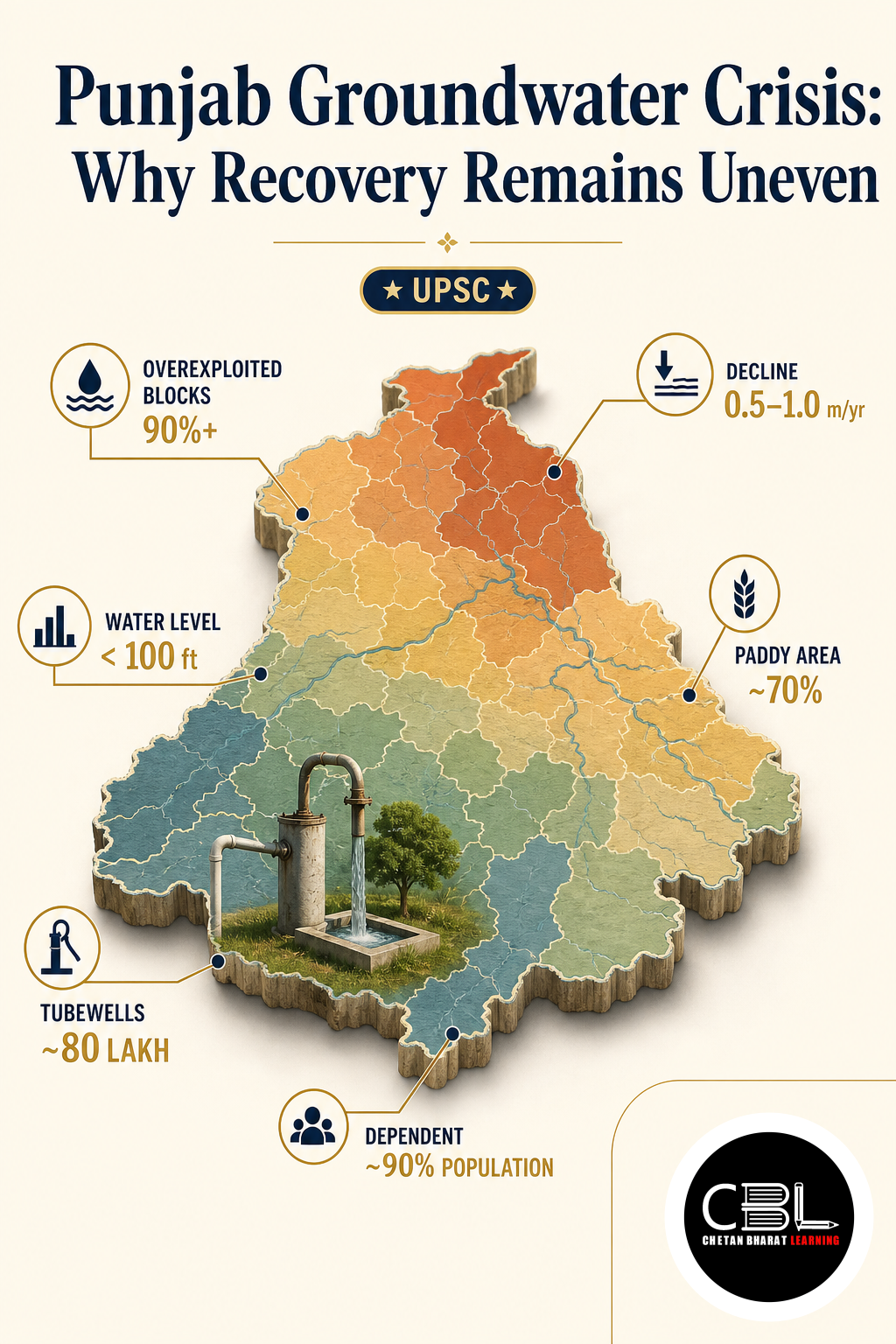
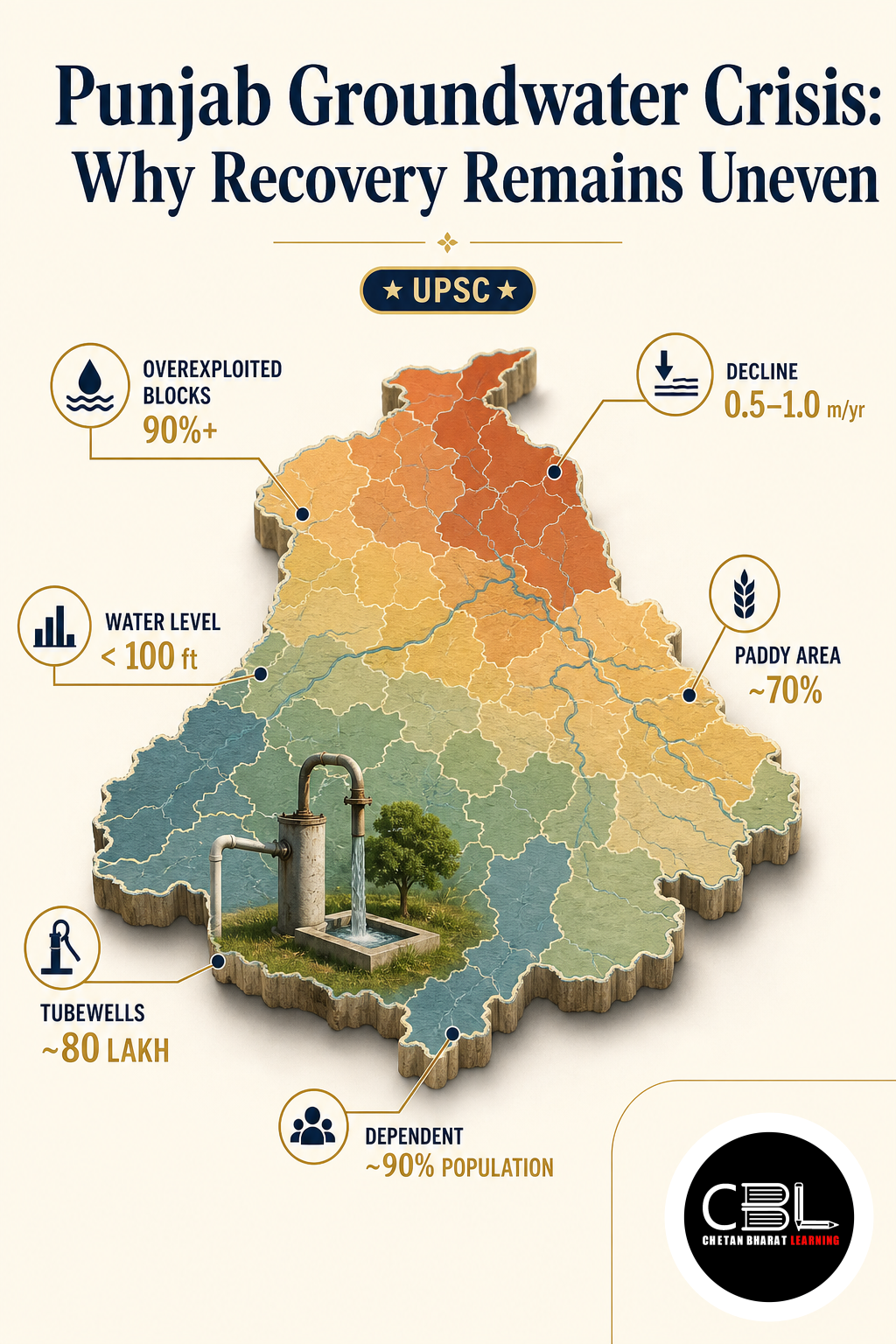
The Punjab Groundwater Crisis refers to persistent withdrawal beyond the replenishment capacity of underground aquifers. Farmers use groundwater mainly for irrigation, while households and industries also depend on the same reserves for drinking water, services and productive activity. The problem becomes severe when annual extraction repeatedly exceeds annual extractable resources, reduces the drought buffer and forces households or cultivators to drill deeper.
The stage of groundwater extraction compares total annual withdrawal with the annual extractable resource. The Central Ground Water Board classifies assessment units as safe, semi-critical, critical or over-exploited through a standard resource assessment framework. An over-exploited unit records a stage above 100 per cent, signalling that present withdrawals exceed the assessed renewable supply even when one favourable monsoon temporarily improves recharge.
Why is Punjab Groundwater Crisis in News?
The Punjab Groundwater Crisis returned to attention after updated assessments showed two trends moving in different directions. The number of over-exploited blocks fell marginally, but the share of observation wells deeper than 40 metres reached 9 per cent after the 2025 monsoon. This means a better block classification does not automatically indicate a broad recovery in water levels, because classification and well-depth trends measure related but distinct conditions.
Official assessment data place Punjab’s extraction stage far above the national average, with irrigation driving most demand and shaping the state’s overall water balance. The Union government outlines national trends, assessment methods and conservation programmes in its groundwater resources statement. The latest evidence requires readers to distinguish short-term recharge gains from long-term aquifer stress and compare several assessment cycles before declaring a durable reversal.
Key Features
Punjab’s groundwater stress reflects connected agricultural, hydrological and policy factors rather than a single cause.
- Rice-wheat concentration: Large areas follow an intensive rotation that creates heavy irrigation demand during hot months, especially before monsoon rainfall becomes dependable.
- Extraction above recharge: A stage above 100 per cent indicates withdrawals greater than assessed renewable groundwater availability, leaving smaller buffers against drought and rainfall shocks.
- Uneven local conditions: Rainfall, soils, canal access and aquifer properties produce different outcomes across districts and blocks, so broad averages can conceal severe local stress.
- Energy-water connection: Low marginal pumping costs can weaken incentives to conserve water at individual farms, particularly when users cannot measure or compare actual withdrawals.
- Growing well depth: Farmers invest in deeper pumps when shallow aquifers decline, raising energy and cultivation costs while making smaller domestic wells more vulnerable.
These features create a feedback loop between declining water levels, rising pumping costs, energy consumption and household investment decisions. Deeper pumping consumes more electricity and increases production expenses, while the absence of dependable alternatives keeps cultivators tied to familiar crops. Small and marginal farmers face greater risk because expensive borewells and pump upgrades can strain household finances; a falling water table also reduces drought resilience because communities lose the underground buffer that normally supports them during weak monsoons.
Challenges
A durable response must address farm incomes, public procurement and aquifer conditions at the same time.
- Weak diversification incentives: Alternative crops need reliable markets, processing networks and price assurance before farmers can shift safely without accepting disproportionate income and production risks.
- Fragmented water governance: Agriculture, power, rural development and water agencies often operate through separate programmes and datasets, weakening coordination across the same aquifer system.
- Limited recharge potential: Urban surfaces, unsuitable structures and local geology can reduce the effectiveness of recharge investments unless planners use site-specific hydrogeological evidence.
- Unequal adaptation capacity: Larger farmers can finance efficient equipment more easily than tenants and small cultivators, who also face weaker access to formal credit and extension services.
- Measurement gaps: Block averages can hide village-level decline and cannot replace frequent monitoring of well depth, pumping volumes, water quality and seasonal recharge.
Policy design must also recognise that Punjab contributes substantially to national grain procurement. A sudden retreat from paddy without credible markets could transfer costs to farmers and disturb food supply arrangements. The state therefore needs a sequenced transition built around income protection, crop planning and locally measured water budgets; related environmental developments appear in CBL’s environment coverage.
Recharge structures alone cannot compensate for unrestricted withdrawal across a large agricultural landscape with recurring seasonal irrigation demand. Their performance depends on rainfall, siting, maintenance, land availability and the capacity of local aquifers to accept water. Canal seepage can support recharge in some regions, while waterlogging or salinity may require different management elsewhere; authorities must therefore avoid one uniform solution for the entire state.
Way Forward
Punjab can reduce demand by combining crop diversification with assured procurement, storage, processing and extension support. Maize, pulses, oilseeds and horticulture should expand only where agro-climatic conditions and markets support stable returns. Direct-seeded rice, laser land levelling, suitable micro-irrigation and scientific irrigation scheduling can lower water use, but farmers need training and timely technical support; power reforms should reward verified conservation while protecting affordable access for vulnerable cultivators and avoiding abrupt cost increases during the transition.
The Punjab Groundwater Crisis also requires aquifer-level planning rather than isolated construction targets. Agencies should publish seasonal water budgets, expand observation networks and involve panchayats and water-user groups in monitoring; recharge works must follow hydrogeological assessment and receive maintenance funds after construction. The Centre’s water conservation update describes programmes that states can align with local plans; a transparent combination of demand management, managed recharge and livelihood support offers the most credible path to recovery, provided agencies report outcomes rather than only expenditure and construction targets.
Prelims Practice Corner
Q1. The stage of groundwater extraction is calculated as which ratio?
(a) Recharge to rainfall (b) Extraction to extractable resource (c) Irrigation to canal flow (d) Storage to runoff
Answer: (b) It compares annual groundwater extraction with annual extractable groundwater resources.
Q2. An assessment unit becomes over-exploited when its extraction stage is:
(a) Below 70% (b) 70-90% (c) 90-100% (d) Above 100%
Answer: (d) Extraction above the assessed renewable resource places the unit in this category.
Q3. Which institution jointly assesses India’s dynamic groundwater resources with states?
(a) Central Water Commission (b) Central Ground Water Board (c) NITI Aayog (d) National Rainfed Area Authority
Answer: (b) The Central Ground Water Board conducts the assessment with state agencies.
Q4. Water supplies, irrigation and canals mainly fall under which constitutional list?
(a) Union List (b) State List (c) Concurrent List (d) Residuary powers
Answer: (b) Entry 17 of the State List covers water, subject to Union List provisions.
Q5. Which sector accounts for the largest share of groundwater extraction in India?
(a) Industry (b) Domestic use (c) Irrigation (d) Inland navigation
Answer: (c) Irrigation accounts for the dominant share of annual groundwater withdrawal.
Mains Practice Questions
Q1. Groundwater depletion in Punjab is as much an incentive problem as a hydrological problem. Discuss. (250 words, 15 marks)
Intro: Define groundwater stress through extraction relative to renewable availability.
Body: Examine cropping patterns, procurement, electricity pricing, farm risk, aquifer limits and unequal adaptation capacity.
Conclusion: Recommend a phased water transition that protects both aquifers and farm incomes.
Q2. Suggest an integrated strategy for sustainable groundwater management in north-western India. (150 words, 10 marks)
Intro: Link groundwater security with agriculture, energy and climate resilience.
Body: Cover aquifer budgets, crop diversification, efficient irrigation, power incentives, recharge and community monitoring.
Conclusion: Emphasise measurable local plans supported by coordinated state and Union programmes.
FAQs on Punjab Groundwater Crisis
Why is groundwater declining in Punjab?
Intensive irrigation demand often exceeds natural and managed recharge. Cropping choices, energy incentives, rainfall variability and local aquifer conditions together shape the decline.
Does a fall in over-exploited blocks prove recovery?
No. Block classification may improve while water levels fall in particular monitoring wells. Analysts should compare extraction, recharge, well depth and trends across several assessment cycles.
How can Punjab conserve groundwater without hurting farmers?
The state can pair diversification with procurement, markets and income safeguards. Efficient irrigation, aquifer-based recharge and community monitoring can reinforce that transition.
Related Current Affairs
Preparing for UPSC, PCS or HCS?
Talk to a mentor at Chetan Bharat Learning, Chandigarh. Free guidance on choosing the right exam and building a study plan.
Chat on WhatsAppCall 97793 53345UPSC / IAS / PCS coaching in Chandigarh · Trusted by aspirants across Punjab & Haryana
Leave a Reply
You must be logged in to post a comment.