
UPSC Mapping
Prelims
Montreal Protocol, HFCs, ODS and Kigali Framework
Mains
GS Paper III: Environment, Climate Change and Energy
| Adopted | 15 October 2016 |
|---|---|
| Location | Kigali, Rwanda |
| Parent Treaty | Montreal Protocol |
| India Ratified | 2021 |
Article
Kigali Amendment marks ten years of international action to reduce hydrofluorocarbons and make cooling more climate-friendly. World Ozone Day 2026 highlights how refrigerant policy, efficient equipment, correct installation, proper maintenance and global finance can serve development without intensifying warming. The transition matters for India because growing demand for air-conditioning and cold chains must align with energy security and climate goals while widening reliable access for vulnerable communities.
What is the Kigali Amendment?
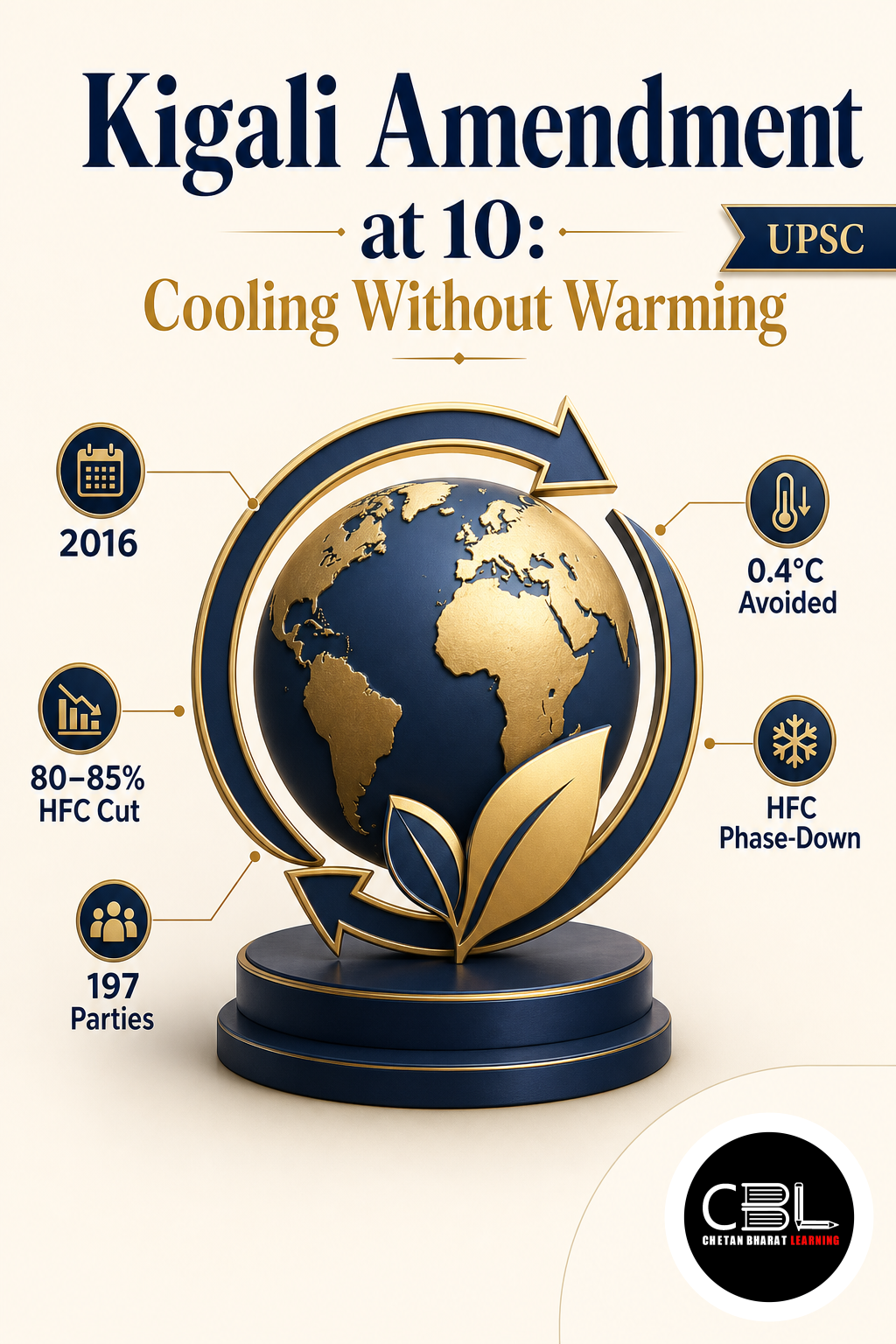
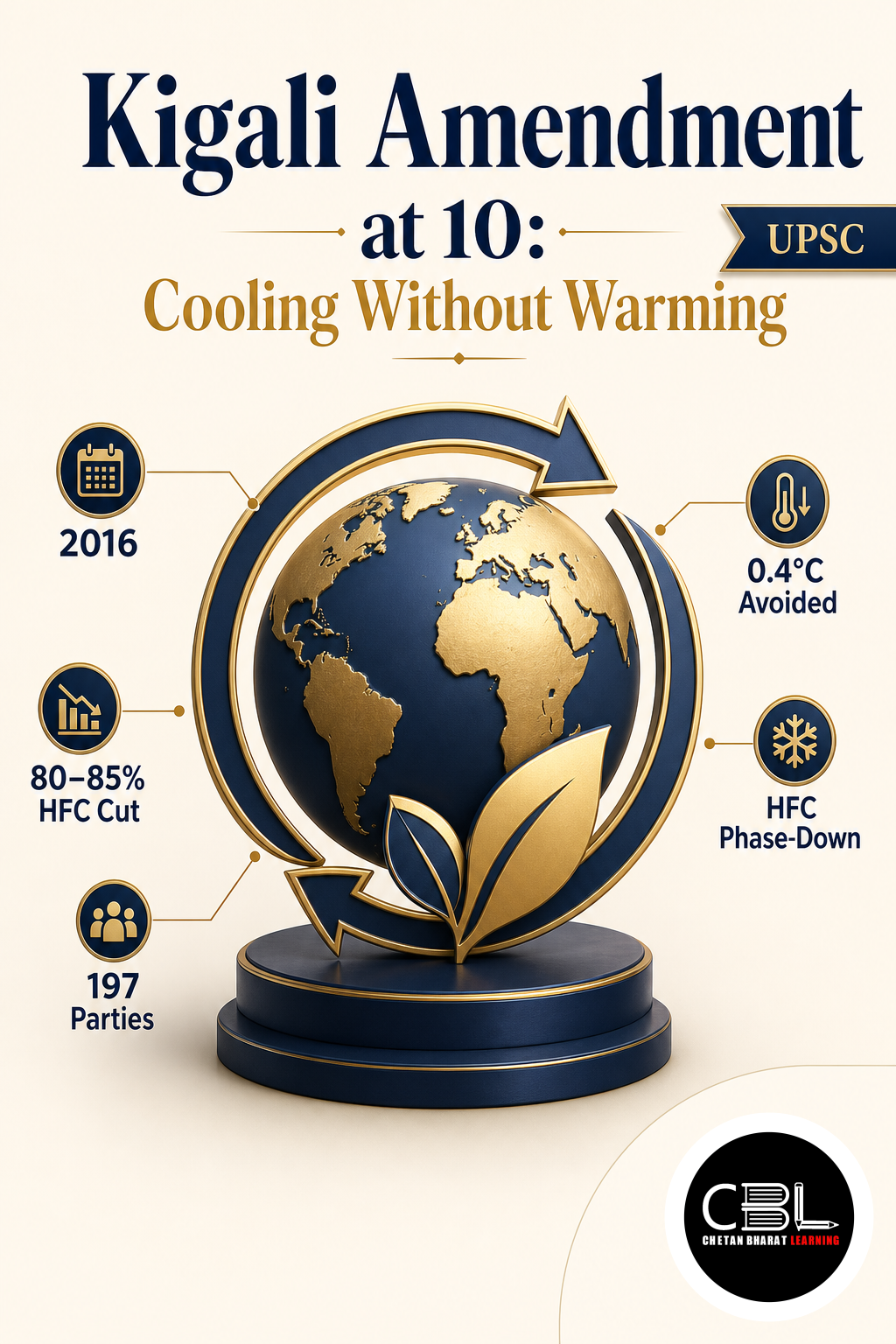
The Kigali Amendment is a legally binding addition to the Montreal Protocol that requires countries to gradually reduce production and consumption of specified hydrofluorocarbons used widely in refrigeration, air-conditioning, foams, aerosols and specialised industrial applications. Parties adopted it in Rwanda in October 2016 after recognising that HFC use could rise rapidly with expanding refrigeration and air-conditioning. Although HFCs generally do not destroy stratospheric ozone, many possess high global-warming potential and can trap far more heat than carbon dioxide over defined periods, making their rapid growth a serious climate risk even after earlier ozone-depleting refrigerants were controlled.
The amendment builds on institutions created for eliminating ozone-depleting substances, including reporting, licensing, compliance support, scientific assessment and financial assistance through institutions that governments and industries already understand. It gives country groups differentiated schedules reflecting capability and development circumstances rather than imposing one immediate deadline, thereby recognising equity while retaining binding long-term direction. This design allows industries to replace refrigerants, modify manufacturing lines, test components, train technicians, update safety standards and expand safe alternative technologies while preserving access to essential cooling for hospitals, vaccines, food supply chains, workplaces, schools and heat-exposed households.
Why is the Kigali Amendment in News?
The Kigali Amendment is in news as World Ozone Day 2026 celebrates ten years of sustainable cooling under the agreement. The official theme, Global action for a cooler planet, links the Montreal Protocol’s ozone success with climate benefits from reducing HFCs and improving equipment efficiency. The UNEP Ozone Secretariat campaign emphasises science-based policy, universal participation, compliance, financing and industry innovation as mutually reinforcing conditions for credible and durable environmental cooperation.
World Ozone Day falls on 16 September, commemorating the 1987 agreement on the Montreal Protocol. The anniversary also draws attention to rising cooling needs caused by urbanisation, higher incomes, food and vaccine cold chains, and more frequent extreme heat, all of which make reliable cooling an increasingly important development service rather than a luxury. India must expand cooling access while lowering electricity demand, refrigerant leakage and lifecycle emissions, making implementation a combined challenge of climate justice, industrial policy and public health, particularly as extreme heat raises the human and economic cost of inadequate cooling.
Key Features
- HFC phase-down: Parties reduce controlled HFC consumption and production from agreed baselines through staged steps, allowing regulators and industry to plan investment rather than face an abrupt universal prohibition.
- Differentiated timelines: Developed and developing-country groups follow different schedules, reflecting varying technological capacity, historical responsibility, cooling demand and the need to preserve affordable access for households and essential services.
- Technology transition: Manufacturers must adopt lower-warming refrigerants, redesign equipment and improve safety systems, addressing flammability, pressure, toxicity and specialised servicing requirements.
- Energy-efficiency opportunity: Replacing old cooling equipment reduces both direct refrigerant emissions and indirect emissions from electricity use, creating larger climate benefits when paired with efficient appliances and cleaner power.
- Institutional continuity: The Montreal Protocol’s reporting, review, scientific panels, licensing and financial architecture provide an established system for monitoring progress and supporting developing countries.
Challenges
- Alternative safety: Several low-warming refrigerants require new equipment designs, ventilation, leak detection and technician procedures, making updated standards and training essential.
- Servicing-sector capacity: India’s large informal and small-enterprise repair network needs certification, tools and continuing instruction to prevent unsafe handling and refrigerant release.
- Affordability pressures: New appliances and refrigerants may initially cost more, so poorly designed regulation could exclude low-income households or small businesses without targeted finance.
- Energy demand: Refrigerant substitution alone cannot control emissions if inefficient air-conditioners expand electricity consumption and increase peak load.
- Leakage and disposal: Weak recovery, recycling and end-of-life systems allow gases to escape from old equipment, undermining production and sale gains.
Way Forward
India should align refrigerant transition with the India Cooling Action Plan, appliance-efficiency standards, building codes and passive-cooling design. Policy must support domestic research, component manufacturing and conversion of small enterprises while expanding technician certification across formal and informal service networks. Public procurement and clear labelling can accelerate demand for safe, efficient equipment, while bulk buyers can demonstrate demand and reduce early market uncertainty.
Implementing the Kigali Amendment also requires accurate inventories, import licensing, quota administration, customs enforcement, leak prevention and systems that recover refrigerants from retired appliances. The Montreal Protocol framework offers reporting, scientific review and international support for nationally appropriate action, including technology conversion and institutional capacity in developing countries.
Prelims Package
- Q1: The Kigali Amendment was adopted under which treaty?
(a) Paris Agreement (b) Montreal Protocol (c) Ramsar Convention (d) Basel Convention
Answer: (b) Montreal Protocol. - Q2: Why are HFCs controlled despite generally not depleting ozone?
(a) Many are potent greenhouse gases (b) They create acid rain (c) They are radioactive (d) They increase ocean salinity
Answer: (a) Many HFCs have high global-warming potential and contribute strongly to climate change. - Q3: World Ozone Day is observed annually on which date?
(a) 5 June (b) 16 September (c) 22 April (d) 2 February
Answer: (b) It commemorates the agreement on the Montreal Protocol on 16 September 1987. - Q4: Which statement correctly distinguishes CFCs from HFCs?
(a) Both have identical ozone effects (b) HFCs generally do not deplete ozone (c) CFCs never affect climate (d) HFCs contain chlorine
Answer: (b) HFCs generally spare ozone but many still possess high global-warming potential. - Q5: Improving cooling efficiency reduces which emissions directly linked to power consumption?
(a) Indirect emissions (b) Refrigerant leakage only (c) Marine emissions (d) Volcanic emissions
Answer: (a) Efficient equipment lowers electricity use and related indirect emissions from power generation.
Mains Package
Q1. Sustainable cooling requires simultaneous action on refrigerants, energy efficiency and equitable access. Discuss. (250 words, 15 marks)
Answer Structure
- Intro: Explain direct and indirect emissions from cooling.
- Body: Cover HFCs, efficient appliances, buildings, electricity, affordability, skills and cold chains.
- Conclusion: Connect climate-friendly cooling with health, livelihoods and energy security.
Q2. What lessons does the Montreal Protocol offer for global environmental governance? (150 words, 10 marks)
Answer Structure
- Intro: Present it as a science-based multilateral environmental agreement.
- Body: Discuss universal participation, differentiated schedules, finance, compliance and adaptive amendments.
- Conclusion: Emphasise cooperation that combines ambition with technological and financial support.
FAQs
- Does the agreement protect only the ozone layer?
- Its HFC controls primarily deliver climate benefits because HFCs generally do not deplete ozone. The agreement uses the Montreal Protocol’s institutions to support this additional objective.
- Why is energy efficiency important during refrigerant replacement?
- Cooling equipment also produces indirect emissions through electricity consumption. Efficient systems reduce power demand and can deliver benefits beyond refrigerant substitution alone.
- What is India’s central implementation challenge?
- India must expand affordable cooling while shifting technology, training technicians and controlling energy demand. Policy must protect access for vulnerable households and small enterprises.
Related Current Affairs
Preparing for UPSC, PCS or HCS?
Talk to a mentor at Chetan Bharat Learning, Chandigarh. Free guidance on choosing the right exam and building a study plan.
Chat on WhatsAppCall 97793 53345UPSC / IAS / PCS coaching in Chandigarh · Trusted by aspirants across Punjab & Haryana
Leave a Reply
You must be logged in to post a comment.