
UPSC Mapping
| Prelims | Article 44, Concurrent List and Presidential Assent |
|---|---|
| Mains | GS Paper II: Constitution, Federalism and Social Justice |
What is the Uniform Civil Code?
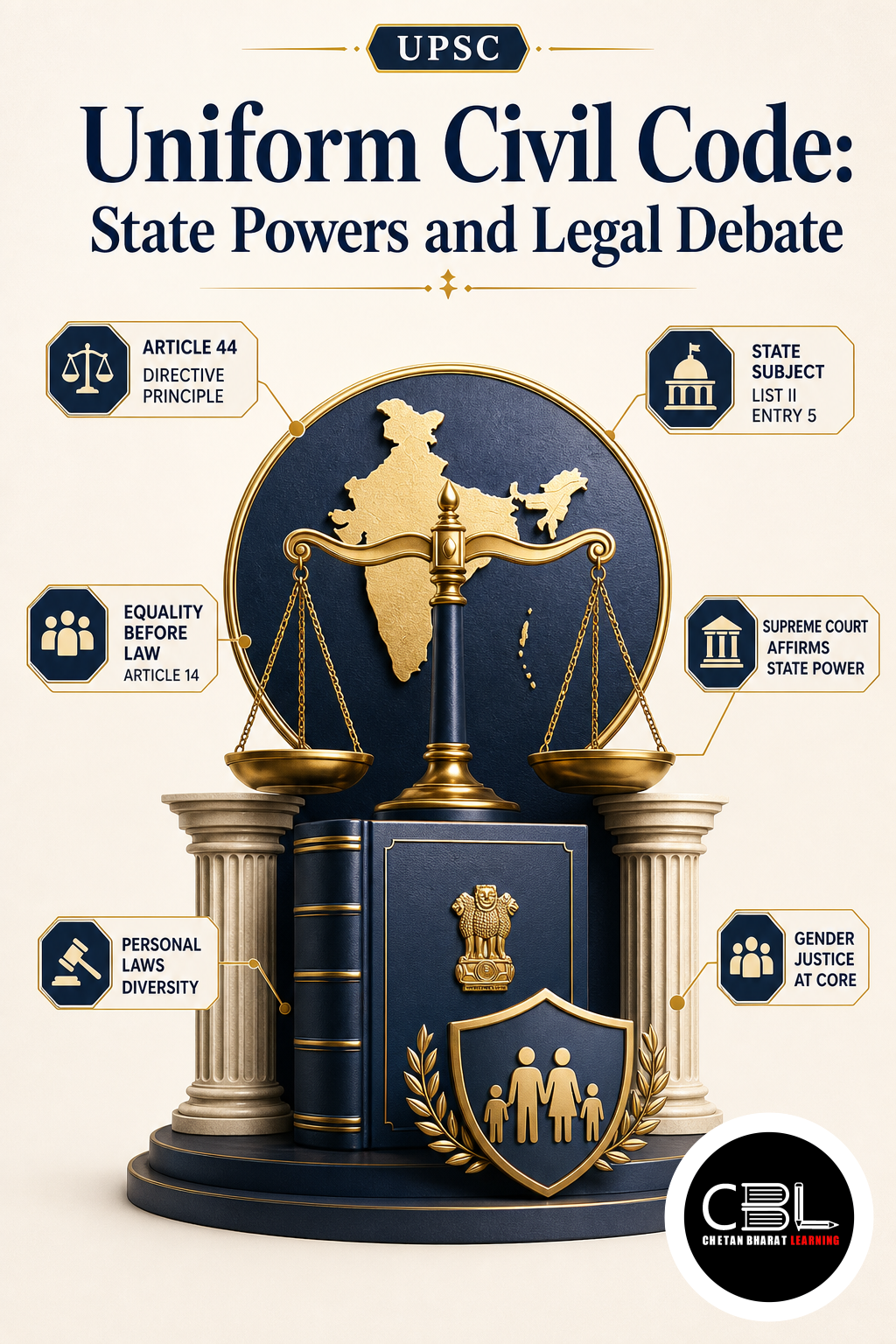
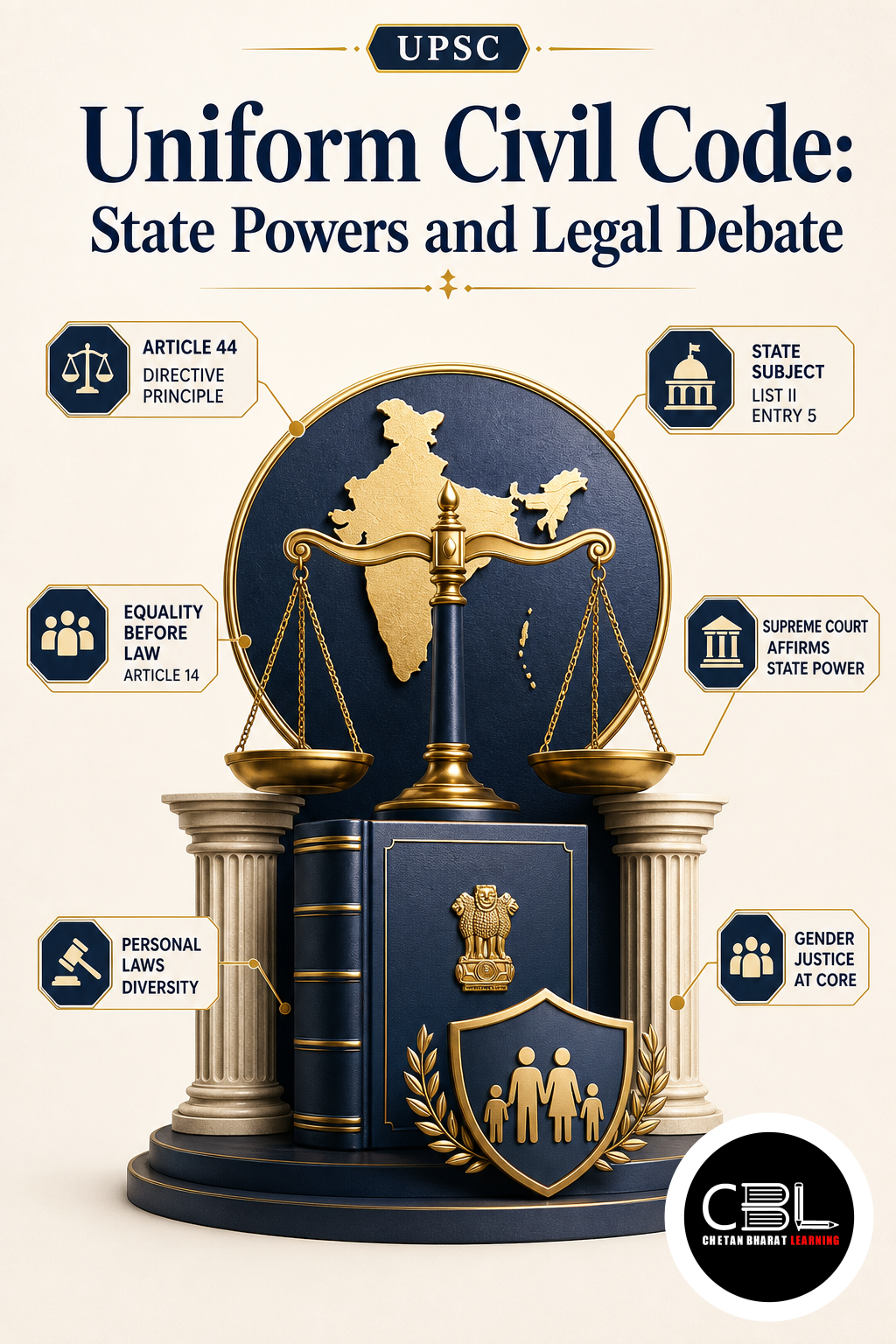
The Uniform Civil Code refers to a common framework governing specified civil matters such as marriage, divorce, maintenance, adoption, guardianship, succession and inheritance. Article 44 directs the State to endeavour to secure such a code throughout India. As a Directive Principle of State Policy, it guides legislation and governance but does not itself create an immediately enforceable individual claim in court, leaving elected legislatures responsible for defining the content, scope and timing of reform.
Uniformity need not mean identical rules for every factual or legal situation, because legislation can recognise age, consent, dependency, disability and protected customary arrangements. The constitutional objective must operate alongside equality, dignity, privacy, religious freedom and cultural protections. A legally durable code must therefore identify discriminatory outcomes, establish a clear secular and gender-just standard and justify every distinction through careful scrutiny under constitutional rights and proportionality.
Why is the Uniform Civil Code in News?
The Uniform Civil Code is in news after Union Home Minister Amit Shah said the policy would be introduced across all 21 NDA-governed states before the 2029 Lok Sabha election. This signals a state-led route rather than immediate enactment of one nationwide parliamentary code, potentially creating several laboratories of reform but also significant territorial variation. Uttarakhand already brought its framework into operation on 27 January 2025, creating an administrative model involving registration and digital services for several personal civil matters, allowing policymakers to assess real effects on citizens, courts, registrars and digital governance.
State legislatures can act because Entry 5 of the Concurrent List covers marriage, divorce, adoption, wills, intestacy, succession, joint family and partition. If a state law conflicts with an existing parliamentary law in the same field, Article 254 becomes relevant. The official Constitution portal provides the governing text; a conflicting state measure reserved for and receiving presidential assent may prevail within that state, though Parliament retains power to override it later through parliamentary legislation, preserving national legislative supremacy within the concurrent field.
Key Features
- Common legal standards: Citizens may receive the same core rules on marriage, divorce, maintenance and succession regardless of religion, improving predictability and reducing situations where legal outcomes depend primarily on community identity, while improving legal certainty for interfaith families and citizens moving between jurisdictions.
- Gender-justice objective: Equal inheritance, monogamy, consent-based marriage and accessible maintenance can address discriminatory practices, although the final impact depends on drafting, remedies and actual enforcement.
- Concurrent competence: Parliament and state legislatures can both legislate on major personal-law subjects, allowing state experimentation while creating possible differences, overlap and repugnancy across jurisdictions.
- Registration systems: Digital records for marriage, divorce and related declarations may improve proof, service delivery and enforcement, but they require secure databases and proportionate documentation.
- Protected exceptions: Legislatures may preserve constitutionally protected customs or exclude specified communities, yet exceptions must remain clear, evidence-based and subject to periodic review.
Challenges
- Diversity and trust: Personal laws involve religious practice, family structures and community identity, so limited consultation or majoritarian framing can produce resistance even where particular reforms advance equality.
- Federal fragmentation: Different state codes may create conflicting rights and procedures for couples, families or property spanning multiple states, requiring clear rules on domicile and mutual recognition.
- Repugnancy disputes: Courts may need to determine whether a state provision conflicts with parliamentary law and which portions can survive independently after a constitutional challenge.
- Privacy concerns: Compulsory registration can expose sensitive personal information unless access and enforcement powers remain narrowly controlled.
- Implementation capacity: Registrars, courts and local officials need sustained training, public guidance and accessible grievance systems.
Way Forward
Governments should publish draft provisions, conflict tables and rights-impact assessments before enactment, allowing women’s groups, disability organisations, tribal bodies, religious communities, jurists and state institutions to respond. Reform should begin with widely supported principles including consent, minimum age, equal remedies, non-discrimination and protection of children, elderly persons and dependants. Clear savings clauses and transitional rules can prevent uncertainty concerning existing marriages, succession plans, decrees and property rights, while phased commencement can give institutions and affected families time to adapt while publicly reported implementation data supports timely correction.
A credible Uniform Civil Code must pursue equality without treating administrative uniformity as an end in itself. The official Uttarakhand portal offers practical evidence on registration, rules and service delivery that other states can independently evaluate before legislating. Independent review, privacy safeguards, accessible legal aid and cooperative federal consultation can ensure that reform strengthens citizenship rights while respecting constitutional diversity, individual autonomy and the legitimate space available for state experimentation.
Prelims Practice Corner
Q1. Which constitutional provision specifically refers to a Uniform Civil Code?
(a) Article 32 (b) Article 44 (c) Article 51A (d) Article 368
Answer:
Article 44 is a Directive Principle concerning a common civil code.
Q2. Personal-law subjects such as marriage and succession appear in which legislative list?
(a) Union List (b) State List only (c) Concurrent List (d) Residuary List
Answer:
Entry 5 of the Concurrent List covers several major personal-law matters.
Q3. Article 254 primarily deals with what?
(a) Constitutional amendments (b) Repugnancy in Concurrent List laws (c) Emergency powers (d) Inter-State Council
Answer:
It governs inconsistency between parliamentary and state laws on Concurrent List subjects.
Q4. What can happen when a conflicting state law receives presidential assent under Article 254(2)?
(a) It may prevail in that state (b) It automatically amends the Constitution (c) It binds every state (d) Parliament loses future power
Answer:
The law may operate within that state, subject to Parliament’s later overriding power.
Q5. Article 44 belongs to which part of the Constitution?
(a) Fundamental Rights (b) Directive Principles (c) Fundamental Duties (d) Emergency Provisions
Answer:
Article 44 forms part of the Directive Principles of State Policy.
Mains Practice Questions
Q1. Examine the constitutional opportunities and federal challenges of state-level civil-code legislation. (250 words, 15 marks)
- Intro: Link Article 44 with Entry 5 of the Concurrent List.
- Body: Discuss state competence, Article 254, experimentation, interstate variation, equality and rights.
- Conclusion: Support cooperative consultation and constitutionally tested drafting.
Q2. Personal-law reform must balance gender justice with religious and cultural freedoms. Discuss. (150 words, 10 marks)
- Intro: Frame the issue through equality, dignity and pluralism.
- Body: Examine discriminatory outcomes, protected customs, consultation, privacy and proportionality.
- Conclusion: Recommend rights-based reform supported by trust and legal clarity.
FAQs on Uniform Civil Code
Can a state legislature enact its own civil code?
Yes, states can legislate on relevant Concurrent List subjects. A conflicting provision may require presidential assent under Article 254(2) to prevail within that state.
Is Article 44 directly enforceable by courts?
No. It is a Directive Principle guiding the State, while legislation must still comply with enforceable Fundamental Rights and other constitutional limitations.
Does presidential assent prevent Parliament from acting later?
No. Parliament may later enact a law that adds to, amends, varies or repeals the state law, even after assent under Article 254(2).
Related Current Affairs
Preparing for UPSC, PCS or HCS?
Talk to a mentor at Chetan Bharat Learning, Chandigarh. Free guidance on choosing the right exam and building a study plan.
Chat on WhatsAppCall 97793 53345UPSC / IAS / PCS coaching in Chandigarh · Trusted by aspirants across Punjab & Haryana
Leave a Reply
You must be logged in to post a comment.