
UPSC Mapping
Prelims: Circular Economy, EPR, CPCB and SDG 12
Mains: GS Paper III: Environment, Economy and Sustainable Development
Article
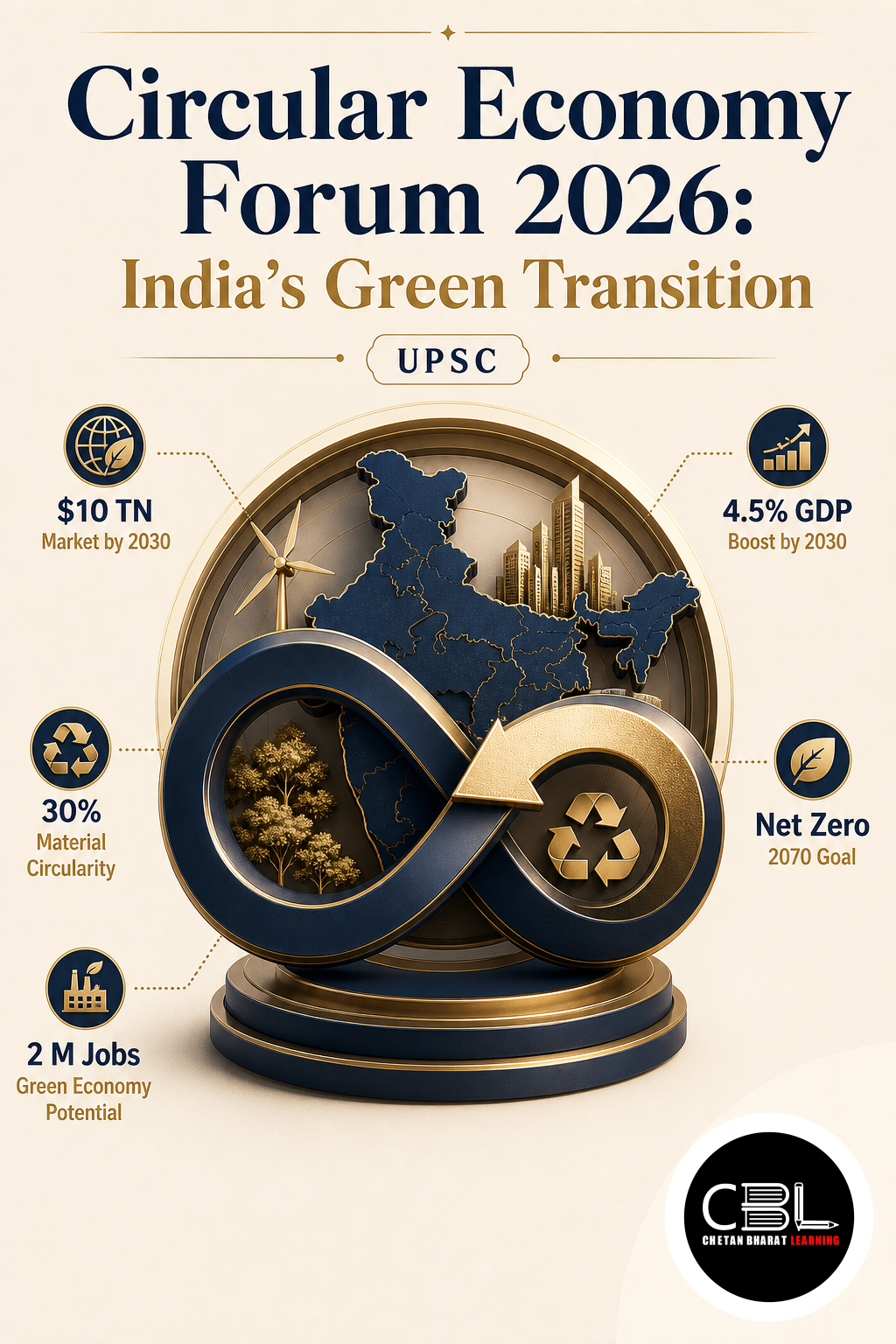
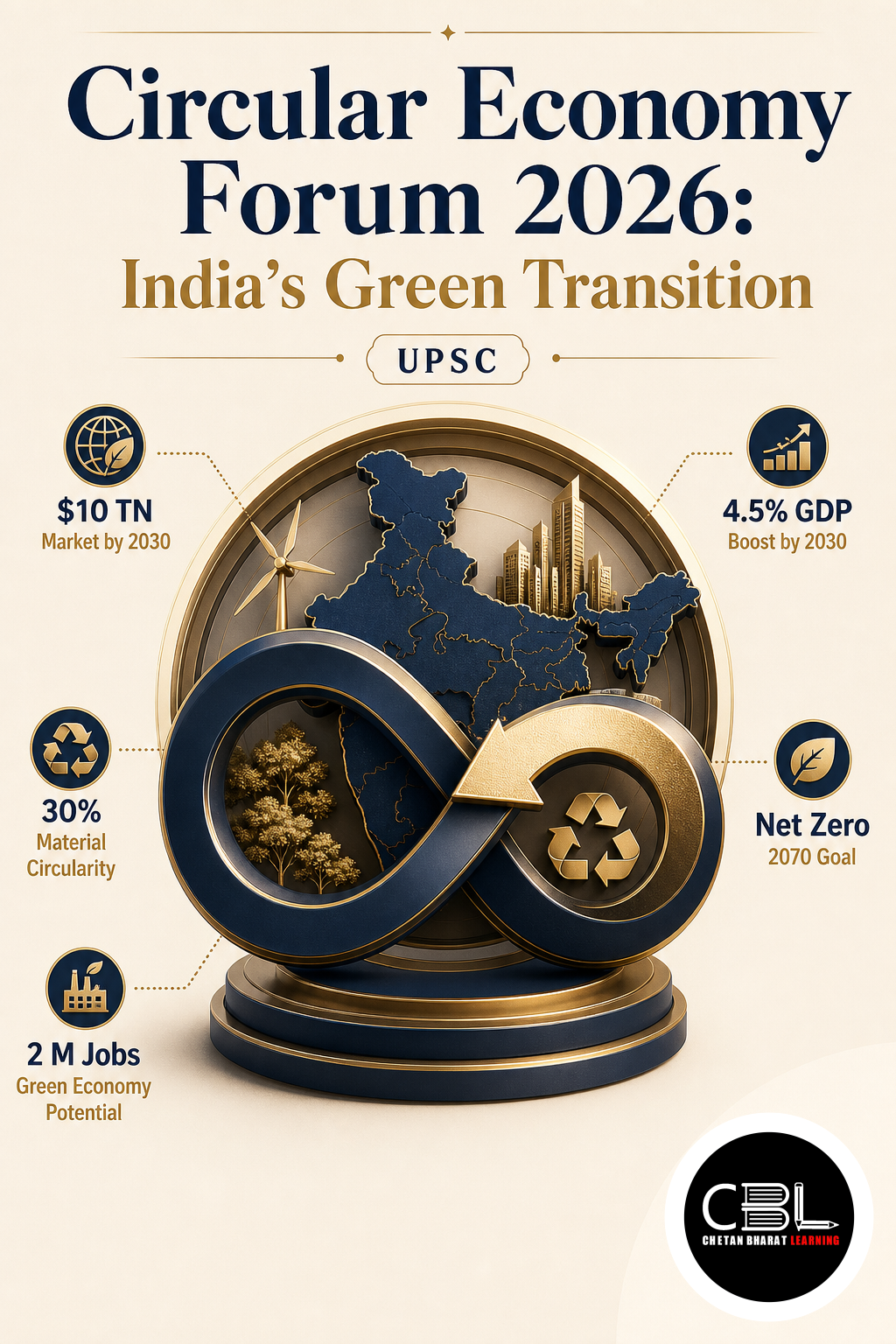
Circular Economy Forum brings the global debate on resource efficiency, circular finance and sustainable production to India. The 2026 gathering in Gandhinagar connects policymakers, businesses, researchers and innovators seeking to retain materials within productive use, reduce demand for new extraction and build markets around maintenance, repair and high-quality recovered inputs; related environmental developments appear in the daily current affairs archive. Its significance lies in converting waste-management obligations into investment, employment, industrial resilience and measurable environmental gains while reducing exposure to volatile raw-material imports and growing volumes of municipal and industrial waste.
What is the Circular Economy Forum?
The Circular Economy Forum is a global platform for discussing how economies can reduce waste, extend product life and recover value from materials. Its 2026 edition is jointly organised by India’s Central Pollution Control Board, the Finnish Innovation Fund Sitra and government partners. The forum treats circularity as an economic strategy involving product design, repair, reuse, refurbishment, remanufacturing and recycling, rather than limiting action to disposal after waste has already formed, thereby moving environmental responsibility upstream towards designers, manufacturers, retailers, financiers and major institutional buyers.
A linear economy follows the sequence of extraction, production, consumption and disposal, often losing valuable materials after a short use period. A circular system seeks to slow and close these flows through durable design, maintenance, sharing, secondary materials and industrial symbiosis. This shift can reduce pressure on virgin resources, lower pollution and supply-chain exposure, and create markets for repair services, recycled inputs and resource-efficient technologies while reducing energy demand, ecological damage and strategic dependence on imported minerals or components.
Why is the Circular Economy Forum in News?
The Circular Economy Forum is in news because India is hosting its tenth edition in Gandhinagar from 15 to 18 September 2026, marking the event’s first South Asian edition. The official PIB announcement expects more than 2,000 stakeholders from over 65 countries and over 125 exhibitors. The gathering places India and the Global South within discussions on circular investment, technology, jobs and resilient production at a time when material security increasingly shapes industrial and geopolitical choices.
Key Features
- Global participation: Government officials, business leaders, investors, researchers, start-ups and civil-society actors can compare policies and form partnerships across countries with different capacities, resource bases and development priorities, helping successful local experiments travel across regulatory systems and commercial markets.
- Finance mobilisation: Discussions seek to direct public and private capital towards circular business models, recycling infrastructure, efficient manufacturing and innovations that produce measurable environmental benefits alongside commercially viable returns, although financiers still need dependable revenue models, credible material-flow data and consistent policy signals.
- Technology integration: Sessions examine artificial intelligence, digitalisation and industrial solutions that can trace materials, improve sorting, predict maintenance and connect recovered resources with manufacturers demanding reliable secondary inputs, thereby improving accountability and lowering transaction costs throughout complex value chains.
- Inclusive transition: Employment, youth leadership, skills and enterprise development feature alongside environmental goals, recognising that workers and informal waste collectors require protection, training and access to formal value chains, equipment, credit, occupational safeguards and recognition for knowledge already developed through daily recovery work.
- Action-oriented format: Plenaries establish common direction, thematic sessions examine sectoral problems, exhibitors display working solutions and accelerator events help participants convert broad commitments into projects, investment networks and implementation partnerships with named institutions, timelines, finance requirements and outcomes that governments can monitor.
Challenges
- Design and standards: Many products remain difficult to repair, disassemble or recycle because components, adhesives and mixed materials were selected without end-of-life recovery, common labelling or secondary-material standards in mind, locking future waste and recovery costs into decisions taken before consumers purchase the goods.
- Collection gaps: Recycling capacity cannot operate efficiently without segregated waste, dependable collection and traceable supply, while fragmented municipal systems and weak consumer participation often contaminate otherwise recoverable material streams, increase processing costs and lower the quality or market value of recycled outputs.
- Informal-sector inclusion: Waste pickers contribute substantial collection and sorting labour but often lack safe conditions, social security and negotiating power, making formalisation necessary without destroying livelihoods or local expertise that municipal systems frequently depend upon for doorstep collection and material sorting.
- Market uncertainty: Recycled inputs may face volatile supply, uneven quality and competition from cheaper virgin materials, discouraging long-term investment unless procurement rules, standards and fiscal signals create dependable demand and narrow the price disadvantage faced by responsibly recovered materials.
- Greenwashing risks: Companies may advertise minor recycling initiatives while maintaining waste-intensive models, requiring verified data and lifecycle assessment, clear baselines, third-party assurance and public disclosure of actual material recovery, themes followed in the environment current affairs section.
Way Forward
India should strengthen Extended Producer Responsibility through reliable audits, interoperable digital records and fees that reward durable, repairable and recyclable product design. Government procurement can create demand for certified secondary materials, while common quality standards can improve confidence among manufacturers and lenders. Cities need source segregation, decentralised recovery, safe infrastructure and contracts that integrate waste workers with fair payment and social protection, while small enterprises need affordable technology, credit and access to quality testing.
The Circular Economy Forum should generate sector-specific partnerships with milestones for plastics, electronics, batteries, textiles, construction and critical minerals. The UNEP guidance on producer responsibility explains why producers must address impacts across the product lifecycle, including the post-consumer stage. Combining circular design, transparent finance, worker inclusion and measurable resource productivity can turn waste reduction into a durable, accountable and employment-generating industrial and development strategy that improves competitiveness, reduces pollution, strengthens material security, supports innovation and shares economic gains across workers, consumers, small enterprises, cities and resource-producing regions.
Prelims Practice Corner
| Q1 | Which sequence best represents a linear economy? | (a) Repair, share, reuse (b) Extract, produce, consume, discard (c) Refurbish, remanufacture, recycle (d) Reduce, recover, regenerate | Answer: (b) |
|---|---|---|---|
| Q2 | WCEF 2026 is being hosted in which Indian city? | (a) Jaipur (b) Gandhinagar (c) Hyderabad (d) Bengaluru | Answer: (b) |
| Q3 | Extended Producer Responsibility primarily places lifecycle responsibility on whom? | (a) Consumers alone (b) Producers (c) Courts (d) International organisations | Answer: (b) |
| Q4 | Sustainable consumption and production are central to which SDG? | (a) SDG 5 (b) SDG 8 (c) SDG 12 (d) SDG 16 | Answer: (c) |
| Q5 | Which practice most directly extends a product’s useful life? | (a) Premature disposal (b) Planned repair and refurbishment (c) Mixed-waste dumping (d) Extraction of virgin material | Answer: (b) |
Mains Practice Questions
Q1. A circular economy is an industrial transformation, not merely a waste-management programme. Examine. (250 words, 15 marks)
Intro: Contrast linear production with circular material flows.
Body: Discuss design, repair, secondary materials, finance, jobs, supply resilience and EPR.
Conclusion: Link resource productivity with sustainable, employment-intensive and competitive industrialisation.
Q2. How can India make its circular transition environmentally credible and socially inclusive? (150 words, 10 marks)
Intro: Frame circularity as a governance and just-transition challenge.
Body: Cover standards, audits, municipal collection, informal workers, procurement and greenwashing.
Conclusion: Recommend measurable outcomes backed by accountable institutions, reliable data, inclusive finance and enforceable standards.
FAQs on Circular Economy Forum
What is the main theme of WCEF 2026?
Its theme is Circular Economy: Transition for People and Prosperity. It links resource efficiency with jobs, inclusion, resilience and sustainable growth.
How does circularity differ from recycling?
Recycling recovers material after use, while circularity also prevents waste through durable design, repair, sharing, reuse and remanufacturing. Recycling remains one component of a wider system.
Why is EPR important for India?
EPR shifts post-consumer responsibility towards producers and can finance collection and recycling. Strong audits and traceability are necessary to prevent false claims and ensure genuine recovery.
Related Current Affairs
Preparing for UPSC, PCS or HCS?
Talk to a mentor at Chetan Bharat Learning, Chandigarh. Free guidance on choosing the right exam and building a study plan.
Chat on WhatsAppCall 97793 53345UPSC / IAS / PCS coaching in Chandigarh · Trusted by aspirants across Punjab & Haryana
Leave a Reply
You must be logged in to post a comment.