

UPSC Mapping
| Prelims | Geography & International Relations |
|---|---|
| Mains | GS Paper II |
Quick Facts
| Capital | Juba |
|---|---|
| Independence | 2011 (from Sudan) |
| Oil revenue share | 90% of government revenue |
What is South Sudan?
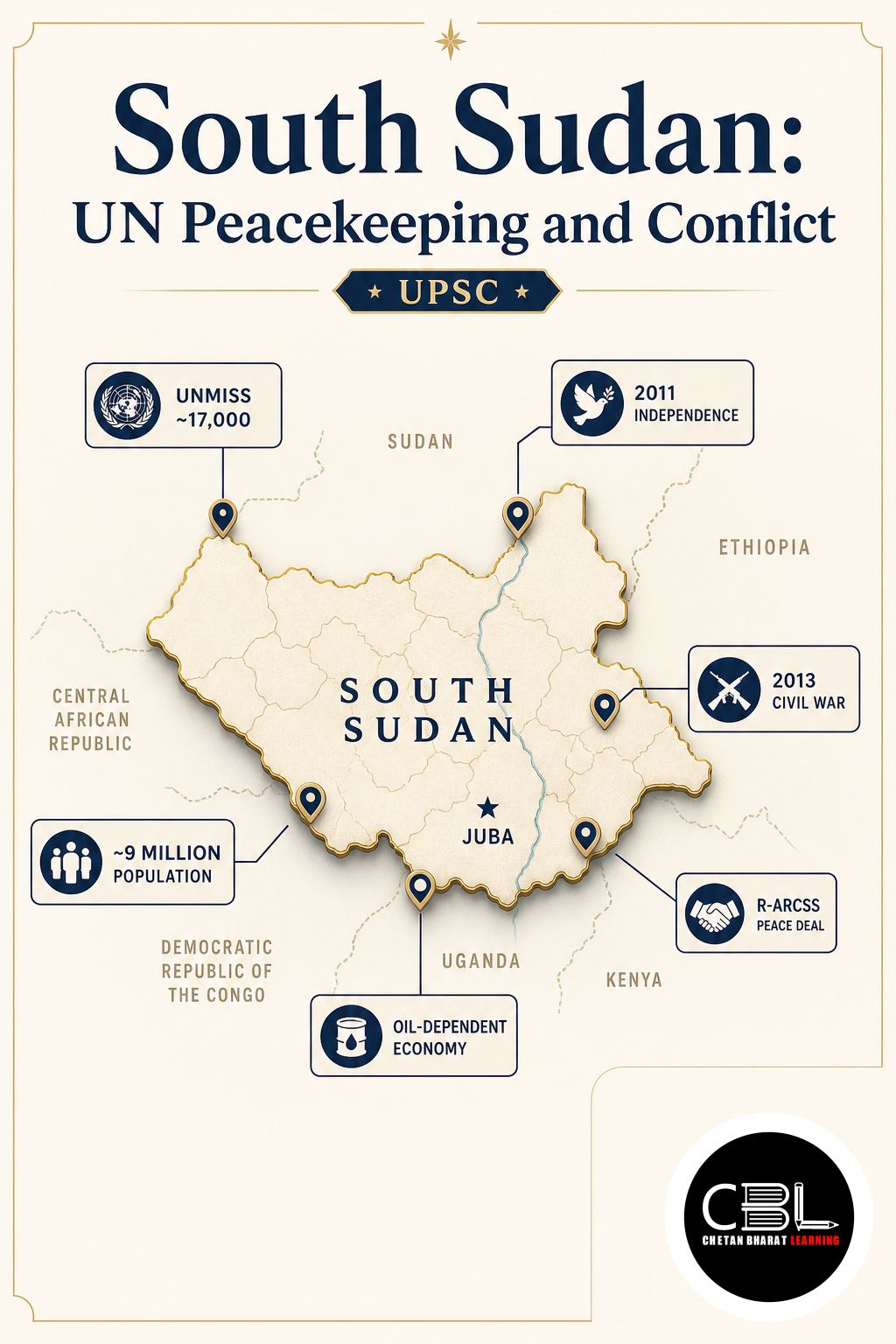
South Sudan is a landlocked country in East-Central Africa, gaining independence from Sudan in 2011 after a long civil war. It is the world’s newest internationally recognised state. The capital is Juba. It borders Sudan to the north, Ethiopia to the east, Kenya to the southeast, Uganda to the south, the Democratic Republic of the Congo to the southwest, and the Central African Republic to the west.
South Sudan has significant oil reserves, ranking fifth in Africa, and derives about 90% of its government revenue from the oil sector. However, the country has been plagued by internal conflict, ethnic violence, and humanitarian crises since its independence.
Why is South Sudan in News?
India condemned the recent attack on peacekeepers deployed by the UN Mission in South Sudan (UNMISS), highlighting the ongoing insecurity and the risks faced by peacekeeping forces. The attack underscores the fragile security situation and the challenges of the peace process.
Additionally, South Sudan has been in the news due to its oil-related economic instability, the impact of the war in neighbouring Sudan, and the UN’s efforts to mediate peace. For official UN updates, refer to the UNMISS website.
Key Features of South Sudan
- Geography: Landlocked, part of the Nile basin; Al Sudd is one of the world’s largest inland wetlands.
- Borders: Shares borders with six countries: Sudan, Ethiopia, Kenya, Uganda, DRC, and CAR.
- Highest point: Mount Kinyeti (3,187 m) in the Imatong Mountains.
- Oil economy: Holds Africa’s fifth-largest oil reserves; oil revenue accounts for 90% of government income.
- UN Mission: UNMISS is the UN peacekeeping mission in the country.
Challenges Facing South Sudan
- Civil conflict: Ongoing ethnic and political violence has caused tens of thousands of deaths and displaced millions.
- Humanitarian crisis: Famine, food insecurity, and lack of basic services affect a large portion of the population.
- Oil dependence: Over-reliance on oil makes the economy vulnerable to price fluctuations and infrastructure damage.
- Flooding and climate: Al Sudd wetland is sensitive to climate change, affecting livelihoods and access.
- Peacekeeping challenges: UNMISS faces attacks, limited mobility, and political obstacles to implementing its mandate.
Way Forward for South Sudan
Stabilising South Sudan requires renewed political dialogue among warring factions, supported by regional and international actors like the Intergovernmental Authority on Development (IGAD) and the UN. Economic diversification away from oil, combined with investment in agriculture and infrastructure, is essential.
Strengthening the capacity of the South Sudanese government and civil society, along with protecting human rights, are necessary for sustainable peace. For regional peace efforts, refer to the IGAD website for updates.
Prelims Practice Corner
Q1. In which year did South Sudan gain independence?
- (a) 2005
- (b) 2011
- (c) 2013
- (d) 2015
Answer: (b) South Sudan gained independence from Sudan in 2011.
Q2. What is the capital of South Sudan?
- (a) Khartoum
- (b) Juba
- (c) Nairobi
- (d) Addis Ababa
Answer: (b) The capital is Juba.
Q3. Which UN mission operates in South Sudan?
- (a) MONUSCO
- (b) UNMISS
- (c) MINUSCA
- (d) UNAMID
Answer: (b) UNMISS is the UN Mission in South Sudan.
Q4. What percentage of South Sudan’s government revenue comes from oil?
- (a) 50%
- (b) 70%
- (c) 90%
- (d) 95%
Answer: (c) Oil revenue accounts for about 90% of government revenue.
Q5. Which African country does NOT share a border with South Sudan?
- (a) Kenya
- (b) Uganda
- (c) Tanzania
- (d) Ethiopia
Answer: (c) Tanzania does not border South Sudan; it is further south, beyond Kenya and Uganda.
Mains Practice Questions
Q1. Analyse the reasons for the persistent conflict in South Sudan and the role of the international community in its resolution. (15 marks)
Answer Structure:
- Intro: Briefly introduce South Sudan’s post-independence history.
- Body: Discuss ethnic divisions, power struggles, oil revenues as a driver of conflict, and weak institutions. Evaluate the role of the UN, IGAD, and bilateral actors in peacekeeping and mediation. Suggest ways to strengthen the peace process.
- Conclusion: Emphasise the need for inclusive governance, economic diversification, and regional cooperation.
Q2. Evaluate the effectiveness of UN peacekeeping missions in Africa, with special reference to UNMISS in South Sudan. (10 marks)
Answer Structure:
- Intro: Mention the role of UN peacekeeping in conflict zones.
- Body: Assess UNMISS’s achievements—protection of civilians, facilitating humanitarian aid—and limitations—security incidents, political constraints, and lack of mandate enforcement. Compare with other missions if relevant.
- Conclusion: Suggest reforms to peacekeeping operations, including stronger mandates and political support.
FAQs on South Sudan
Why is South Sudan called the world’s newest country?
It gained independence from Sudan on 9 July 2011, following a referendum in accordance with the Comprehensive Peace Agreement of 2005.
What is the major geographical feature of South Sudan?
Al Sudd, fed by the White Nile, is one of the world’s largest inland wetlands, located in central South Sudan.
What is the primary source of revenue for South Sudan?
Oil exports, which account for about 90% of the country’s government revenue, making its economy highly dependent on oil prices.
Related Current Affairs
Preparing for UPSC, PCS or HCS?
Talk to a mentor at Chetan Bharat Learning, Chandigarh. Free guidance on choosing the right exam and building a study plan.
Chat on WhatsAppCall 97793 53345UPSC / IAS / PCS coaching in Chandigarh · Trusted by aspirants across Punjab & Haryana
Leave a Reply
You must be logged in to post a comment.