

UPSC Mapping
| Exam | Topic |
|---|---|
| Prelims | Environment & Economy |
| Mains | GS Paper 3 |
Article
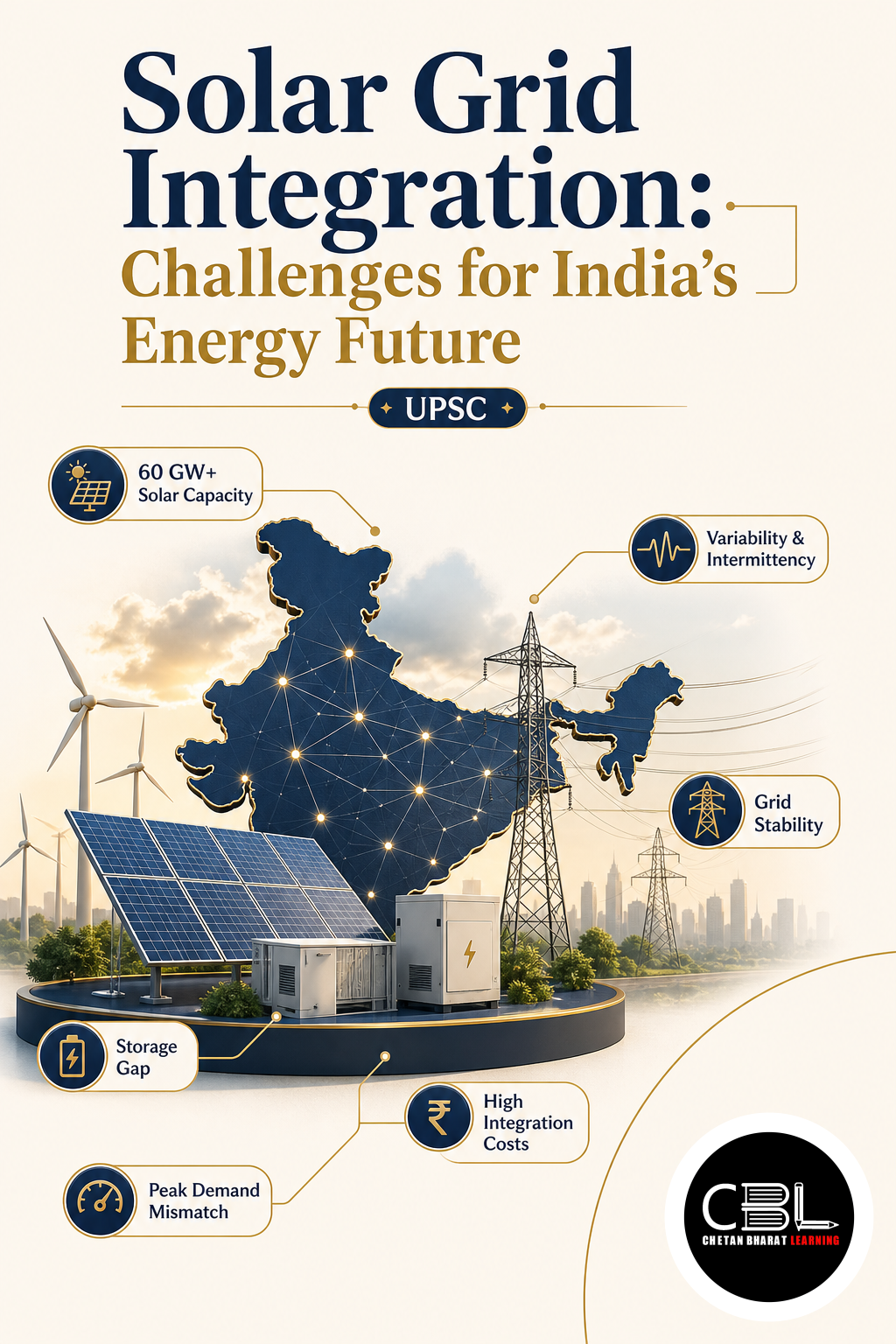
India’s solar grid integration challenge has emerged as a critical bottleneck in the renewable energy transition. Despite becoming the world’s third-largest installer of renewable energy and achieving its 50% non-fossil capacity target five years early, the country is now grappling with the harder problem of keeping a solar- and wind-heavy grid stable and affordable. For more on environmental issues, explore our daily current affairs archive.
| Fact | Data |
|---|---|
| Solar Curtailment (H1 2026) | 8,000+ million units |
| Battery Storage Cost (UP tender) | Rs 6.45 per unit |
| Coal Power Cost | Rs 4.67 per unit |
What is Solar Grid Integration?
Solar grid integration refers to the process of incorporating solar power generation into the electricity grid in a stable, reliable, and cost-effective manner. Unlike conventional thermal power plants, solar generation is variable and dependent on weather conditions and time of day.
The integration challenge arises because solar output peaks around midday when electricity consumption is often low, creating a mismatch between generation and demand. This requires flexible resources, storage, and grid management strategies to maintain stability.
Why is Solar Grid Integration in News?
India reportedly curtailed over 8,000 million units of solar generation in the first half of 2026, highlighting the scale of the solar grid integration challenge. While transmission bottlenecks contribute, a simpler part of the problem is that there is not enough demand when solar generation is at its highest.
The Uttar Pradesh tender for four-hour battery storage came in at Rs 6.45 per unit, even with subsidy support, compared to Rs 4.67/kWh for coal power and Rs 3.65/kWh for solar alone. According to a PIB release, the government is working on comprehensive solutions for grid integration.
Key Features of India’s Solar Integration Challenge
- The Duck Curve: Solar generation creates a daily demand-supply mismatch, with midday peaks and evening ramps requiring rapid response.
- Curtailment: Forced reduction of solar generation due to grid constraints, lack of storage, or low demand.
- Inverter-Based Generation: Solar and wind plants lack the physical inertia of thermal generators, requiring special grid management.
- Geographic Variability: Solar availability varies significantly across regions, requiring transmission infrastructure.
- Seasonal Factors: Seasonal variations in solar output affect grid planning and operations.
Challenges in Solar Grid Integration
- Storage Economics: Battery storage remains expensive, with tender prices at Rs 6.45/unit compared to coal at Rs 4.67/unit.
- Transmission Constraints: Inadequate transmission infrastructure limits the evacuation of renewable power.
- Grid Stability: Managing grid frequency and voltage with increasing renewable share is technically challenging.
- Demand-Supply Mismatch: Solar peak generation often does not align with peak demand hours.
- Policy and Regulatory Gaps: Markets for flexibility, balancing, and congestion management are still developing.
Way Forward for Solar Grid Integration
India needs to broaden the conversation beyond battery storage to include flexible demand and smarter electricity markets. The priority should be increasing electricity consumption when renewable generation is abundant through industrial electrification, time-of-use tariffs, and workplace charging for electric vehicles.
Developing market mechanisms that fairly compensate generators for curtailment, and creating congestion and balancing markets, can increase demand for load-level flexibility. As suggested by a CEA report, integrating rooftop solar with small-scale storage and smart controls can deliver system benefits at lower cost than utility-scale projects.
Prelims Practice Corner
Q1. How much solar generation was curtailed in India during the first half of 2026?
- a) 5,000 million units
- b) 8,000 million units
- c) 10,000 million units
- d) 12,000 million units
Answer: b) 8,000 million units
Q2. What is the ‘duck curve’ in the context of solar grid integration?
- a) The shape of solar panels
- b) The daily demand-supply mismatch with solar generation
- c) A type of battery storage
- d) A transmission line design
Answer: b) The duck curve represents the daily demand-supply mismatch where solar peaks at midday but demand peaks in the evening.
Q3. What was the cost of four-hour battery storage in the recent Uttar Pradesh tender?
- a) Rs 3.65 per unit
- b) Rs 4.67 per unit
- c) Rs 6.45 per unit
- d) Rs 7.50 per unit
Answer: c) Rs 6.45 per unit
Q4. What is curtailment in the context of renewable energy?
- a) Reducing demand for electricity
- b) Forced reduction of renewable generation
- c) Increasing renewable capacity
- d) Improving grid efficiency
Answer: b) Curtailment is the deliberate reduction of otherwise available renewable generation due to grid constraints.
Q5. Which of the following is NOT a solution for solar grid integration?
- a) Energy storage
- b) Demand response
- c) Reducing solar capacity
- d) Grid flexibility
Answer: c) Reducing solar capacity is not a solution; the goal is to integrate more renewable capacity effectively.
Mains Practice Questions
Q1. “India has solved the easy problem of building renewables at scale; the harder problem is grid integration.” Discuss the challenges and solutions for solar grid integration in India. (15 Marks)
Answer Structure:
- Intro: Contextualize India’s renewable energy achievement and the emerging integration challenge.
- Body: Discuss challenges like curtailment, storage economics, transmission constraints, and the duck curve. Propose solutions including storage, flexible demand, market mechanisms, and grid modernization.
- Conclusion: Emphasize the need for a holistic approach integrating technology, policy, and markets.
Q2. Examine the role of energy storage in India’s renewable energy transition. (10 Marks)
Answer Structure:
- Intro: Define energy storage and its significance for renewable integration.
- Body: Discuss types of storage (battery, pumped hydro, etc.), current economics, policy support, and challenges. Include recent developments like the UP tender.
- Conclusion: Suggest measures to make storage more affordable and accessible.
FAQs on Solar Grid Integration
What is solar grid integration?
Solar grid integration refers to incorporating solar power into the electricity grid in a stable, reliable, and cost-effective manner, addressing challenges of variability and intermittency.
Why is solar curtailment happening in India?
Curtailment occurs due to grid constraints, transmission bottlenecks, low demand during peak solar generation hours, and limited storage capacity to absorb excess power.
How can India improve solar grid integration?
Solutions include energy storage, flexible demand through industrial electrification, time-of-use tariffs, transmission expansion, and creating markets for flexibility and balancing.
Related Current Affairs
Preparing for UPSC, PCS or HCS?
Talk to a mentor at Chetan Bharat Learning, Chandigarh. Free guidance on choosing the right exam and building a study plan.
Chat on WhatsAppCall 97793 53345UPSC / IAS / PCS coaching in Chandigarh · Trusted by aspirants across Punjab & Haryana
Leave a Reply
You must be logged in to post a comment.