

UPSC Mapping
| Prelims | Health & Economy |
|---|---|
| Mains | GS Paper 2 (Health & Social Justice) |
Article
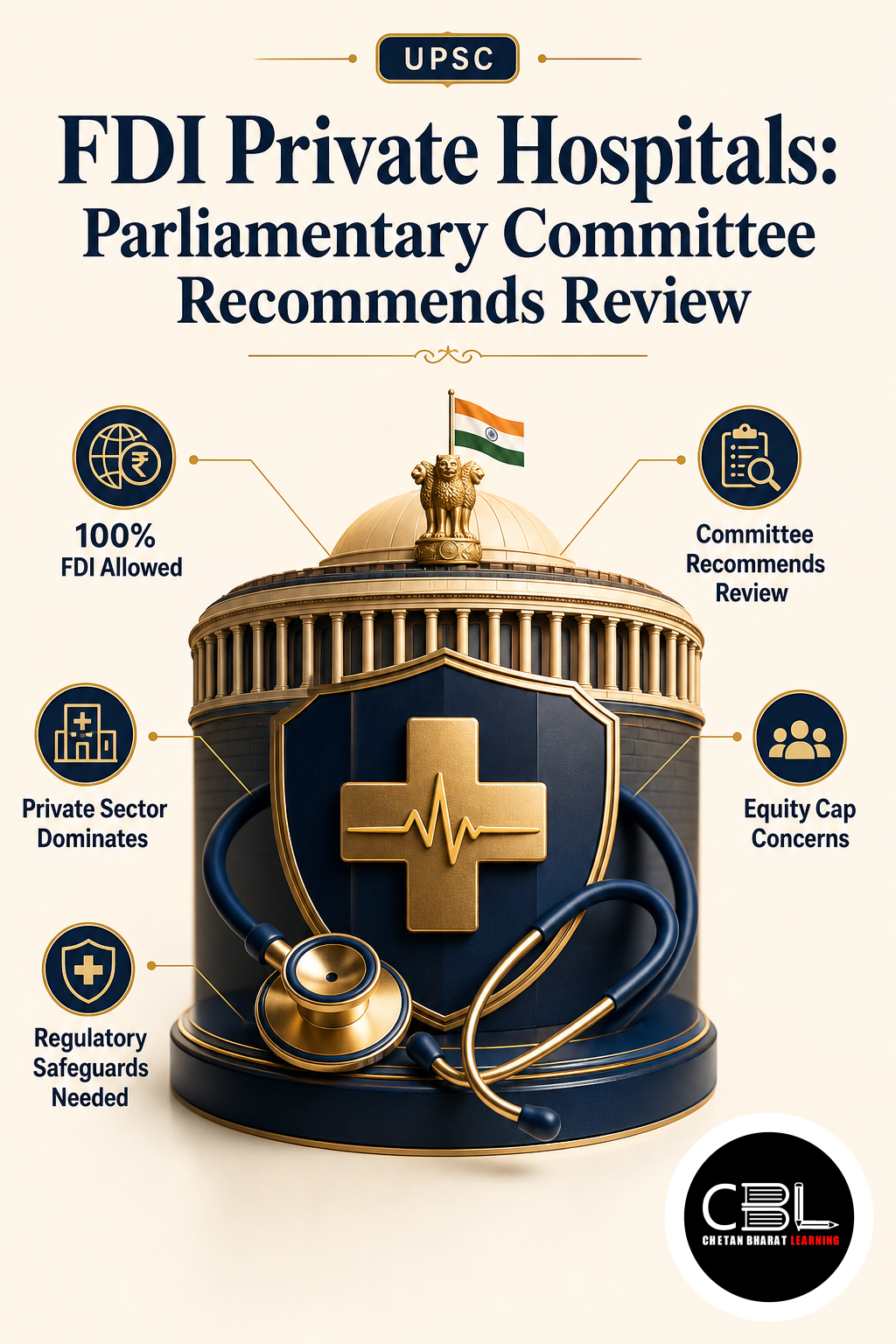
FDI Private Hospitals have come under scrutiny as a Parliamentary Committee on Health and Family Welfare recommended reviewing and rationalising FDI limits, warning that aggressive corporatisation and foreign capital could increase healthcare costs and affect affordability. The recommendations come against a widening public-private cost gap—private hospitalisation costs about 7.6 times more than government hospitals.
The committee’s report suggests greater scrutiny of FDI in hospital operations and acquisitions while encouraging foreign investment in medical devices, consumables, and specialised medicines.
Quick Facts
| Cost Gap | Private 7.6× Public |
|---|---|
| Reserved Beds Proposal | Increase from 10% to 20% |
What is the FDI Private Hospitals Debate?
The debate centres on whether foreign direct investment in private hospitals should be more closely scrutinised to prevent cost escalation and maintain affordability. NSSO data shows private hospitalisation costs are 7.6 times higher than in government hospitals, raising concerns about exclusion of poorer patients.
Why is FDI Private Hospitals in News?
The Parliamentary Committee tabled its recommendations calling for a review of FDI limits. It also proposed establishing autonomous multi-speciality public hospitals in every revenue division to reduce dependence on major cities and create competitive pressure on private healthcare.
Key Features of Recommendations
- Review FDI: Scrutinise foreign investment in operations and acquisitions, while encouraging investment in devices, consumables, and medicines.
- Strengthen Public Healthcare: Set up autonomous multi-speciality hospitals in every revenue division.
- Cost Control: Standardise and cap prices of essential treatments, diagnostics, and procedures.
- Promote Tier-2/3: Offer tax incentives, soft loans, subsidised land, and concessional electricity.
- Cross-Subsidisation: Use higher-paying patients to subsidise care for poorer patients.
Challenges in Regulation
- Cost Escalation: Foreign capital may lead to premium pricing.
- Regulatory Capacity: Strong infrastructure needed to implement price caps.
- Incentive Leakage: Subsidies may not translate into affordability without oversight.
- Public-Private Gap: Public healthcare requires significant investment to compete.
- Reserved Beds Enforcement: Ensuring quality care for BPL/EWS patients is challenging.
Way Forward
India should encourage FDI in technology and equipment while regulating hospital acquisitions to prevent monopolistic pricing. Implement price caps for essential treatments with robust monitoring and invest in public healthcare as a strong alternative. Public-private partnerships must include clear social obligations, cross-subsidisation, reserved beds, regular audits, and ethics committees.
Prelims Practice Corner
-
Q1. According to NSSO data, private hospitalisation costs how many times more than government hospitals?
- (a) 3.5 times
- (b) 5.2 times
- (c) 7.6 times
- (d) 10 times
Answer: (c) 7.6 times.
-
Q2. What is the current mandatory reservation of beds for BPL/EWS in private hospitals?
- (a) 5%
- (b) 10%
- (c) 15%
- (d) 20%
Answer: (b) 10%.
-
Q3. Which committee made these recommendations?
- (a) Standing Committee on Finance
- (b) Parliamentary Committee on Health and Family Welfare
- (c) NITI Aayog
- (d) Ministry of Health Task Force
Answer: (b) Parliamentary Committee on Health and Family Welfare.
-
Q4. What is cross-subsidisation as proposed?
- (a) Charging all patients the same price
- (b) Using higher-paying patients to subsidise treatment for poorer patients
- (c) Government paying all hospital bills
- (d) Increasing taxes on hospitals
Answer: (b) Using higher-paying patients to subsidise treatment for poorer patients.
-
Q5. Where does the committee recommend setting up autonomous public multi-speciality hospitals?
- (a) Every district
- (b) Every revenue division
- (c) Every state capital
- (d) Only in metropolitan cities
Answer: (b) Every revenue division.
Mains Practice Questions
-
Q1. Critically examine the recommendations of the Parliamentary Committee on FDI in private hospitals and their implications for healthcare affordability in India. (250 words, 15 marks)
Answer Structure:
- Intro: Context of rising healthcare costs and committee’s recommendations.
- Body: Discuss review of FDI, strengthening public healthcare, cost control, Tier-2/3 promotion, cross-subsidisation, reserved beds; analyse challenges.
- Conclusion: Balanced approach combining FDI regulation with public investment.
-
Q2. What are the arguments for and against allowing FDI in private hospitals in India? (150 words, 10 marks)
Answer Structure:
- Intro: Frame the FDI debate.
- Body: For: capital infusion, technology transfer, infrastructure improvement. Against: cost escalation, profit orientation, regulatory challenges.
- Conclusion: Regulation and oversight are key to maximising benefits.
FAQs on FDI Private Hospitals
-
Why is FDI in private hospitals being reviewed?
The committee warns that aggressive corporatisation and foreign capital could increase healthcare costs and affect affordability, given the 7.6× cost gap between private and public hospitals.
-
What are the key recommendations?
Recommendations include reviewing FDI, strengthening public healthcare, implementing cost-control measures, promoting Tier-2/3 hospitals, cross-subsidisation, and increasing reserved beds for BPL/EWS patients.
-
What is cross-subsidisation?
It is a mechanism where hospitals receiving government incentives use revenue from higher-paying patients to subsidise treatment for poorer patients.
Related Current Affairs
Preparing for UPSC, PCS or HCS?
Talk to a mentor at Chetan Bharat Learning, Chandigarh. Free guidance on choosing the right exam and building a study plan.
Chat on WhatsAppCall 97793 53345UPSC / IAS / PCS coaching in Chandigarh · Trusted by aspirants across Punjab & Haryana
Leave a Reply
You must be logged in to post a comment.