

UPSC Mapping
| Prelims | Economy & Banking |
|---|---|
| Mains | GS Paper 3 (Economic Development & Banking) |
Quick Facts
| Effective Date | 1 April 2027 |
|---|---|
| Benchmark Reset | 3 months (max) |
| Migration Deadline | 1 April 2029 |
Article
What are the RBI Loan Directions?
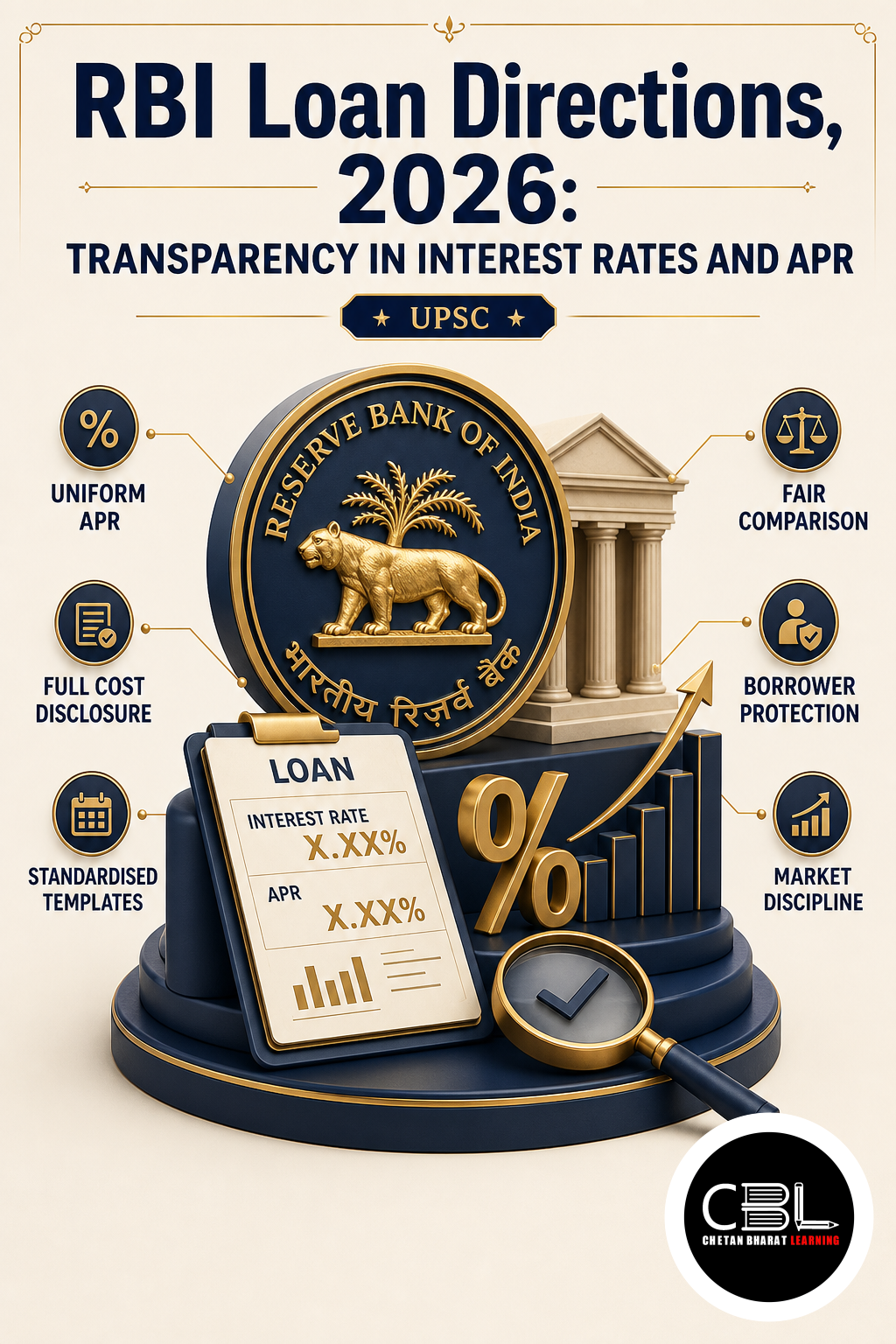
The RBI Loan Directions, 2026, propose a comprehensive framework for interest rates on loans and advances, applying to commercial banks, RRBs, cooperative banks, All-India Financial Institutions, and NBFCs (including housing finance companies) for their domestic operations. The directions cover fixed and floating-rate loans, with interest calculated on a daily reducing balance.
Commercial banks will be required to link all floating-rate personal loans and MSME loans to an external benchmark, such as the RBI policy repo rate or Government Treasury Bill yields. The benchmark, reset frequency, and reset date must be clearly specified in the loan agreement.
Why are RBI Loan Directions in the News?
The RBI Loan Directions are in the news because the draft framework is open for public consultation, with implementation planned for April 2027. The directions aim to improve the transmission of RBI monetary-policy changes to borrowers and strengthen transparency in loan pricing.
Key provisions include a maximum reset period of three months (extendable to 12 months for agricultural loans), an explicit APR ceiling for microfinance and small-value loans, and a one-time migration of existing loans by April 2029 with borrower consent and no additional charges. For more details, refer to the PIB release.
Key Features of RBI Loan Directions
- External Benchmark: Floating-rate personal and MSME loans linked to RBI repo rate or Treasury yields.
- Benchmark Reset: Maximum reset period of 3 months (12 months for agricultural loans).
- Loan Spread: Includes credit-risk premium, operating costs, term premium, and business-strategy considerations.
- APR Safeguard: Explicit APR ceiling for microfinance and small-value loans, including all charges.
- Migration of Existing Loans: One-time migration by April 2029 with borrower consent and no migration charges.
Challenges in RBI Loan Directions
- Borrower Consent: Migrating existing loans requires borrower consent, which may be difficult to obtain en masse.
- Technology Integration: Banks and NBFCs need to upgrade systems to comply with reset requirements and APR calculations.
- Credit-Risk Premium Revision: Periodic review of credit-risk profiles for premium revision requires robust credit assessment systems.
- APR Ceiling Implementation: Setting and enforcing APR ceilings for small-value loans may be complex given diverse borrower profiles.
- Regulatory Compliance: Ensuring all lenders comply with the new framework, especially smaller institutions. For more on banking regulation, visit the economy section.
Way Forward for RBI Loan Directions
To ensure effective implementation of the RBI Loan Directions, the RBI should provide clear implementation guidelines and timelines for lenders. Capacity building for smaller NBFCs and cooperative banks on compliance is essential.
Public awareness campaigns can help borrowers understand the new framework and their rights. The APR ceiling should be periodically reviewed to reflect market conditions while protecting vulnerable borrowers. The migration process should be smooth, with adequate communication to borrowers about the benefits. For international best practices, refer to the BIS.
Prelims Practice Corner
Question 1
From which date are the RBI Loan Directions proposed to take effect?
- (a) 1 January 2027
- (b) 1 April 2027
- (c) 1 July 2027
- (d) 1 April 2028
Answer: (b) 1 April 2027.
Question 2
Which loans must be linked to an external benchmark?
- (a) All fixed-rate loans
- (b) Floating-rate personal and MSME loans
- (c) Only housing loans
- (d) Only agricultural loans
Answer: (b) Floating-rate personal and MSME loans.
Question 3
What is the maximum benchmark reset period for most loans?
- (a) 1 month
- (b) 3 months
- (c) 6 months
- (d) 12 months
Answer: (b) 3 months.
Question 4
What is the APR safeguard for microfinance loans?
- (a) No APR limit
- (b) An explicit APR ceiling including all charges
- (c) APR cannot exceed 10%
- (d) APR is fixed by the government
Answer: (b) An explicit APR ceiling including all charges.
Question 5
By when must existing loans be migrated to the new framework?
- (a) 1 April 2028
- (b) 1 April 2029
- (c) 1 April 2030
- (d) 1 April 2031
Answer: (b) 1 April 2029.
Mains Practice Questions
Question 1
Discuss the significance of the RBI’s draft directions on loan interest rates for transparency and monetary policy transmission in India. (250 words, 15 marks)
Answer Structure:
- Intro: Introduce the draft directions and their objectives.
- Body: Discuss key provisions: external benchmark, reset frequency, loan spread, APR safeguard, migration. Analyse how these improve transparency and monetary policy transmission. Address challenges: borrower consent, technology integration.
- Conclusion: Suggest implementation measures for a smooth transition.
Question 2
What is an external benchmark for loan interest rates, and why is it important? (150 words, 10 marks)
Answer Structure:
- Intro: Define an external benchmark.
- Body: Explain that it is a reference rate outside a bank’s control (e.g., RBI repo rate). Linking loans to it ensures quicker transmission of policy rate changes to borrowers, improving transparency and fairness.
- Conclusion: Conclude that external benchmarks are vital for effective monetary policy.
FAQs on RBI Loan Directions
What is the purpose of the RBI Loan Directions, 2026?
To improve transparency, consistency, and monetary policy transmission in loan pricing, and prevent excessive pricing for vulnerable borrowers.
What is an APR ceiling?
For microfinance and small-value loans, lenders must prescribe an explicit APR ceiling that includes interest and all other charges.
Will existing loans be affected?
Yes, existing benchmark-linked loans will undergo a one-time migration by April 2029 with borrower consent and no migration charges.
Related Current Affairs
Preparing for UPSC, PCS or HCS?
Talk to a mentor at Chetan Bharat Learning, Chandigarh. Free guidance on choosing the right exam and building a study plan.
Chat on WhatsAppCall 97793 53345UPSC / IAS / PCS coaching in Chandigarh · Trusted by aspirants across Punjab & Haryana
Leave a Reply
You must be logged in to post a comment.